Assessing the classicality of photon echo from excitons in lead halide perovskite nanocrystals - APS Journals
This story deserves to be shared
Send it to someone who'd care, or post it on your networks.
Photon echo (PE) spectroscopy is a powerful technique for probing decoherence mechanisms and charge carrier dynamics in semiconductor systems. Beyond traditional coherence measurements, characterizing the photon statistics of the echo signal is important for assessing its potential in quantum information applications and understanding the underlying quantum mechanical processes. Here, we study the photon statistics of PE signals generated by excitons in ensembles of lead halide perovskite CsPbI3 nanocrystals at cryogenic temperature of 2 K using continuous-variable quantum state optical tomography based on homodyne detection. Pronounced Rabi oscillations of the PE amplitude allow us to evaluate the statistics for various pulse areas in the excitation sequence. The damping of the oscillations with increasing pulse area is attributed to spatial excitation inhomogeneity and excitation-induced dephasing. Despite the large ensemble of optically addressed excitons, the efficiency of generated PE signals is low which is attributed to the complex energy level structure of excitons and non-radiative recombination channels in CsPbI3 nanocrystals.
This article is an excerpt. To read the full content, visit the original source. APS Journals
Related articles
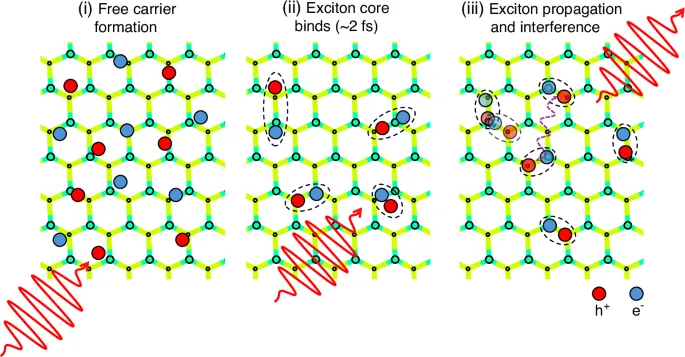
Excitons make quantum leap in just 2.5 femtoseconds - Nature
volume 15, Article number: 356 (2026) Cite this article AbstractLight irradiation in two-dimensional materials is well-known to excite tightly-bound many-body excitonic states that dominate optical responses. Recent theory analysis under intense laser conditions identifies the mechanisms and timescales through which excitons form, evolve, and dissociate. These findings open new opportunities for sensing and optically controlling many-body physics on ultrafast timescales.
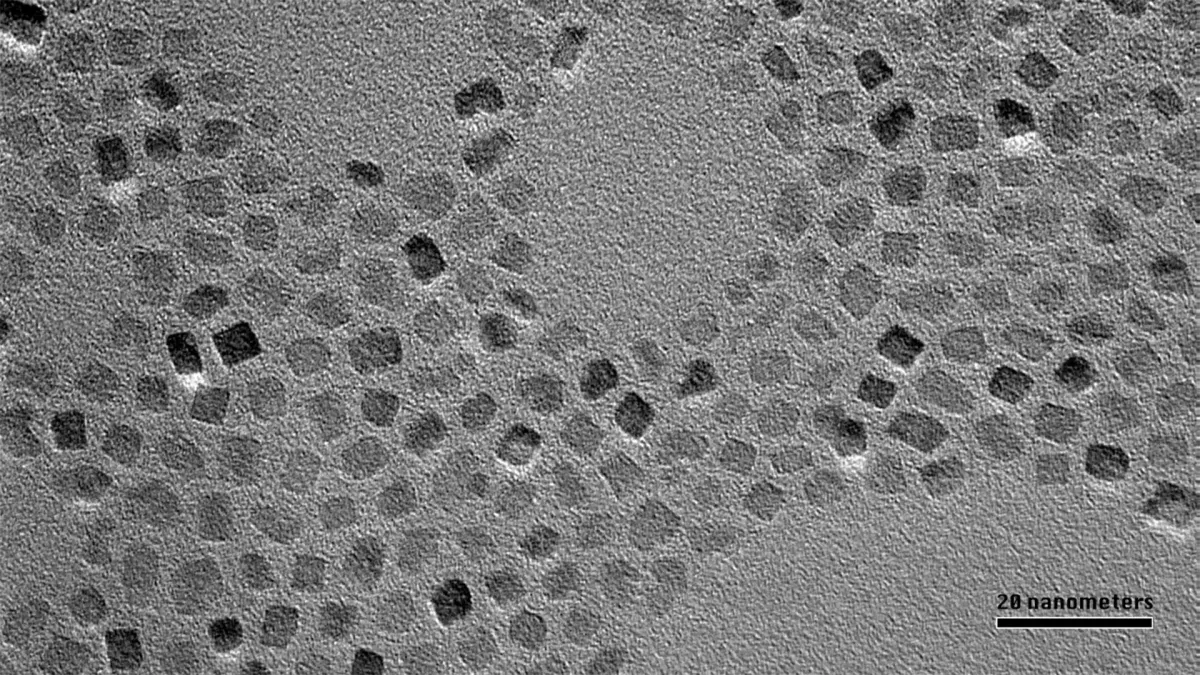
A new recipe unlocks “impossible” nanocrystals for LEDs, implants, and superconductors - Science Daily
Nanocrystals have become an important part of modern materials science, with quantum dots helping inspire the 2023 Nobel Prize in Chemistry. Yet despite their enormous potential, researchers have only been able to produce these microscopic crystals from a relatively narrow range of materials. Now, chemists at the University of Chicago and Argonne National Laboratory have developed a method for creating nanocrystals from metal nitrides, a technologically important group of materials that had resisted conventional nanocrystal synthesis. The study, published in Nature, could expand the possibilities for electronics and other applications, including flexible lighting and medical implants.

Perovskite laser maintains stable performance over 400 million pulses - Phys.org
In a study published in Advanced Optical Materials, researchers at Vilnius University (VU) demonstrated perovskite-based laser structures that maintained stable performance over more than 400 million pulses. Their findings address one of the major challenges limiting the practical use of perovskites: their instability. These semiconductor materials could play an important role in next-generation optical technologies, but their tendency to degrade has long posed a challenge for researchers worldwide. In some sense, perovskites can be compared to graphene. Like perovskites, graphene spent years being studied in labs because of its potential before industry eventually began using it. Today, it's widely applied in solar energy, electronics and batteries. Perovskites may hold even greater potential, but they come with a major drawback: they're highly unstable and degrade quickly in the presence of moisture.
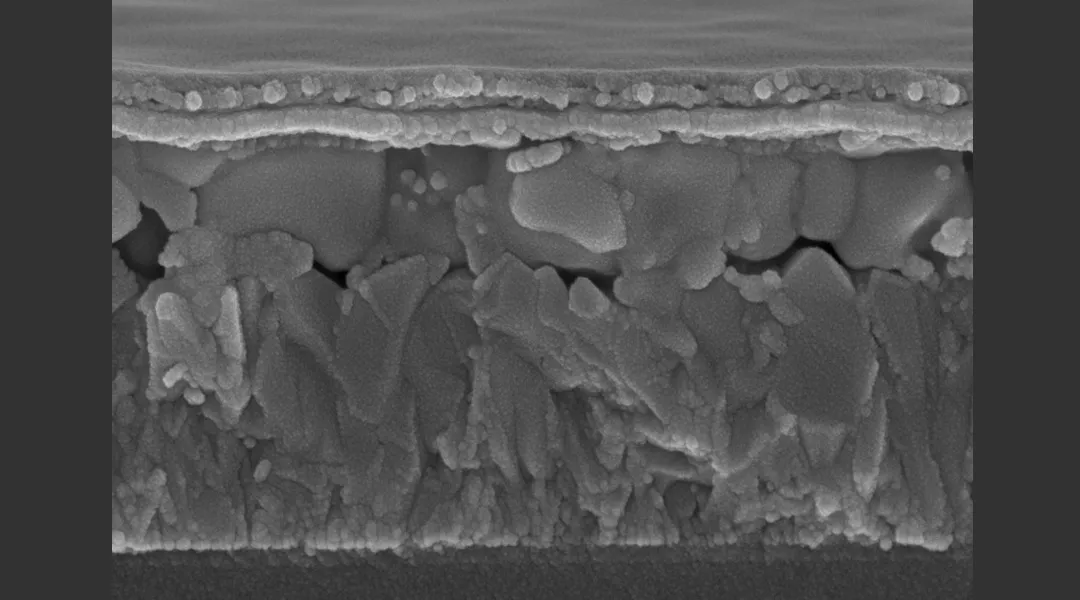
Chance discovery boosts the efficiency of perovskite tandem solar cells - Advanced Science News
Researchers have uncovered a way to suppress halide segregation in tandem solar cells, improving both efficiency and stability. Their strategy works across multiple mixed-halide perovskite compositions, suggesting the approach may be broadly applicable to this important class of photovoltaic materials. Tandem solar cells stack two different light-absorbing materials on top of one another, allowing them to convert more sunlight into electricity than either material alone. Mixed-halide perovskites—crystals containing both iodide and bromide ions—are commonly used as the top layer because their composition can be tuned to absorb high-energy light while permitting longer wavelengths to pass through to the lower cell. However, because iodide and bromide crystallize at different rates, the resulting films tend to be uneven in composition, with bromide-rich regions forming near the surface.
0 comments
No comments yet. Be the first to share your thoughts!