APOD: 2025 November 15 - Andromeda and Friends - NASA Science (.gov)
This story deserves to be shared
Send it to someone who'd care, or post it on your networks.
This article is an excerpt. To read the full content, visit the original source. NASA Science (.gov)
Related articles
APOD: 2026 September 27 – Andromeda Before Photoshop - NASA Science (.gov)
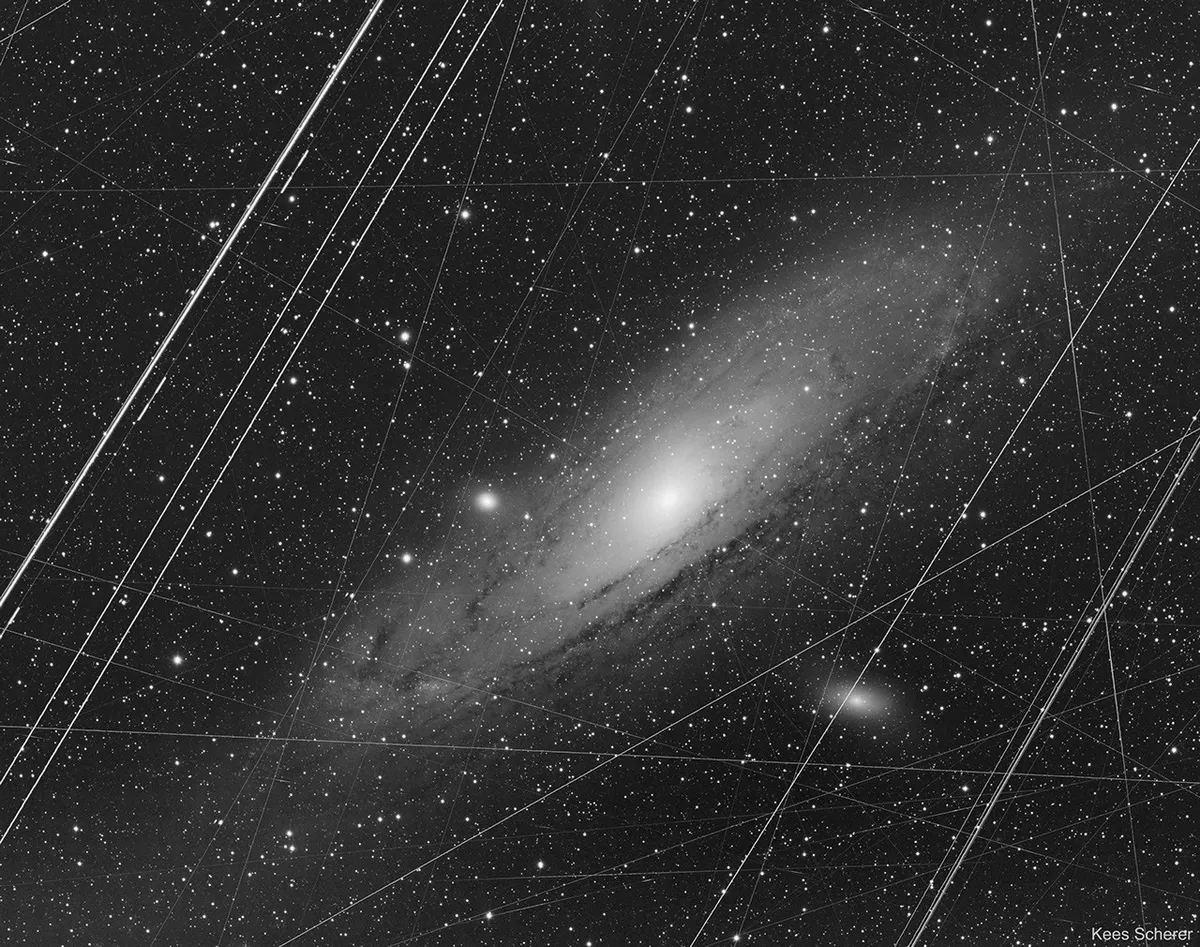
Discover the cosmos! Each day a different image or photograph of our fascinating universe is featured, along with a brief explanation written by a professional astronomer. Explanation: What does the Andromeda galaxy really look like? The featured before image shows how our Milky Way Galaxy's closest major galactic neighbor really appears in a long exposure through Earth's busy skies and with a digital camera that introduces normal imperfections. The picture is a stack of 223 images, each a 300 second exposure, taken from a garden observatory in Portugal during 2019. Obvious image deficiencies include bright parallel airplane trails, long and continuous satellite trails, short cosmic ray streaks, and bad pixels. In the after image, these imperfections were actually not removed with Photoshop specifically, but rather greatly reduced with a series of computer software packages that included Astro Pixel Processor, DeepSkyStacker, and PixInsight.

Quantum Tug-of-War Limits High-Temperature Superconductivity - Mirage News
New work helps show why the dream of high-temperature superconductivity has been so hard to realize: a quantum brawl between superconductivity and a competing state of matter. The finding resulted from a collaboration that included theorists with the Simons Foundation's Flatiron Institute in New York City and experimentalists at Quebec's Institut national de la recherche scientifique (INRS). The researchers investigated a copper alloy called a 'cuprate' as it transitioned from the superconducting state to an enigmatic neighboring state of matter called the 'pseudogap.' Using laser pulses and computer simulations, they were able to understand the behavior of electrons inside the cuprate. In a paper published October 20 in Nature Physics , the team shows how the two states — superconductivity and the pseudogap — wrestle for dominance. That finding challenges the idea that superconductivity in cuprates merely builds upon a pre-existing pseudogap phase. "We're really showing that these states are competing," says study co-author Olivier Gingras , an associate research scientist at the Flatiron Institute's Center for Computational Quantum Physics (CCQ).
0 comments
No comments yet. Be the first to share your thoughts!