227% jump in companies setting comprehensive climate targets as corporate climate planning accelerates - Science Based Targets Initiative
This story deserves to be shared
Send it to someone who'd care, or post it on your networks.
This article is an excerpt. To read the full content, visit the original source. Science Based Targets Initiative
Related articles

Machine Learning Speeds Analysis and Design in All-Atom Molecular Dynamics Simulations - Spectroscopy Online
Siddhartha Das explains how machine learning helps his group sift through roughly a trillion simulation data points. It reveals water and electroosmotic flow behavior and could speed the design of sensor-like channels. In this interview conducted at SciX 2026, which took place in Sparks, Nevada from October 4–9, Siddhartha Das, a Professor of Mechanical Engineering at the University of Maryland, describes how machine learning has become a major tool in his group’s work with all-atom molecular dynamics (MD) simulations. He also explains how pairing the two approaches can accelerate the design of engineered channels. The starting point, Das explains, is the sheer volume of data these simulations produce. A system of one million particles tracked over one million time steps yields roughly one trillion data points. Das describes this as fertile ground for analysis, but notes that working through it manually is impractical. Machine learning, he says, can reveal insights that even the most sophisticated atomistic simulations might miss, and can surface findings far faster than conventional analysis. Das offers two examples.

Scientists discover why animals evolved necks, and surprisingly it wasn’t to turn their heads - The Brighter Side of News
Models suggest that separating the head from the shoulders did not immediately give early tetrapod relatives highly mobile necks. Mechanical tests on lake sturgeon, combined with fossil anatomy, predict only small head movements in most species examined. The findings favor a link with forelimb locomotion, but movement estimates depend on a living analogue and exclude several surrounding tissues. An anatomical neck did not necessarily give ancient vertebrates the freedom to look around. Models of several early tetrapod relatives suggest their heads remained surprisingly restricted, even after the skull separated from the shoulders. The findings challenge the assumption that greater head mobility drove one of the major changes associated with the transition toward land. The authors propose that changing demands on the shoulders offer a better explanation than a newly flexible head. As front appendages took on a greater role in movement, separating the shoulder apparatus from the skull may have become advantageous. Substantial neck mobility, their analysis suggests, generally developed later, rather than arriving automatically with that separation.
Elusive uranium 'sandwich' molecule isolated after more than 50 years - Phys.org
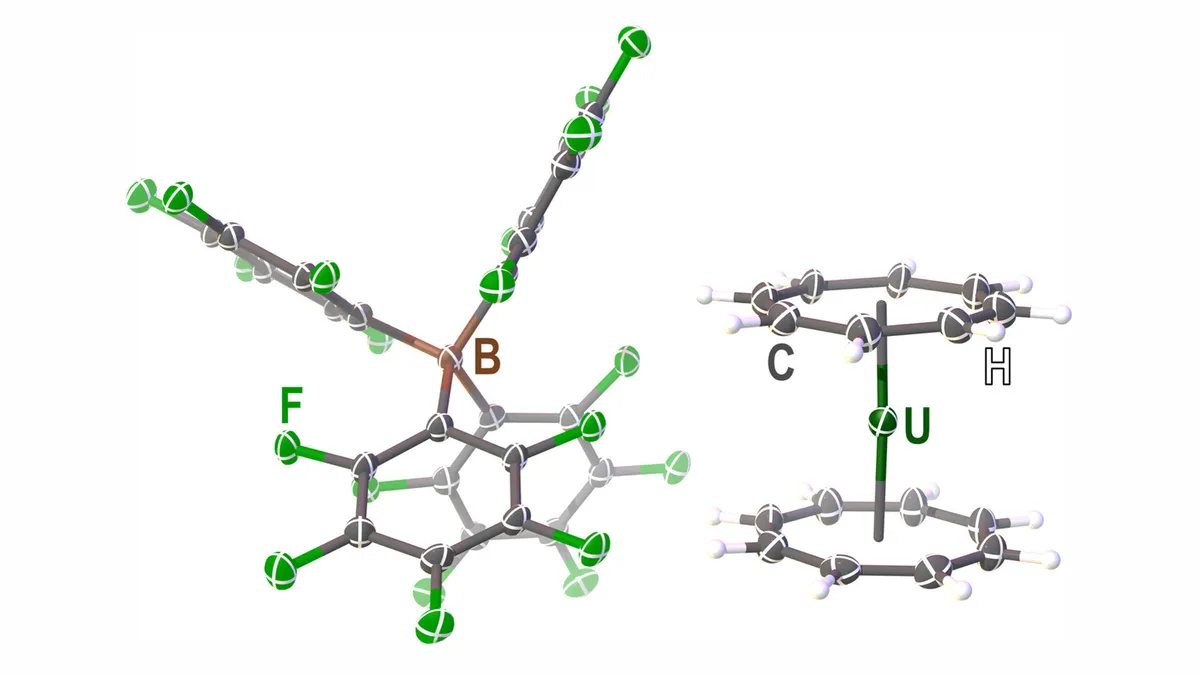
In a study published in Nature Communications, researchers from The University of Manchester and Lancaster University have isolated and characterized uranocenium, the positively charged form of a landmark uranium compound called uranocene. The work shows that this long-sought molecule is stable, and that it behaves in a way that challenges how chemists usually think about bonding in heavy elements. Uranocene is a 'sandwich' molecule: a single uranium atom held between two flat rings, each made of eight carbon atoms. It is the uranium counterpart of ferrocene, an iron sandwich molecule whose discovery contributed to the 1973 Nobel Prize in Chemistry. Ferrocene readily gives up an electron to form the ferrocenium cation, a switch so clean and reliable that it is used as a reference standard in laboratories worldwide. Until now, no one had been able to isolate the equivalent uranium compound.

This Is What Our Mysterious Denisovan Cousins Probably Looked Like - Gizmodo
Compared with Neanderthals, Denisovans are a relatively recent discovery. But evidence suggests they’re among our closest extinct relatives—and now, we may finally have a face to put onto a Denisovan’s name. Just last month, research teams primarily based in China reported the discovery of Denisovan remains that shed light on their geographical distribution, as well as their biology, diet, and societal practices. Yesterday, a different team involving many of the same researchers published new analyses in Nature of a collection of 20 fossils from Xujiayao, a paleoanthropological site in eastern China. From protein analysis, the team affirmed that the remains—dated to between 138,000 and 199,000 years old—were Denisovan. Further investigations of the fossils’ physical features allowed the team to guess what these ancient humans might have looked like—hence, the illustration above. According to the study, Denisovans had a low cranial profile, rectangular eye sockets, a massive brow ridge, flat cheekbones, and a slightly protruded jaw.

Pedal to the metal: NASA's Psyche heads toward asteroid belt - Phys.org
As depicted in this artist’s concept, NASA’s Psyche spacecraft will approach the metal-rich asteroid Psyche in summer 2029 using its solar electric propulsion system, powered by large cross-shaped solar arrays. Credit: NASA/JPL-Caltech With a successful Mars gravity assist in its rearview mirror, NASA's Psyche spacecraft has fired up its thrusters and is accelerating toward the metal-rich asteroid of the same name. During the first leg of its journey, following an October 2023 launch, the mission used its electric propulsion system intermittently to maneuver into the right position to harness Mars' gravity for a propellant-saving speed boost and a slight trajectory change.
NASA's Hubble charts path for Roman with gravitational lenses - Phys.org
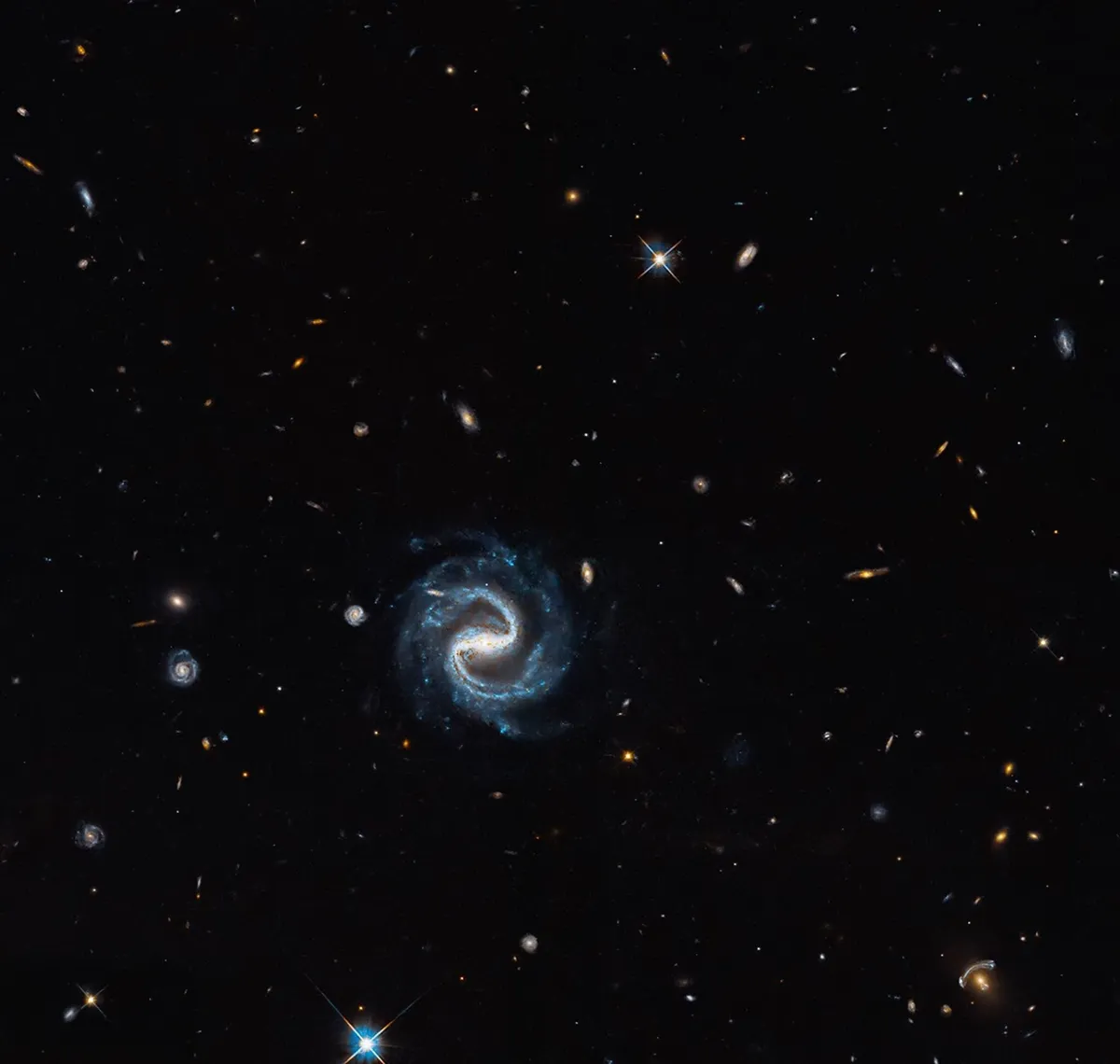
A sinuous spiral galaxy (center) appears in the same field of view as a vivid gravitational lens (right corner) in this Hubble image. The lens consists of a reddish elliptical foreground galaxy and the blue arcs of a magnified background galaxy. Credit: NASA, ESA and X. Huang (University of San Francisco); Processing: Gladys Kober (NASA/Catholic University of America) A sweeping barred spiral galaxy marks the spot in this image, but the real treasure is the gravitational lens in the lower-right corner, where a distant background galaxy is being magnified and distorted by the gravity of a closer galaxy.
0 comments
No comments yet. Be the first to share your thoughts!