
Science
Ancient warmth helped flowering plants dominate Earth, study finds - CGTN
Plants with white, cotton-like tufts grow on a rocky hillside. /VCG Plants with white, cotton-like tufts grow on a rocky hillside. /VCG
CGTN·
Categories
6938 articles
Plants with white, cotton-like tufts grow on a rocky hillside. /VCG Plants with white, cotton-like tufts grow on a rocky hillside. /VCG

BANGOR, Maine (WABI) - The Hollywood Casino in Bangor hosted the inaugural Maine Science Awards Thursday night. The formal evening included cocktails, dinner and recognition honoring scientists, researchers and advocates making Maine a better and smarter place. Honorees were recognized in five categories: Lifetime Achievement, Innovation, Impact, Surprising Science, and Advancing Trust in Science. Organizers say that while the Maine Science Festival is a great gathering every year, they needed something more to shine a spotlight on Maine’s brightest science innovators. “We realized we have a gap of we’re not actually really leaning into a few people in Maine that we can hold up in a spotlight and celebrate the work that they’ve done for Maine explicitly,” said Kate Dickerson, Executive Director of the Maine Discovery Museum. “So that’s what this is about. Tons of nominations came in, like actually way more than we expected, so our committee had a lot of work to do. And that just shows me that people were both really interested in this and that we do have really great things happening here, and we had a lot to work with,” she said.
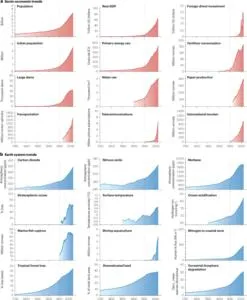
image: Great Acceleration graphs showing the mid-20th-century starting point of the Anthropocene: changes in the socioeconomic system (a) and changes in the Earth system (b) How much have humans changed the Earth? An international research team including a KAIST researcher has proposed a common framework for defining the meaning and starting point of the “Anthropocene,” a period in which human activities have rapidly transformed the global environment. The researchers propose using 1952 as a reference point to distinguish the relatively stable Earth environment before that year from the rapid changes that followed, allowing the scale and speed of today’s environmental crisis to be understood more accurately.

image: PhD candidate Daniel Irving at the University of Sydney A PhD student at the University of Sydney has produced the first comprehensive classification system and map of Martian soils, creating a new framework that could help scientists compare landscapes across the Red Planet and identify promising locations for future exploration, habitation and food production.

On Oct. 6, fourth- and fifth-grade students and their families at West Hazleton Elementary/Middle School enjoyed an engaging and educational presentation by Joe Romano, who combined science and magic to create an unforgettable learning experience. Joe Romano speaks with a student volunteer onstage at West Hazleton Elementary/Middle School. SUBMITTED

What possibilities would it bring to environmental governance and biomedicine if an enzyme could be designed on demand to specifically break down toxic pollutants, or a protease could be created to precisely cleave specific peptides associated with diseases? For a long time, scientists have mainly relied on discovering and modifying natural proteins to achieve these goals. Creating a truly catalytically active enzyme from scratch is far more difficult than designing its three-dimensional structure: multiple key atoms must cooperate precisely in space to complete the expected chemical reaction.
© 2026 Tolerance.ca® Inc. All reproduction rights reserved. All information reproduced on the Web pages of www.tolerance.ca (including articles, images, photographs, and logos) is protected by intellectual property rights owned by Tolerance.ca® Inc. or, in certain cases, by its author. Any reproduction of the information for use other than personal use is prohibited. In particular, any alteration, widespread distribution, translation, sale, commercial exploitation or reutilization of the contents of the Web site, without the prior written permission of Tolerance.ca® Inc., is strictly forbidden. For information, please contact info@tolerance.caTolerance.ca® Inc. is not responsible for external links nor for the contents of the advertisements appearing on Tolerance.ca®. Ads companies may use information about your visits to this web site in order to provide advertisements about goods and services of interest to you.
We’re sharing this article early to provide faster access to peer-reviewed, accepted research. It is citable and carries a permanent DOI. This version is subject to further edits and will be replaced automatically by the final Version of Record. All legal disclaimers apply. AbstractUnderstanding the mechanical behavior of frozen unsaturated sand under thermal gradients is crucial for the design and maintenance of infrastructure in permafrost regions. In this study the shear strength of Ottawa sand under varying temperatures, degrees of saturation, and loading conditions is investigated. A series of laboratory experiments were performed to measure the shear strength of Ottawa sand using direct simple shear equipment placed in a temperature controlled environmental chamber. During the experiments, soil temperatures and stress–strain curves were recorded, and they were analyzed to determine the strength behavior. Results show that shear strength increases with decreasing temperature, increasing ice content, strain rate, and normal stress.

A study of more than 250,000 articles found a sharp rise in material showing signs of AI generation, alongside fewer quotations and expert voices. A new study of Russian media suggests that artificial intelligence is no longer a marginal presence in newsroom workflows. According to research by Kirill Pshinnik, co-founder of the online university Zerocoder, and reviewed by Russian Business, 18% of articles in Russian media in the second quarter of 2026 showed clear signs of being generated by neural networks. The analysis, which covered 254,614 articles from 174 outlets between 2020 and the first half of 2026, also found that such pieces contained direct quotations 2.1 times less often and expert remarks 2.6 times less often than articles judged to have been written by people.
MELBOURNE, Oct. 16 (Xinhua) -- Extreme global warmth drove both mass extinctions and explosions in plant diversity during two periods over the past 140 million years, offering new insights into how flowering plants became dominant on Earth, a new study has found. The study examined fossilized pollen and spores to show that the mid-Cretaceous and early Cenozoic periods of extreme global warmth were central to plant evolution, both for flowering plants and the other main types on Earth, according to a statement released Thursday by Australia's University of Tasmania (UTAS). Researchers said that land plants sustain almost all terrestrial animals, fungi and bacteria, while flowering plants are the most productive and diverse group, with about 400,000 species worldwide. The team examined more than 60,000 fossil occurrences and applied methods that overcome the major biases in the fossil record, generating revised estimates of fossil pollen and spore diversity over the past 130 million years, according to the study published in Nature Plants.

Researchers at the University of Basel have investigated how fine particles in exhaust emissions from aircraft and marine engines change in the atmosphere. Their findings show that aircraft emissions in particular become more toxic over time. Fine particulate matter consists of tiny particles with diameters in the nanometer range. They are produced, for example, by fuel combustion, remain suspended in the air and can penetrate deep into the respiratory tract. There, they can trigger what is known as oxidative stress – a process that promotes inflammation and, in the long term, can lead to serious health problems such as respiratory or cardiovascular diseases. Scientists refer to this harmful property of the particles as their oxidative potential.

Scientists have uncovered a biological mechanism that helps explain how exercise protects aging muscles and restores their ability to repair themselves. The discovery reveals why physical activity can counteract some of the changes that weaken muscles with age and points toward potential new treatments for age-related muscle loss. The research, led by Duke-NUS Medical School in collaboration with Singapore General Hospital and Cardiff University, identified a molecular system that becomes disrupted as muscles grow older. Exercise can help bring this system back into balance, allowing muscle cells to remove damaged proteins and maintain healthy tissue.
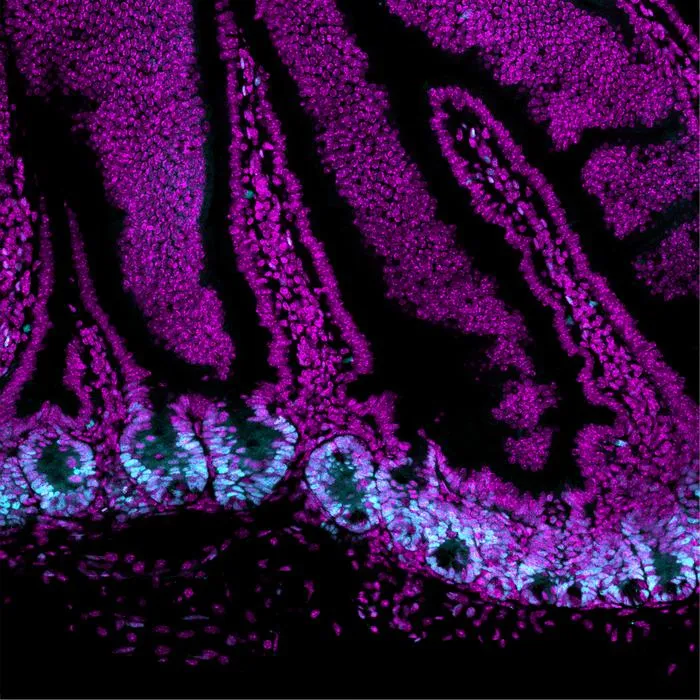
Image of Hes1-Achilles (cyan) gut-slices counterstained with DAPI (magenta). Credit: Sonja Weterings. Copyright: Hubrecht Institute.
Left: Movie showing rhythmic communication between cells in intestinal organoids, mini-guts grown in the lab. Right: Graphs showing that the amount of the chemical signal Hes1 oscillates at different rhythms in different intestinal cells. Hiromune Eto. Copyright: Hubrecht Institute.
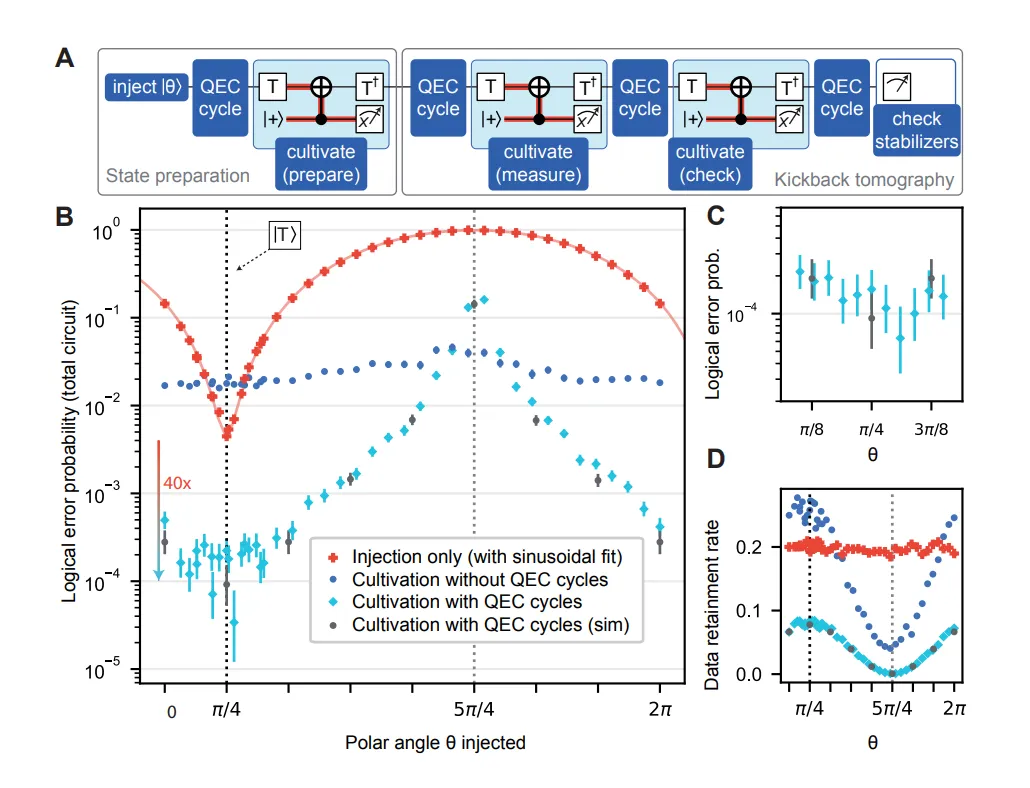
In a milestone study published in Science, experimentalists and software engineers at Google Quantum AI have demonstrated the first physical hardware implementation of magic state cultivation, achieving a 40-fold error reduction and producing T-states with a record 99.99(1)% logical fidelity (error rate ≤ 0.0001) on the company’s Willow superconducting quantum processor. The research paper (“Magic state cultivation on a superconducting quantum processor“) addresses one of fault-tolerant quantum computing’s most severe physical bottlenecks. For over two decades, generating the non-Clifford T-states required for universal, fault-tolerant quantum computation via traditional distillation protocols was projected to consume 90% to 95% of a quantum computer’s total physical qubit footprint. Cultivation creates these states in a fraction of the spatial footprint by utilizing small, interactive color codes before grafting the purified states into surface codes.

It’s weird to think there was a time when people didn’t logically assume that inhaling cigarette smoke several times a day didn’t have some kind of native effect on the body. Some doctors even recommended smoking at one point. Now we know smoking causes a range of issues, like cancer and emphysema. But those are the broad implications that affect everyone. According to new research, cigarettes can impact our reproductive organs, but those impacts may affect men and women differently. A study published in Frontiers in Toxicology by researchers at the Universities of Nottingham and Sheffield looked at how cigarette smoke extract affected male and female mice over twelve weeks. The team found that while tobacco smoke wrecks reproductive health across the board, regardless of whatever factors you threw in front of it, it does operate through distinct biological routes depending on sex.

The National Center for Science Education welcomes its third cohort of Sound Science Fellows. The six new fellows join other higher education faculty and museum educators to enhance professional learning opportunities in climate science, evolution, and the nature of science for K-12 science teachers, identify and resolve common misconceptions about those topics, and conduct research to develop best practices for science education. The 2027 fellows are: Tajma Cameron, Assistant Professor of Science Education and Research Faculty at the National Center for the Elimination of Educational Disparities (NCEED) at Morgan State University; Pradeep (Max) Dass, Professor of Science Education at the University of Texas at Tyler; Jennifer Kreps Frisch, Associate Professor and Department Head of Education at the University of Minnesota Duluth; Daniel Pimentel, Assistant Professor of Science Education at the University of Alabama; Jennifer Redfearn, Senior STEM Specialist for the North Carolina Center for the Advancement of Teaching; and Ryan Summers, Associate Professor of Science Education at the University of North Dakota.