
BBlogFlow

Categories

Health

5190 articles

Health

CDC to send ‘disease detective’ to help tackle Pennsylvania measles outbreak - The Guardian

The county at the center of Pennsylvania’s measles outbreak is at a clear disadvantage because, local officials say, it lacks its own health department and it will now get special assistance from the Centers for Disease Control and Prevention (CDC). As of Wednesday, Pennsylvania had confirmed 1,222 measles cases, up from 86 the week before. Six measles-associated deaths have also been confirmed by the state. The CDC announced on Thursday it would send a scientist – specifically, a “disease detective” – from the agency’s epidemic intelligence service to help tackle Pennsylvania’s growing outbreak. “CDC will continue working closely with Pennsylvania health officials to provide the expertise and support needed to respond to the outbreak and protect public health,” a CDC spokesperson told NBC News on Thursday. The spokesperson also added that the CDC director, Dr Erica Schwartz, recommends the MMR vaccine “as the most effective way to prevent measles and protect against infection”. The network also reported that in addition to the deployment of the “disease detective,” the CDC was releasing nearly $4m to aid the measles response efforts in Pennsylvania.
The Guardian·
Health

New research shows how microplastics and water interactions could lead to cell damage - Los Angeles Times

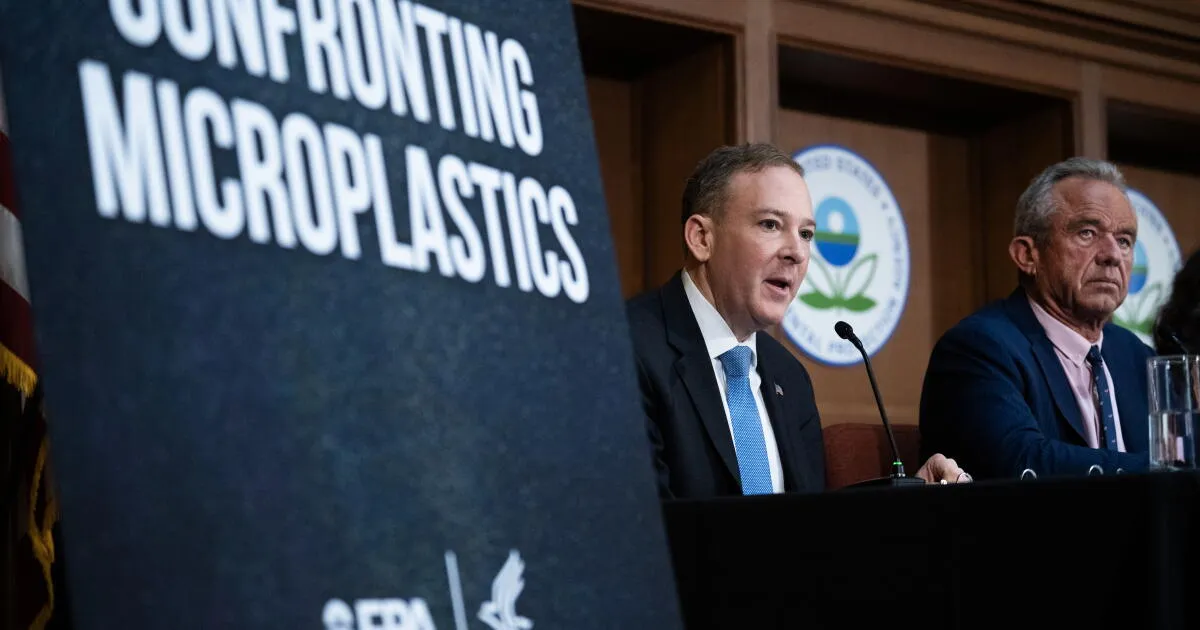
Scientists have found microplastics in virtually every part of the human body. Yet many questions remain about what exactly these infinitesimal flecks of synthetic polymers do to human health, and how they might cause disease. A new paper looking at the chemical reactions between water and disintegrating plastic offers a potential hypothesis for how microplastics might make us sick. Plastics were long thought to be chemically inert, meaning they don’t react easily with other compounds. It’s the reason they are often used for packaging, and why they so stubbornly resist biodegradation. But a Columbia University research team has found that when water molecules come into contact with plastic surfaces, a key chemical reaction does in fact take place. The meeting of water and plastic creates a third class of molecules called reactive oxygen species. ROS are a type of free radical, a broad term for one class of unstable, high-energy molecules. ROS are known to damage cells and promote inflammation. They “tend to damage nearby materials and molecules,” said Wei Min, a professor of chemistry and biomedical engineering at Columbia and co-author of the study.

Los Angeles Times·
Health

Subjective Cognitive Decline Linked to Dementia Biomarkers - EMJ

SUBJECTIVE COGNITIVE DECLINE was associated with a high burden of modifiable dementia risk factors, according to new real-world data from a Brain Health Service cohort. Researchers analysed baseline data from 186 consecutive individuals attending a Brain Health Service, including 132 individuals with subjective cognitive decline.

EMJ·
Health

Metabolic reprogramming of macrophage-specific transketolase orchestrates angiogenesis in diabetic wounds - Nature

We’re sharing this article early to provide faster access to peer-reviewed, accepted research. It is citable and carries a permanent DOI. This version is subject to further edits and will be replaced automatically by the final Version of Record. All legal disclaimers apply. AbstractDiabetic wound healing is profoundly impaired by macrophage metabolic dysfunction, which compromises angiogenesis. Here, we show a macrophage transketolase (TKT) as a crucial metabolic checkpoint governing vascular regeneration in diabetes. We demonstrate that loss of TKT in macrophages accelerates amino acid and fatty acid catabolism, elevates reactive oxygen species, and disrupts endothelial cell proliferation and differentiation. Mechanistically, hyperglycemia activates the AGEs-RAGE signaling cascade through suppressing TKT expression, establishing a pathological TKT-AGEs-RAGE axis that reprograms macrophage metabolism toward dysfunction. Then, we engineer a nanozyme-integrated hydrogel patch that selectively increases TKT level in macrophages, which rebalances macrophage metabolism, reduces oxidative stress, and rescues angiogenic capacity.

Nature·
Health

Mobile app monitoring may reduce serious complications after surgery, new study finds - Medical Xpress

Mobile app-based monitoring may help address the vulnerable days and weeks after surgery when recovery shifts from the hospital to home with little direct supervision. Patients using mobile apps had a lower risk of serious complications, emergency room visits and readmissions after surgery, but the benefits depended on physician or other clinician involvement, rather than the technology alone, according to research presented at the Anesthesiology 2026 annual meeting. "Just using an app may not make recovery safer," said Mouad Elganga, B. S., lead author of the study and a medical student at the Temerty Faculty of Medicine, University of Toronto.

Medical Xpress·
Health

ICR Expands Research Partnerships to Accelerate Progress in Cancer Research - Oncodaily

“This expanding partnership is strategically significant, broadening the depth and diversity of research disciplines we can apply to cancer challenges and enabling our research to involve even larger, more diverse patient populations across London and the South East. Dr. Barbara Pittam, our Chief Research and Academic Officer, attended the Imperial College Academic Health Science Centre meeting this week on behalf of the ICR.

Oncodaily·
Health

ZAPP: a zero-aware photovoltaic power prediction framework - Nature

We’re sharing this article early to provide faster access to peer-reviewed, accepted research. It is citable and carries a permanent DOI. This version is subject to further edits and will be replaced automatically by the final Version of Record. All legal disclaimers apply. AbstractPredicting photovoltaic power generator outputs is not easy, especially when the values are near zero, because even very small errors can lead to large percentage errors. We introduce a new forecasting framework, ZAPP (Zero-Aware Photovoltaic Power Predictor), that handles near-zero errors while maintaining high prediction accuracy. The model does not rely on a single unified regression model but instead attaches two refinement stages to a base regression model. The first stage, called ZeroGate, predicts whether the output should be zero. The second refinement stage, the low-power MAPE reducer, fine-tunes the non-zero outputs near the zero level without significantly affecting scale-dependent regression metrics.

Nature·
Health

Development and internal validation of a clinical risk score for early delirium detection in older emergency department patients - Nature

We’re sharing this article early to provide faster access to peer-reviewed, accepted research. It is citable and carries a permanent DOI. This version is subject to further edits and will be replaced automatically by the final Version of Record. All legal disclaimers apply. AbstractDelirium is a common but frequently underrecognized neuropsychiatric syndrome among older adults in the emergency department (ED), associated with prolonged hospitalization and increased mortality. To develop a clinical risk score for early delirium detection in older emergency department patients. We conducted a prospective cohort study in the ED of a tertiary hospital from July 2024 to July 2025. Patients aged ≥ 65 years who remained in the ED for > 4 h were assessed using the Thai version of the Confusion Assessment Method intensive care unit (CAM-ICU) within 12 h of arrival. Demographic data, comorbidities, functional status, medications, presenting features, vital signs, laboratory values, and ED diagnoses were collected. Multivariable logistic regression was used to derive a clinical risk score, which was evaluated area under the receiver operating characteristic curve (AuROC).

Nature·
Health

Effect of nursing care program on healthy lifestyle behaviours and quality of life in women with endometriosis: a randomised controlled trial - Nature

We’re sharing this article early to provide faster access to peer-reviewed, accepted research. It is citable and carries a permanent DOI. This version is subject to further edits and will be replaced automatically by the final Version of Record. All legal disclaimers apply. AbstractThis study was conducted to determine the effect of Endometriosis Nursing Care Program (ENCP), developed in line with Health Promotion Model for women with endometriosis, on women's quality of life and healthy lifestyle behaviours. This prospective, single-centre, randomized controlled trial was conducted with 46 women diagnosed with endometriosis who applied to the Endometriosis Outpatient Clinic of a training research hospital. Women with an Endometriosis Health Profile Questionnaire-5 (EHP-5) score ≥ 22 indicating reduced quality of life were included. Participants were randomly assigned to an intervention group (n = 23) receiving Endometriosis Nursing Care Program (ENCP) or a control group (n = 23) receiving routine care. The ENCP consisted of two individual 60-min sessions delivered two weeks apart. The primary outcome was change in quality of life measured by EHP-5.

Nature·
Health

1 in 4 Ebola deaths are children in Democratic Republic of Congo's worst outbreak - CBC

, Alexandra Mae Jones | CBC News | Posted: October 17, 2026 8:00 AM | Last Updated: 2 hours agoWith more than 9,200 confirmed cases and 4,400 deaths, children are vulnerable 'on so many levels'Image | DR Congo Ebola ChildrenCaption: Congolese medical workers dressed in personal protective equipment carry children tested for Ebola inside a secured Ebola response zone in Bunia, D. R. C., on June 9. An estimated 1,900 children have been separated from their caregivers because of the disease. (Gradel Muyisa Mumbere/Reuters)Outside of a treatment centre for Ebola in a northeastern corner of the Democratic Republic of Congo, as the country battles its worst outbreak on record, Neema Nyaloka bounces a baby on her lap. Nyaloka survived Ebola herself. Now, she works with UNICEF to take care of the droves of children isolating from their parents who are being treated for it. UNICEF is operating 12 other child-care centres next to treatment centres full of Ebola patients. Some kids are waiting for their parents to recover, but others have been left stranded after family members passed away.

CBC·