We Finally Know What Tore a 500-Km 'Grand Canyon' Into The Atlantic Seafloor - ScienceAlert
This story deserves to be shared
Send it to someone who'd care, or post it on your networks.
This article is an excerpt. To read the full content, visit the original source. ScienceAlert
Related articles

A Deep-Sea Mining Trial Rapidly Threw The Seafloor Ecosystem Off Kilter - ScienceAlert
The deep sea may seem very far away, but it's more connected to our world than you might think. In the South China Sea, for instance, nutrient-rich waters well up from the deep, sustaining coastal fisheries that support the livelihoods of about 3.7 million people each year. Mining companies also have their eyes on the deep sea, where they can see riches in polymetallic nodules, cobalt-rich rocks, and other mineral deposits. A new paper from scientists at the Chinese Academy of Sciences gives a preview of how deep-sea mining can rapidly disrupt the microbes central to nutrient cycling on the South China Sea floor. The results are reported in the scientific journal Total Environment Microbiology. In 2020, samples of cobalt-rich rock were collected during a mining trial in the South China Sea, at around 1,300 meters below sea level. As is typical of deep-sea mining, the rocks were crushed into small pieces first, and then transported to the surface. "A large amount of sediment and other particulate matter were stirred up duringmining, and this process had several direct and indirect effects on the insitu microbial ecosystem," the authors note.
The American Mountains With The Darkest Night Skies - WorldAtlas
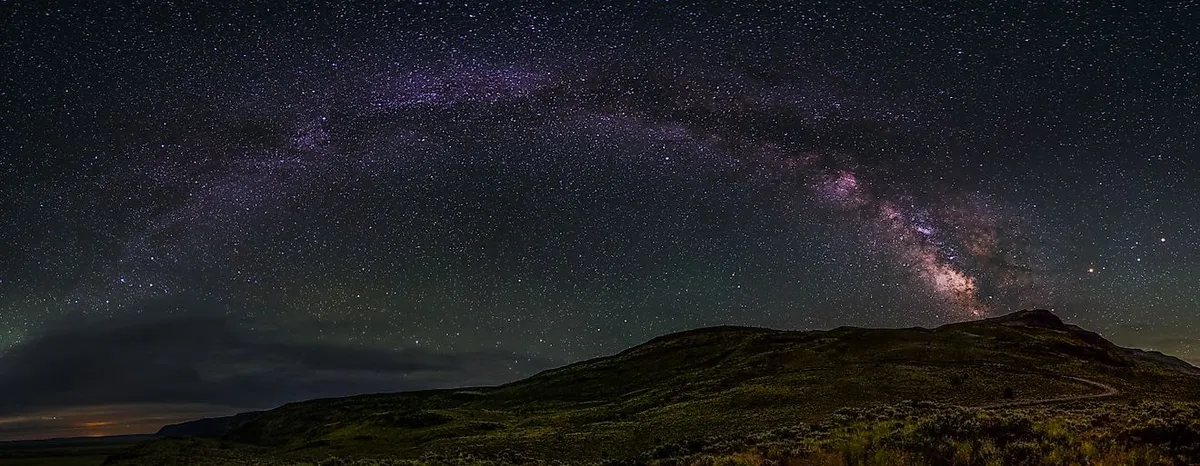
More than 99% of the US population lives under light-polluted skies, according to a 2016 study published in Science Advances. With streetlights, brightly lit parking lots, arenas, and passing headlights brightening the night, it can be easy to forget how dark the sky actually is and how many stars appear when you get away from populated areas. Seeing that many stars for the first time can make you pause and remember where you truly are. You are on a rock spinning through space, surrounded by a universe filled with stars, planets, and galaxies larger than anything you can imagine. A remote mountain excursion can combine a dark sky encounter with a day of hiking and sightseeing. After sunset, bright stars emerge above the slopes and ridgelines. These American mountains lie within officially designated dark sky locations that protect natural darkness and the views of the universe it reveals. In northeastern New Mexico, Capulin Volcano sits among volcanic cones, mesas, and buttes in one of the darker areas of the lower 48 states. These landforms help shield the night sky from distant lights, while the rugged terrain has discouraged development in the area.
What’s Happening in Space Policy October 18-24, 2026 - Space Policy Online
Here is SpacePolicyOnline.com’s list of space policy events for the week of October 18-24, 2026 and any insight we can offer about them. The House and Senate are in recess, except for pro forma sessions, until after the midterm elections. This week has two especially interesting events — the launch of JAXA’s Martian Moons eXploration (MMX) mission tomorrow (Monday) afternoon EDT, and a NASA update on the Artemis program on Friday — plus many others. We’re also keeping track of the discussions on social media about the very close approach of Russia’s Kosmos 2612 to the U. S.-registered ICEYE X36 Synthetic Aperture Radar (SAR) satellite.
0 comments
No comments yet. Be the first to share your thoughts!