Universal coarsening in a homogeneous two-dimensional Bose gas - Science | AAAS
This story deserves to be shared
Send it to someone who'd care, or post it on your networks.
This article is an excerpt. To read the full content, visit the original source. Science | AAAS
Related articles
Intrinsic backward emission of coherent Raman photons from homogeneous media - Nature
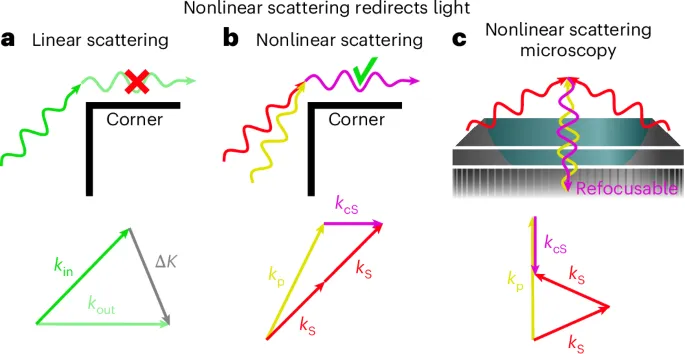
MainLight propagation in homogeneous media is strongly constrained by momentum conservation1. As a consequence, scattered photons cannot easily change direction unless the material provides the required spatial frequencies. In the linear regime, this means that light cannot simply ‘turn a corner’: without abrupt edges, gratings or disorder, backward-directed scattering remains strongly suppressed. This fundamental limitation shapes not only our intuition about how light interacts with matter, but also the design of optical instruments that seek to collect scattered photons efficiently, particularly in settings where only same-side access is available. Nonlinear optical interactions obey a more flexible form of momentum conservation2. By combining the wavevectors of multiple optical fields, they open scattering pathways that are strictly forbidden in the linear regime. Remarkably, this enables coherent photons to be redirected around a corner even in a perfectly homogeneous medium3.

Newly discovered protein controls the space between mitochondrial membranes - News-Medical
Mitochondria are the tiny powerpacks that supply most of the energy our cells need. Their ability to generate this energy relies on a distinctive architecture: two membranes, one tucked inside the other, separated by a narrow gap called the intermembrane space (IMS). This tiny space helps sustain the chemistry of energy production, making its organization critical to how these cellular powerpacks function. Now, a new study led by a University of Ottawa Faculty of Medicine investigator reports a potentially transformative discovery: the volume of the IMS is genetically controlled and adjustable. By controlling where this space expands or narrows within each mitochondrion, cells can actively shape the internal architecture of their powerpacks and tune how they function.

Ancient virus may help explain differences in human and chimpanzee brains - News-Medical
Pandemics can arise wherever animal or human populations are sufficiently large, and they are not confined to the modern age. Johan Jakobsson, Professor of Molecular Neurogenetics at Lund University, believes that the findings from the new study are highly relevant: they show that a virus can cause a DNA sequence to change across an entire population. "The virus we investigated specifically affected chimpanzees. Yet humans and chimpanzees have largely the same genetic makeup. That is why it is important to understand the differences in how genes are regulated. Our findings suggest that one gene, LINC00662, plays a significant role in early human brain development," says Johan Jakobsson.
0 comments
No comments yet. Be the first to share your thoughts!