Swimming Advisory for Big Point Park Beach - Algoma Public Health
This story deserves to be shared
Send it to someone who'd care, or post it on your networks.
This article is an excerpt. To read the full content, visit the original source. Algoma Public Health
Related articles

Canada plunges into early flu season as vaccines begin to roll out - Global News
Infectious disease experts say Canada’s flu season started about seven weeks earlier than usual this year, but with proper interventions, there is no need to sound the alarm bells just yet. According to data from Health Canada, 6.1 per cent of tests detected influenza in the week ending Oct. 17. For the same week in 2025, 0.8 per cent of tests came back positive. Health Canada defines the epidemic threshold at five per cent, a mark Canada didn’t surpass until mid-November last year. “It’s still within the range of not being unusual, but it absolutely started earlier,” Dr. Isaac Bogoch, an infectious disease specialist at the University Health Network in Toronto, told Global News. Bogoch said it is difficult to know exactly why flu season started earlier this year but noted that Australia’s flu season ended later than usual. Story continues below advertisement

Is your pet struggling with the challenges of aging? Veterinary acupuncture may ease the path forward. - Humane World for Animals
At 14 years old, Jack the corgi is struggling with aging. His back legs are wavering, spine is sagging, discs are bulging, and he has trouble standing. To address these challenges and improve his quality of life, Jack’s caregiver turned to veterinary acupuncture. Positive results followed, she told This Morning, a British talk show, “He walks a lot easier. When he’s had this, he goes home and lays down, and he just rolls upside down, legs akimbo; it’s more a relaxed sleep… He even actually plays with his toys a bit more.” These effects dovetail with many seen in other animals undergoing acupuncture—and those results are helping drive the practice into the mainstream.

Does CKD Require Restricting Potassium-Rich Foods? With Navdeep Tangri, MD - HCPLive
News|Videos|October 23, 2026 In a randomized crossover trial, a liberalized produce diet raised urinary potassium excretion without changing serum potassium. Urinary potassium excretion rose on a liberalized produce diet, while serum potassium did not differ significantly compared with a restricted diet. Patients with chronic kidney disease (CKD) are often advised to limit potassium-rich fruits and vegetables. In a randomized crossover trial, increasing potassium intake through these foods did not produce a statistically significant increase in serum potassium compared with a restricted diet.¹ Navdeep Tangri, MD, professor of medicine at the University of Manitoba in Canada, presented the findings at the American Society of Nephrology (ASN) Kidney Week 2026 in Denver, Colorado. In an interview with HCPLive, he highlighted the disconnect between dietary potassium intake, urinary potassium excretion, and blood potassium concentrations. “I think all of us, when we go back to our physiology textbooks, know that most potassium in the body is not in the blood; it’s inside cells,” Tangri said.
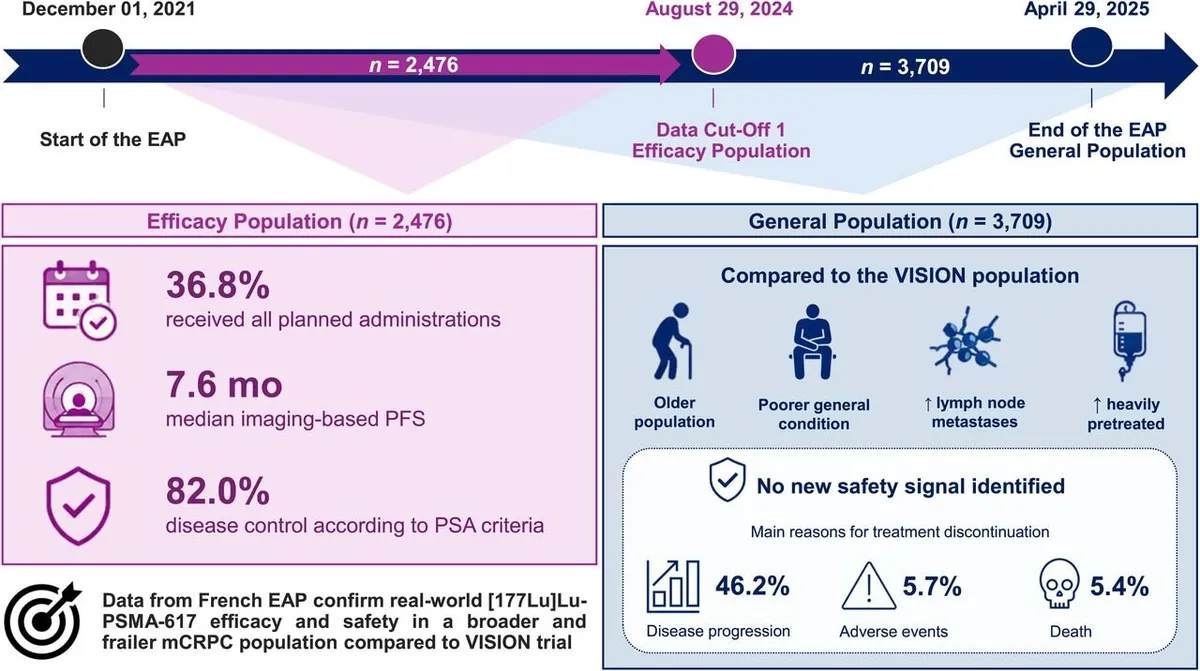
Real-world results confirm benefit of antigen therapy for prostate cancer - Medical Xpress
Overview of real-world treatment patterns and clinical outcomes with [¹⁷⁷Lu]Lu-PSMA-617 in patients with metastatic castration-resistant prostate cancer treated within the French Early-Access Program. The figure summarizes patient population, treatment exposure, efficacy outcomes and safety findings from routine clinical practice. Credit: KPL, Paris. Prostate-specific membrane antigen (PSMA)-targeted radiopharmaceutical therapy is safe and effective for patients with metastatic castration-resistant prostate cancer (mCRPC) in routine clinical practice, consistent with outcomes from the VISION trial. An analysis of outcomes from a French early-access program, the largest real-world cohort of patients studied to date, confirms the benefit-risk profile of the therapy, while also shedding light on patient selection and use trends. This research was published in The Journal of Nuclear Medicine.

KLK2-comPAS trial explores dual T-cell engagement in mCRPC - Urology Times
Kim Chi, MD, FRCPC, discusses the rationale and design of the phase 3 KLK2-comPAS trial evaluating pasritamig alone and in combination with JNJ-9401 in patients with mCRPC. In this video, Kim Chi, MD, FRCP, discusses the rationale and design of the phase 3 KLK2-comPAS trial (NCT07164443) evaluating pasritamig, alone and in combination with JNJ-9401, in patients with metastatic castration-resistant prostate cancer (mCRPC) who have exhausted available life-prolonging treatment options. The design of the study was presented at the 2026 European Society for Medical Oncology Annual Congress in Madrid, Spain as a trials in progress poster. Chi is a medical oncologist at BC Cancer in Vancouver, Canada, and a professor of medicine at the University of British Columbia. According to Chi, the KLK2-comPAS trial builds on the potential of kallikrein-related peptidase 2 (KLK2) as a therapeutic target because of its expression in normal and malignant prostate tissue. Pasritamig is a bispecific antibody that engages CD3 on T cells and KLK2 on prostate cancer cells to stimulate a targeted immune response.
Quebec’s 811 health line faces longer waits ahead of flu season - CityNews Montreal
Informations complètes et à jour, compilées par Google Actualités à partir de sources d'actualité du monde entier
0 comments
No comments yet. Be the first to share your thoughts!