Supercomputer reveals how size could shape the future of nanomedicine - Phys.org
This story deserves to be shared
Send it to someone who'd care, or post it on your networks.
Scientists have long been interested in cellular nanodiscs, tiny particles made from natural cell membranes that mimic many of the functions of living cells. While previous studies demonstrated the therapeutic potential of nanodiscs for drug delivery, detoxification and vaccines, one fundamental question remained unanswered: How does size influence how well they work?
This article is an excerpt. To read the full content, visit the original source. Phys.org
Related articles
From seafloor depths to fishing activity, free software brings ocean data together - Phys.org
For scientists studying the ocean, finding the right data can sometimes be as challenging as figuring out what to do with it. Want to know seafloor depth, the location of underwater mountains or sea surface temperatures? The information exists, but it can take considerable time and computer coding to pull it together from different sources and get it into the proper format.
Water as we've never known it: Physicists test water beyond Earth-like conditions - Phys.org
Water isn't always as it seems. Under extreme conditions, such as those found on other planets, it has been discovered to change its atomic structure, giving it the means to alter its appearance and other properties.
'Smoking gun' may help solve mystery of high-temperature superconductivity - Phys.org
Superconductivity has many important practical applications, including creating powerful magnets used in high-resolution medical scans, transporting electricity efficiently and building ultrasensitive measuring devices. Until now, understanding exactly what lay behind this unique phenomenon at high temperatures has eluded scientists over many decades.
Custom frame timing captures ultrafast events across five orders of magnitude in time - Phys.org
Most conventional methods of ultrafast photography use evenly spaced intervals in which images are taken, but new developments have shown how much can be left out of the story, especially when multiple timescales are involved.
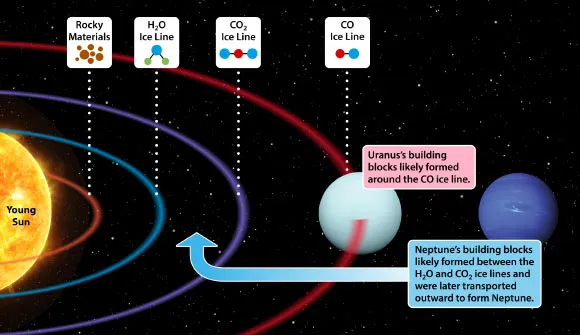
Uranus and Neptune May Have Taken Different Paths to Becoming Ice Giants - Sci.News
Uranus and Neptune are often described as near-twins, but a new study suggests their chemistry, and possibly their histories, may differ more than expected. The materials making up Neptune and Uranus likely came from different regions in the protoplanetary disk around the young Sun. Image credit: SwRI.
0 comments
No comments yet. Be the first to share your thoughts!