Study Shows Enhanced Diagnosis of Coronary Artery Stenosis with Photon-Counting CTA - Applied Radiology
This story deserves to be shared
Send it to someone who'd care, or post it on your networks.
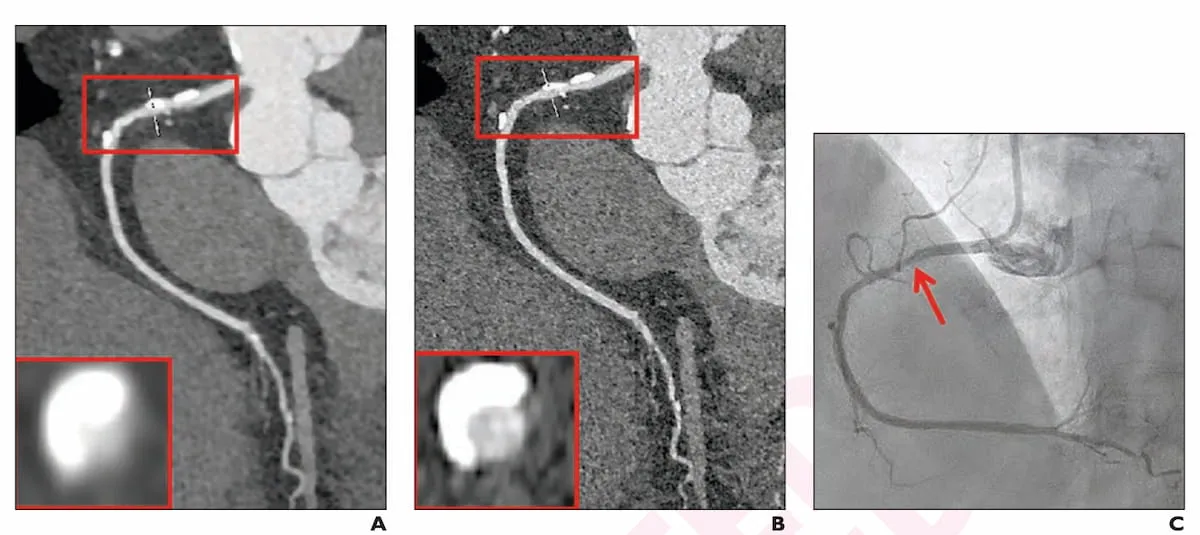
{ "title": "Study Evaluates Diagnostic Accuracy of Photon-Counting Detector CT in Coronary Angiography", "excerpt": "Research finds photon-counting detector CT offers high sensitivity, specificity, and accuracy for detecting coronary artery stenosis. ", "body": "A recent study published in the American Journal of Roentgenology examined the diagnostic performance of standard resolution (SR) and ultra-high resolution (UHR) modes in coronary computed tomography angiography (CCTA) using photon-counting detector CT (PCD CT). Researchers analyzed data from 122 inpatients, totaling 1,613 segments for evaluation. The findings indicate a segment-level sensitivity and accuracy rate consistently above 89.6 percent for diagnosing coronary artery stenosis.\n\nThe study assessed images from 61 patients using SR (total of 788 segments) and 61 patients utilizing UHR (total of 825 segments). The image reconstructions included SRnormal and SR virtual non-calcium (SRVNCa) images for the SR exams, while UHR exams were categorized into UHRnormal and UHRthin images.
This article is an excerpt. To read the full content, visit the original source. Applied Radiology
Related articles

Severe Rheumatic Mitral Stenosis With Multivalvular Abnormalities in a British-Born Adult Without a Recognized History of Acute Rheumatic Fever - Cureus
Rheumatic heart disease (RHD) has become uncommon in the United Kingdom, particularly among British-born adults without a recognized history of acute rheumatic fever (ARF). A 40-year-old British-born female with no previously diagnosed cardiac disease presented with a one-year history of progressive exertional dyspnoea. Chest radiography demonstrated cardiomegaly, and the N-terminal pro-B-type natriuretic peptide concentration was 1,800 pg/mL. Transthoracic echocardiography showed very severe mitral stenosis with characteristic rheumatic morphology, a mitral valve area of 0.33 cm² by planimetry, and a mean transmitral gradient of 16.6 mmHg. Associated findings included mild mitral regurgitation, tricuspid valve abnormalities with moderate-to-severe tricuspid regurgitation, and discordant aortic valve findings consistent with a low-flow, low-gradient pattern of aortic stenosis, an estimated pulmonary artery systolic pressure of approximately 105-110 mmHg, left ventricular systolic impairment, and impaired right ventricular longitudinal systolic function. Further history identified intermittent involuntary left-hand movements, arthralgia, and an annular abdominal eruption with centra
Aortic stenosis: 200 newly identified genes raise hope for future treatments - McGill University Health Centre

Hidden stem cells may be fueling spinal stenosis - Science Daily
Researchers at Weill Cornell Medicine and Hospital for Special Surgery have identified a previously elusive population of stem cells that appears to produce the body's tendons and ligaments, the connective tissues that link muscles and bones. The scientists also found evidence that these cells can become overactive in the lower spine, where they may contribute to lumbar spinal stenosis. The condition affects an estimated 103 million people worldwide and develops when thickened ligaments reduce space inside the spinal canal. This narrowing can put pressure on nerves and lead to pain, numbness and difficulty walking.
0 comments
No comments yet. Be the first to share your thoughts!