Scientists discover a way to reverse coral bleaching at record speed - Phys.org
This story deserves to be shared
Send it to someone who'd care, or post it on your networks.
For the first time, scientists have observed bleached corals on the brink of death fully recover through brief contact with healthy clones. Ghostly white corals returned to full health in a laboratory setting within seven weeks, the fastest documented recovery to date, according to a study published in Science Advances.
This article is an excerpt. To read the full content, visit the original source. Phys.org
Related articles

Coral Bleaching Reversed at Record Speed Using New Stanford Method: ‘Not a Lost Cause, at All’ - Good News Network
Coral bleaching restoration at Stanford – by Dan Griffin / GG Films (via SWNS, cropped) Coral bleaching has been reversed at record speed using a new method developed at Stanford University.

Scientists discover a way to reverse coral bleaching, one of the ocean’s biggest environmental threats - The Brighter Side of News
Bleached coral fragments recovered after touching healthy genetic clones in laboratory experiments involving one species and two genotypes. A week of contact supplied enough beneficial algae for fragments to continue recovering after separation. Tissue fusion appears to enable rapid transfer, but mismatched corals competed instead, and reef-scale restoration remains untested. A few millimeters separated recovery from severe decline in tanks of bleached coral. Fragments touching healthy genetic clones regained their beneficial algae and resumed growth. Fragments held nearby without contact largely succumbed to invasive algae and tissue loss. The laboratory findings, published in Science Advances, reveal a route to rapid recovery after bleaching. Stanford University researchers found that about a week of contact could provide enough algae for recovery to continue independently. The results identify a biological mechanism, rather than a method already demonstrated to restore natural reefs. Danny Collins, an oceans doctoral student at the Stanford Doerr School of Sustainability, led the study with colleagues including Steve Palumbi.

Stanford scientists discover a way to reverse coral bleaching at record speed - Stanford Doerr School of Sustainability
Bleached corals can fully recover within a few weeks through brief contact with healthy corals, opening new possibilities for restoration. Corals provide food and livelihoods to hundreds of millions of people globally through fisheries, tourism, and other benefits. (Image credit: Zephyr 18/Getty)
Physicists prove a long-suspected quantum speed limit for thermalization - Phys.org
Whether we are waiting for a car windshield to defrost in winter or a warm drink to cool down, how long it takes for an object to settle into a stable, even temperature within its environment (thermal equilibrium) depends on numerous factors. These can include surface area, the material properties of an object and airflow.
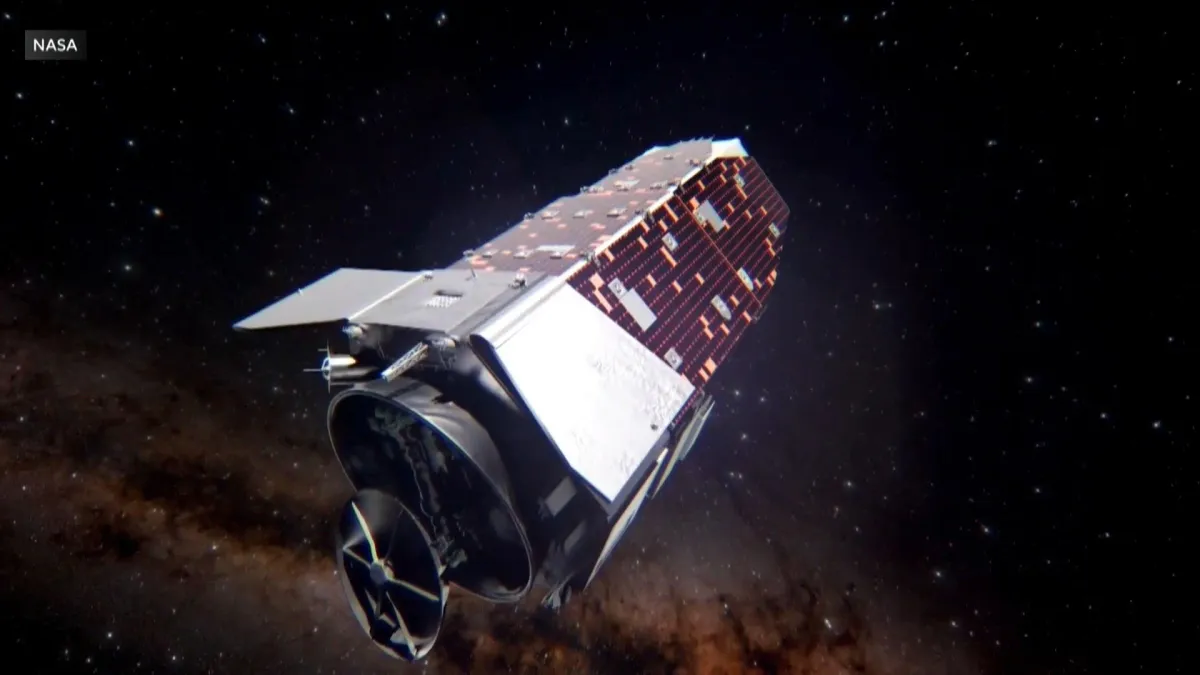
NASA’s Roman Space Telescope prepares to unleash a flood of new cosmic discoveries - The Brighter Side of News
Roman is designed to return about 1.4 terabytes of data daily, with observations becoming publicly available after processing. A collaboration of roughly 900 astronomers is preparing to search those observations for planets, black holes and cosmic explosions. The telescope’s surveys could sharpen measurements of dark energy, but their major discoveries still lie ahead. A distant star briefly brightens. A supernova appears in a galaxy. Somewhere else, an unseen object bends passing starlight. NASA’s Nancy Grace Roman Space Telescope is designed to capture such changes across crowded stretches of sky, then make its observations available for others to investigate. The challenge will be keeping up. Roman is expected to return about 1.4 terabytes of data daily during operations. Jessica Lu, an astronomy associate professor at the University of California, Berkeley, and David Weinberg of Ohio State University have organized a collaboration of roughly 900 astronomers to prepare. Their effort connects two ambitions: finding unusual objects in the Milky Way and understanding why the universe’s expansion is accelerating.
0 comments
No comments yet. Be the first to share your thoughts!