Physicists prove a long-suspected quantum speed limit for thermalization - Phys.org
This story deserves to be shared
Send it to someone who'd care, or post it on your networks.
Whether we are waiting for a car windshield to defrost in winter or a warm drink to cool down, how long it takes for an object to settle into a stable, even temperature within its environment (thermal equilibrium) depends on numerous factors. These can include surface area, the material properties of an object and airflow.
This article is an excerpt. To read the full content, visit the original source. Phys.org
Related articles

Kona Destroys You Like No Other Ironman. We’ve Got the Receipts to Prove It. - Triathlete
No one would argue that the Ironman World Championship in Kona is physically taxing – but it goes well beyond the traditional post-Ironman fatigue due to the challenging conditions. Post-race, you’ll not only suffer physiological stress, but also nervous and digestive system stress, which can create brain fog and emotional volatility.

FEAR IS BIGGER THAN EVER… AND ZERO LATENCY VR HAS THE SCIENCE TO PROVE IT - Plataforma Media
Ahead of Halloween, Zero Latency VR brought in "scientist of fear" Dr. Coltan Scrivner to explain why people can't stop playing with the things that scare them MELBOURNE, Australia, Oct. 2, 2026 /PRNewswire/ — Zero Latency VR, the world's largest and most innovative immersive VR network, is celebrating a double Halloween anniversary: three years since the launch of Outbreak, its free-roam zombie survival shooter, and one year since the debut of Haunted, its immersive haunted house experience. Rather than mark the occasion alone, the company brought in an outside expert: Dr. Coltan Scrivner, a research scientist who studies why humans seek out frightening things for fun.
New monolithic ion trap opens quantum simulations to more researchers - Phys.org
Some quantum systems are so complex that even the most powerful supercomputers struggle to simulate their behavior. One solution is quantum simulation: building a controllable quantum system in the lab and tuning it to mimic the one researchers want to understand.
A new way to detect stabilizing properties of optical devices - Phys.org
In optical fibers, chips and other light-guiding devices, minor defects can scatter photons and disrupt their path. A new study demonstrates a way to reveal properties which, in certain systems, help light wave behavior withstand such flaws. The method could help speed up the search for new kinds of electronics and optical technologies, and contribute to more reliable quantum devices.
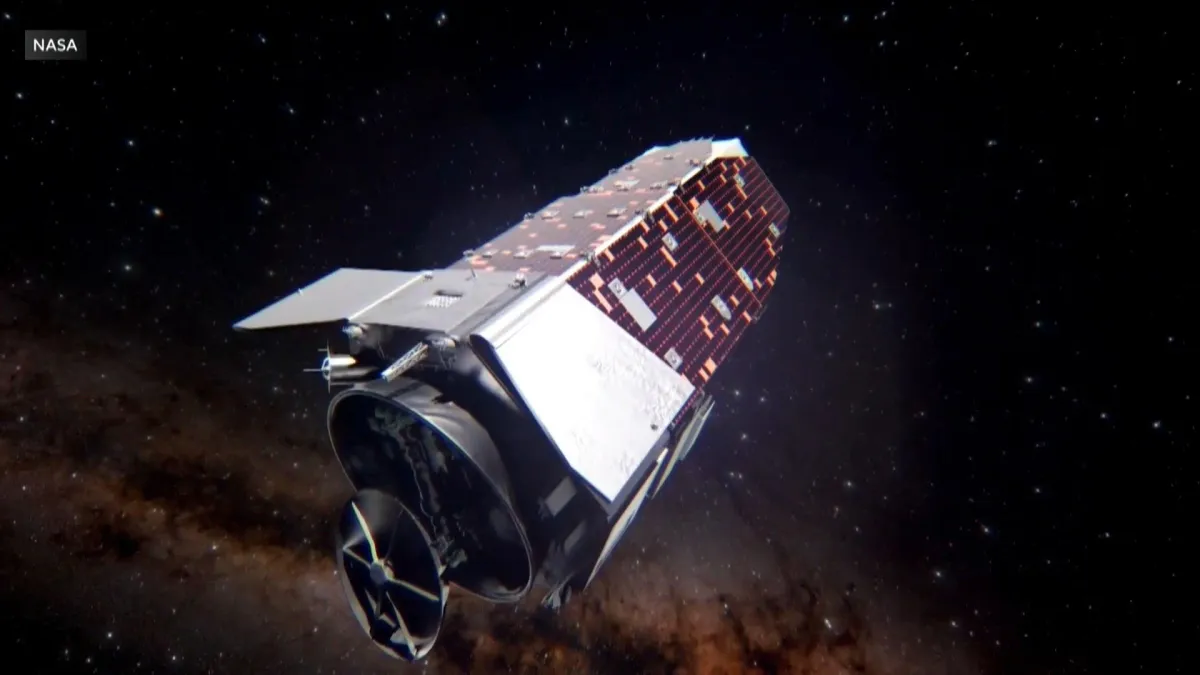
NASA’s Roman Space Telescope prepares to unleash a flood of new cosmic discoveries - The Brighter Side of News
Roman is designed to return about 1.4 terabytes of data daily, with observations becoming publicly available after processing. A collaboration of roughly 900 astronomers is preparing to search those observations for planets, black holes and cosmic explosions. The telescope’s surveys could sharpen measurements of dark energy, but their major discoveries still lie ahead. A distant star briefly brightens. A supernova appears in a galaxy. Somewhere else, an unseen object bends passing starlight. NASA’s Nancy Grace Roman Space Telescope is designed to capture such changes across crowded stretches of sky, then make its observations available for others to investigate. The challenge will be keeping up. Roman is expected to return about 1.4 terabytes of data daily during operations. Jessica Lu, an astronomy associate professor at the University of California, Berkeley, and David Weinberg of Ohio State University have organized a collaboration of roughly 900 astronomers to prepare. Their effort connects two ambitions: finding unusual objects in the Milky Way and understanding why the universe’s expansion is accelerating.
0 comments
No comments yet. Be the first to share your thoughts!