red-and-white aluminum safety barriers convert into public seating at dutch design week
This story deserves to be shared
Send it to someone who'd care, or post it on your networks.
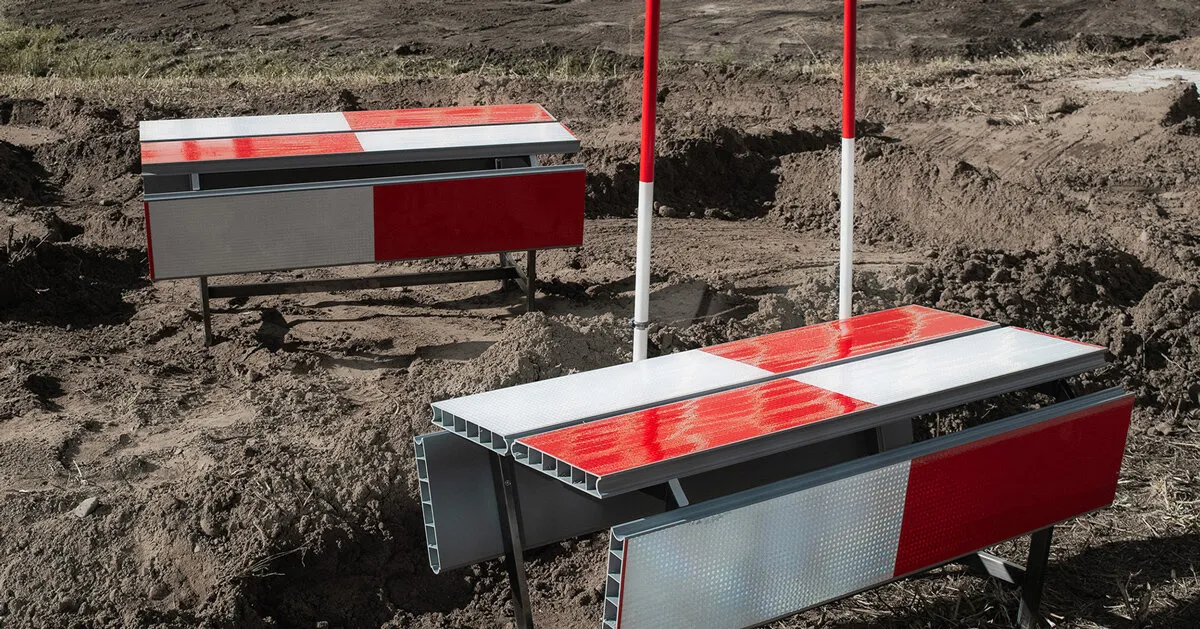
red-and-white safety barriers reimagined as public seatingA signature element of Dutch urban infrastructure, the red-and-white aluminum traffic barrier (schrikhek), serves as the primary design reference for ‘stop!’, a new collection of outdoor benches and stools by Studio Martins Mezulis and 13_0663_tsx. Typically deployed across the Netherlands to signal construction zones and redirect public traffic, these standardized aluminum structures have been reconfigured to serve a social rather than restrictive function in public spaces.all images ©Studio Martins Mezulis and 13_0663_tsx recontextualizing utilitarian infrastructure into furniture The ‘stop!’ collection by Studio Martins Mezulis and creative 13_0663_tsx reinterprets the visual language and material composition of traditional safety infrastructure into functional street furniture. Instead of diverting pedestrians and cyclists away, the modified forms invite users to pause, sit, and gather. By recontextualizing the familiar high-visibility aluminum panels into seating, the project explores how utilitarian safety elements can be adapted for community interaction.
This article is an excerpt. To read the full content, visit the original source. designboom
Related articles
undulating plywood layers form stratum parametric public seating sculpture
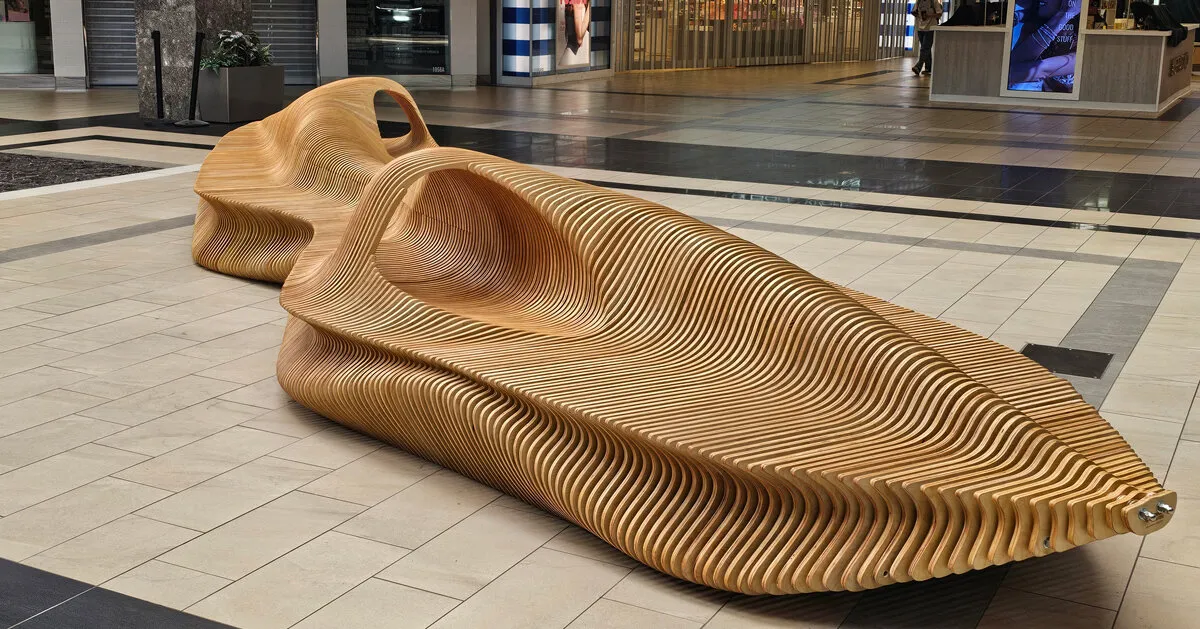
COMPUTATIONAL DESIGN YIELDS Stratum PARAMETRIC TIMBER BENCHSTRATUM is a monumental parametric wooden bench designed and manufactured by Zorka Furniture for Haywood Mall in Greenville, South Carolina. Spanning nearly 29 feet and featuring over 600 individually CNC-cut components, this sculptural installation transforms traditional seating into an interactive architectural landmark, combining innovative design, precision craftsmanship, and functionality in a contemporary public space.all images ©Zorka Furniture600 CNC-CUT PLYWOOD COMPONENTS FORM MODULAR ASSEMBLYThe structure by design and manufacturing studio Zorka Furniture comprises over 600 individually CNC-cut wooden components milled from roughly 100 plywood sheets. Assembled into a three-dimensional, layered mass, the varying profiles produce a rhythmic sequence of curves, integrated seating niches, and arched pass-throughs designed for visitor interaction. Weighing over 5,500 pounds (2,500 kilograms), the bench was fabricated into modular sections, shipped on five pallets, and assembled overnight to accommodate the mall’s operating hours.
sardinian school wraps in perforated aluminum facade to enclose flexible agorà
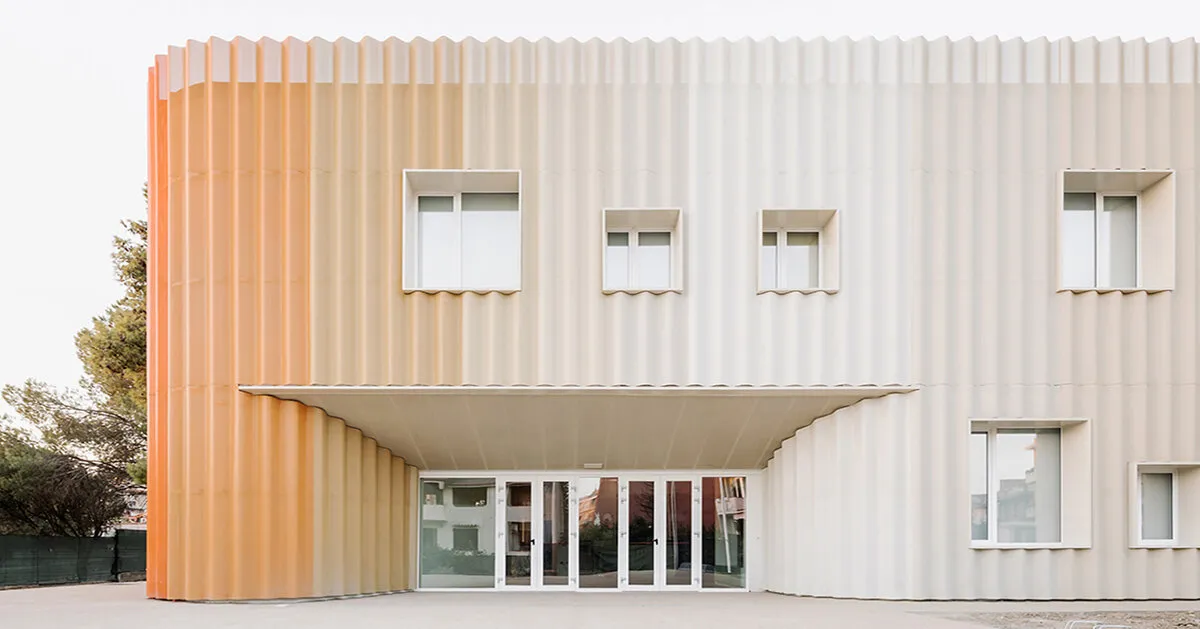
CORRUGATED ALUMINUM SKIN ESTABLISHES A CIVIC LANDMARK IN SARDINIADesigned by Leicho architettura, the new Via Caravaggio school in Sinnai, Sardinia, replaces an obsolete structure with a civic facility that redefines the relationship between public architecture, pedagogy, and urban identity. The building presents a dual spatial character: a compact, highly recognizable exterior volume contrasts with a permeable, porous interior layout. The exterior building envelope is wrapped in micro-perforated corrugated aluminum panels that soften straight edges along curved margins. The textured metal skin shifts in response to daylight, establishing the school as a distinct visual landmark within the neighborhood. A deep, carved recessed entryway marks the transition from the public plaza into the building. Via Caravaggio school in Sinnai, Sardinia, is designed by Italian firm Leicho architettura | all images ©Cèdric DasessonFLEXIBLE CLASSROOM GEOMETRIES CREATE POROUS LEARNING SPACEInside the building by Leicho architettura studio, the rigid geometry of the shell dissolves into a continuous learning landscape.

hedley studios shrinks the porsche 550 spyder into a handcrafted electric two-seater
porsche 550 spyder at 80 percent of its original sizeThere’s a tiny silver Porsche parked among a sunlit meadow in the English countryside. With its rounded rear fenders and tiny windshield, it’s quite similar to the 550 Spyder that Porsche raced in the 1950s. The proportions are familiar, but something is slightly off. This is the Porsche 550 J, a miniature, fully electric version of the historic race car, recreated by British manufacturer Hedley Studios at roughly 80 percent of its original size. Developed in collaboration with Porsche to celebrate 75 years of the company’s motorsport history, the 550 J is an officially licensed, handcrafted vehicle limited to 250 examples. The ‘J’ stands for ‘Junior,’ although the little roadster is large enough to accommodate two people. Measuring just 2.9 meters (9.5 feet) in length and 1.2 meters (3.9 feet) wide, it retains the low profile and flowing aluminum-like contours of its predecessor.the miniature Porsche 550 J’s silver bodywork recalls the original 1950s racer | images courtesy Porschea miniature tribute to porsche’s first purpose-built racing carThe original Porsche 550 Spyder holds a special place in the company’s history.
0 comments
No comments yet. Be the first to share your thoughts!