Prevalence and severity of mental health problems in early-career researchers: a systematic review and meta-analysis - Nature
This story deserves to be shared
Send it to someone who'd care, or post it on your networks.
This article is an excerpt. To read the full content, visit the original source. Nature
Related articles
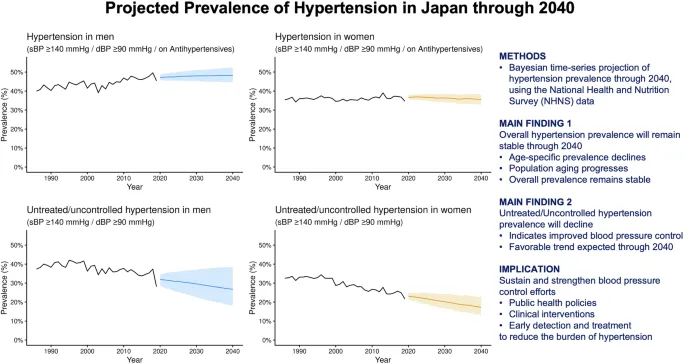
Projected prevalence of hypertension and untreated/uncontrolled hypertension in Japan through 2040 - Nature
IntroductionHypertension is a major global health concern and a leading cause of morbidity and mortality [1]. It is estimated that more than 19 million annual deaths are attributed to cardiovascular disease (CVD) worldwide [2]. In Japan, high blood pressure (BP) has been consistently identified as a strong risk factor for the national burden of CVD, in terms of notable incidence, mortality, direct/indirect healthcare costs, and quality-adjusted life years (QALYs) associated with this condition [3, 4]. Although age-specific mean BP declined in Japan over recent decades [5], hypertension remains a critical public health issue, particularly because of the rapid aging population. The proportion of individuals aged ≥65 years is projected to reach approximately 35% by 2040 in Japan [6], highlighting a potentially higher future burden of hypertension in this country. While the prevalence of hypertension increases with age, population aging may offset the benefits of declining BP levels in each age group. As a result, the future burden of hypertension in Japan remains uncertain.

Neuropathic Pain-Like Features in Patients With Rheumatoid Arthritis and Spondyloarthritis Receiving Targeted Therapies: Prevalence and Associated Factors - Cureus
Persistent pain despite targeted therapy remains a major challenge in patients with rheumatoid arthritis (RA) and spondyloarthritis (SpA), and neuropathic pain-like features may contribute to this residual pain. We conducted a cross-sectional study including 155 patients receiving biologic or targeted synthetic disease-modifying antirheumatic drugs (bDMARDs or tsDMARDs; 78 RA and 77 SpA) to determine the prevalence of neuropathic pain-like features and identify associated clinical factors. Neuropathic pain-like features were screened using the Douleur Neuropathique 4 (DN4) and painDETECT questionnaires. Univariable logistic regression analyses were performed separately for each disease group, followed by parsimonious multivariable models including functional impairment, disease activity, and current pain intensity. Neuropathic pain-like features (DN4 ≥4) were identified in 19 (24.4%) patients with RA and 21 (27.3%) patients with SpA, with no statistically significant between-group difference (p = 0.679). Although median painDETECT scores were significantly higher in SpA, the distribution of painDETECT categories did not differ significantly between the two groups. In univariable an
Mental health statistics: prevalence, services and funding in England - The House of Commons Library

Fire Remains Costliest Cause of Business Interruption Globally as Claim Severity Surges - Risk & Insurance
Liberty Mutual’s Amy Gross discusses how AI, data analytics, drones, and connected technologies are helping construction firms identify risks earlier, improve safety and claims outcomes, and make better-informed decisions — while creating new demands around cybersecurity, privacy and human oversight. In August 2026, Risk & Insurance caught up with Amy Gross, General Manager, North America Construction, Global Risk Solutions, Liberty Mutual. What follows is a transcript of that discussion, edited for length and clarity.
0 comments
No comments yet. Be the first to share your thoughts!