Premature menopause linked to higher heart disease risk and insulin levels - News-Medical
This story deserves to be shared
Send it to someone who'd care, or post it on your networks.

Premature menopause is associated with an increased risk of several long-term health problems due to estrogen deficiency. Cardiovascular disease (CVD) is one of those health risks. However, the underlying cardiometabolic causes are unclear. A new study suggests a possible connection with insulin levels. Results of the study will be presented at the 2026 Annual Meeting of The Menopause Society in San Diego, October 20-24, 2026.
Premature menopause is defined as menopause that occurs before the age of 40 years. Only about 1% of women experience it. Women who experience premature menopause have a longer duration of postmenopause life and have been reported to have higher risks of several adverse health outcomes, including cardiovascular disease and osteoporosis.
This article is an excerpt. To read the full content, visit the original source. News-Medical
Related articles
New Research Links Even Low Alcohol Consumption to Cancer, Heart Disease, and Premature Death - Columbia University Mailman School of Public Health
Exercise variety—not just amount—linked to lower risk of premature mortality - Harvard T.H. Chan School of Public Health
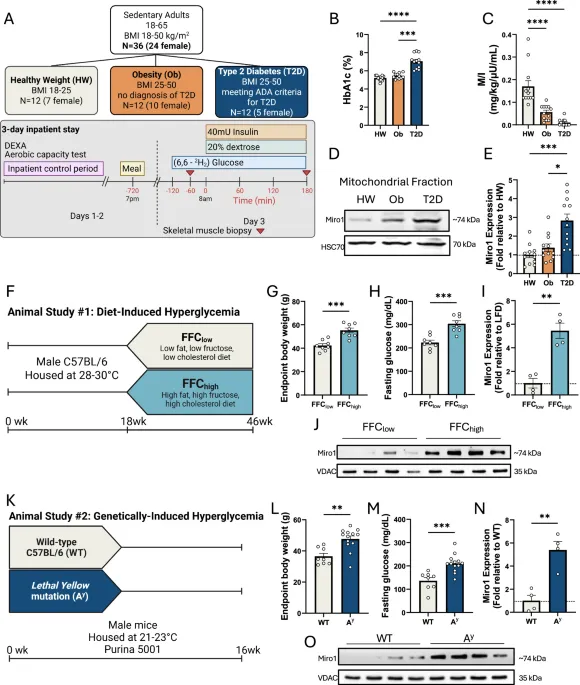
Miro1 mediates skeletal muscle insulin resistance in type 2 diabetes - Nature
IntroductionType 2 diabetes (T2D) has emerged as one of the major public health and economic burdens of the 21st century, affecting more than 37 million people in the United States of America and more than 500 million people globally (~10.5%)1. As these shocking numbers continue to rise, the cost of caring for patients with diabetes and its complications is placing enormous strain on the global economy, totaling nearly $1 trillion dollars in economic impact2, despite the development of nearly a dozen new medications for disease management. As the scale of the problem grows exponentially, our fundamental understanding of the cellular and molecular mechanisms of T2D remains incomplete, limiting our ability to develop effective, targeted medications that address the underlying pathophysiology rather than the disease’s symptoms. T2D arises when insulin secretion is insufficient to compensate for progressive, sustained peripheral insulin resistance, leading to a systemic rise in glucose concentrations.
Miro1 protein linked to insulin resistance in type 2 diabetes - News-Medical
A protein called Miro1 found at elevated levels in the skeletal muscle of people with Type 2 diabetes may contribute to insulin resistance, potentially making it a target for future treatments that help the body regulate blood sugar, according to a study published today in Nature Communications. Researchers found that removing Miro1 restored the muscles' response to insulin in preclinical models, while exercise reduced the protein's levels in people with Type 2 diabetes. The study was led by senior author Dr. John P. Kirwan, recently named executive director of the OU Health Harold Hamm Diabetes Center at the University of Oklahoma. He conducted the research while at LSU's Pennington Biomedical Research Center and now brings his internationally recognized translational research program to OU, where he will build on his work to advance the understanding and treatment of diabetes. The study's first author is Elizabeth Heintz, a doctoral candidate who worked in the Integrated Physiology and Molecular Medicine Laboratory at Pennington Biomedical, and the co-corresponding author is Christopher Axelrod, who has since joined Kirwan at the Harold Hamm Diabetes Center.
0 comments
No comments yet. Be the first to share your thoughts!