New DeepSeek ban in US, Swiss-Asia crypto ties deepen: Asia Express
This story deserves to be shared
Send it to someone who'd care, or post it on your networks.

CHINATreasury proposes blocks on US investments in AI and semiconductors in some foreign countriesThe US Treasury has proposed new rules that would block investment in artificial intelligence projects (sorry, ‘Super Intelligence’ projects) and certain high risk semiconductors in some foreign countries. The blocks have been mainly aimed at geopolitical rival China, but will now also encompass other adversaries including Russia, Iran, North Korea and Cuba. The rules would implement the COINS Act from December 2025 and expand the Outbound Investment Security Program that went into effect in January 2025. They rules build on previous restrictions on selling high powered AI chips to China. The US is backing up its threats too, having announced the first $200,000 penalty this month to Amidi, LLC. Treasury for failing to report an investment by its Chinese subsidiary into embodied AI and robotics company Shanghai Qiongche Intelligent Technology (AKA Noematrix.)US bans DeepSeek from civilian agency IT systemsThe US Department of Homeland Security has ordered the removal of DeepSeek products from federal civilian agency IT systems.
This article is an excerpt. To read the full content, visit the original source. Cointelegraph
Related articles

Ethereum delays Glamsterdam test after security devs flag risk to existing contracts
Skip to main contentCrypto NewsOct 23, 2026, 12:59 a.m. EDT2 min readEthereum delays Glamsterdam test after security devs flag risk to existing contracts. (Ethereum)SummaryEthereum developers postponed the Glamsterdam upgrade on the Hoodi test network after researchers found that proposed gas-accounting changes could alter how existing smart contracts handle failed transactions. ChainSecurity found that EIP-8037 and EIP-8038 could leave some contracts with more or less gas than expected, potentially making errors permanent or causing otherwise valid operations to fail. No replacement date has been announced for the Hoodi test or its planned 200 million gas limit, and Ethereum’s mainnet upgrade date remains unconfirmed. Ethereum developers have called off Monday's Glamsterdam upgrade on the Hoodi test network after security researchers identified a problem that could change how existing smart contracts handle failed transactions, potentially allowing errors to become permanent. The upgrade was due to activate on Oct. 26 at 17:42:48 UTC.

Cardano holders are being asked to bet $5 million on copper hitting a new record
Skip to main contentCrypto NewsOct 23, 2026, 12:36 a.m. EDT3 min readCardano holders are being asked to bet $5 million on copper hitting a new record. (Shutterstock)SummaryToto Finance is seeking 22 million ADA, or about $5 million, from Cardano’s treasury to buy and tokenize copper, with voting set to close Nov. 15. Copper would need to rise about 49.4% for the treasury to recover its investment if the full budget is spent and ADA’s dollar price remains unchanged. The proposal would use more than half of Cardano’s remaining withdrawal allowance, while Toto could receive up to 3.36 million ADA and retain commercial rights to its separately funded tokenized-copper business. Cardano’s community treasury is being asked to spend about $5 million on a copper reserve whose costs would leave the metal needing to rise nearly 50% just to recover the original investment under the proposal’s assumptions. Toto Finance, a company that turns physical commodities into blockchain tokens, wants 22 million ADA for what it calls the Cardano Strategic Copper Reserve. Voting closes Nov. 15.

Bitcoin Core changes security policy as AI makes bugs easier to find
Bitcoin Core is changing how it handles security vulnerabilities, explaining that large language models have made certain software flaws significantly easier to discover. In an email to the Bitcoin Development Mailing List on Thursday, Bitcoin Core developer Antoine Poinsot said that in the past, vulnerabilities were generally kept under lengthy disclosure embargoes to give users time to upgrade before details became public. Maintaining that secrecy generally meant fixes could not be backported to older software versions, leaving users waiting until the next major release. However, Poinsot said LLMs have made some flaws so easy to rediscover that delaying fixes offers little protection. “The embargo period achieves little but it delays the availability of a fixed release,” said Poinsot. “We are therefore updating our policy disclosure to accommodate those.”The change comes as AI-assisted security research puts pressure on developers across Bitcoin’s software ecosystem. Under the updated policy, vulnerabilities deemed “easily discoverable” will receive fixes as soon as possible across all maintained major versions, with security advisories published alongside the updates.
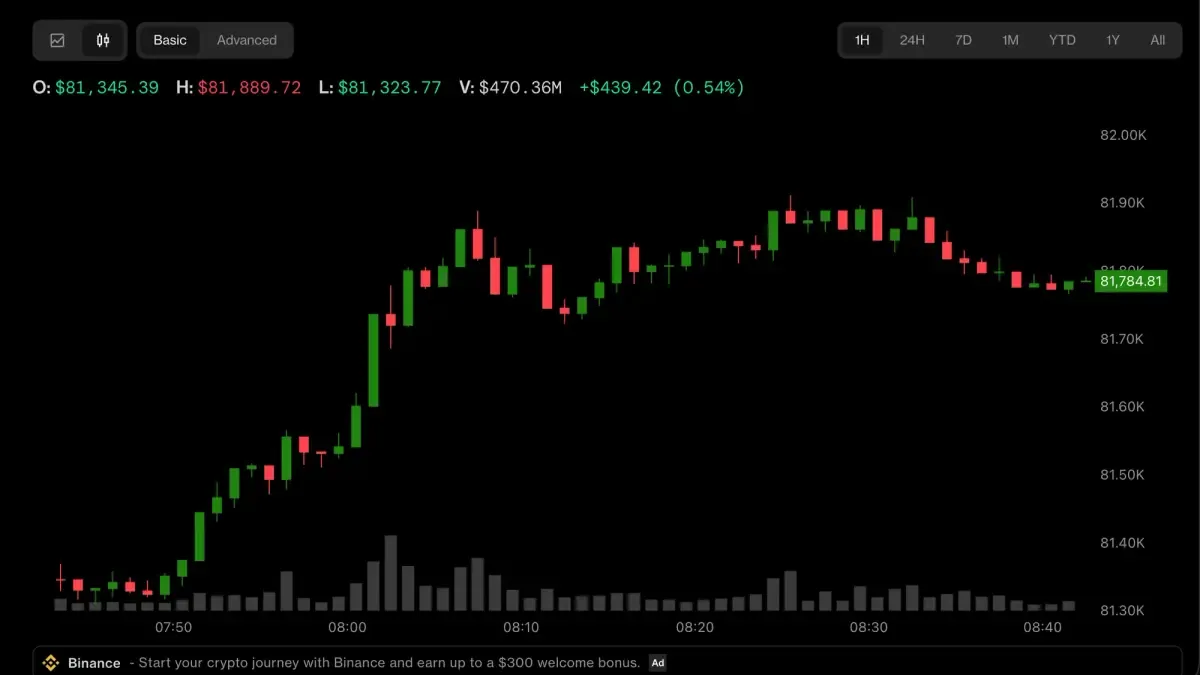
Bitcoin, gold trim early losses as yen gives up gains. Oil stays near $100
Skip to main contentCrypto NewsOct 22, 2026, 11:13 p.m. EDT2 min readBitcoin's price bounce. (CoinDesk)SummaryBitcoin recovered to nearly $82,000 during Asian trading Friday as gold, Asian stocks and Nasdaq futures rebounded while the Japanese yen surrendered early gains. About $435 million in cryptocurrency futures positions were liquidated over 24 hours, including $385 million in bullish bets, as bitcoin tested its 50-day moving average. Persistently high oil prices and weak demand for spot bitcoin exchange-traded funds, which recorded $381 million in outflows Thursday, could limit a broader rally in risk assets. Bitcoin BTC$84,459.46 and gold (XAU) pared losses during Friday’s Asian hours alongside a recovery in stocks as the Japanese yen gave up early gains. The largest cryptocurrency by market value recovered to nearly $82,000 after hitting lows below $81,000 overnight, according to CoinDesk data. At the time of writing, bitcoin was testing its 50-day simple moving average, a widely followed gauge of near-term market momentum. Other cryptocurrencies, such as ether ETH$2,490.55, XRP (XRP), solana (SOL), and dogecoin DOGE$0.08295 saw similar moves.

B.C. online furniture retailer Cymax, once a COVID winner, is shutting down
Burnaby-based furniture seller lays off 135 employees, set to file for receivership

Switzerland approves first spot Bitcoin ETF for retail investors
BIT Asset Management’s Bitcoin Fund ETF is expected to begin trading on SIX Swiss Exchange in November, with its public offering restricted to Switzerland. Switzerland’s financial regulator FINMA has approved the first Swiss-law exchange-traded fund allowing retail investors to gain direct exposure to Bitcoin. On Thursday, BIT Asset Management said its Bitcoin Fund ETF (BBIT) is expected to begin trading on SIX Swiss Exchange in November. The fund holds Bitcoin directly and is approved for public offering in Switzerland only. “Most bitcoin products listed in Europe today are exchange-traded products (ETPs), which are debt instruments that carry issuer risk,” said BIT Asset Management. The Bitcoin Fund ETF is instead a Swiss collective investment scheme, where assets are held separately from those of the fund management company and are “ring-fenced” for investors, it said. The fund falls under Switzerland’s “other funds for alternative investments” category with particular risk. FINMA noted that other fund providers have also submitted applications for Bitcoin ETFs.
0 comments
No comments yet. Be the first to share your thoughts!