mRNA vaccines hold promise for many diseases. Now the tech is under fire - Science News
This story deserves to be shared
Send it to someone who'd care, or post it on your networks.
This article is an excerpt. To read the full content, visit the original source. Science News
Related articles

Here’s what the first mRNA flu vaccine could mean for flu season - Science News
Moderna’s mFlusiva uses the same technology as COVID-19 vaccines Moderna’s mFlusiva, a flu vaccine approved for use in people age 50 and older, uses the same technology as COVID-19 vaccines.

MIT’s paper-thin robot swims with power from living cells - Tech Explorist
New aquabot offers a way to design small, efficient “biohybrid” robots. Continue reading MIT’s paper-thin robot swims with power from living cells on Tech Explorist .

Medusa's eye, Halloween fireballs and more: 5 skywatching targets to look out for this spooky season - Space
Five spooky skywatching targets perfect for naked eye stargazing this Halloween!

Scientists Capture Remarkable Coral Recovery in Stunning Images - Scubaverse
s reveals how a severely bleached coral can regain its colour, offering a fascinating glimpse into the recovery processes of these vulnerable marine animals. The images, captured over nine weeks by underwater photographer and researcher Danny Collins, document the transformation of a coral from a ghostly white appearance to a rich golden-brown, with its individual polyps becoming increasingly visible.

Inside the Supermassive Debate Over the James Webb Telescope’s ‘Little Red Dots’ - WIRED
Oct 24, 2026 5:00 AMThe Webb telescope sees tiny red dots everywhere. Astronomers can’t agree on what they are, but some believe they may be enormous stars with black holes inside. Courtesy of Mark Belan/Quanta MagazineThe original version of this story appeared in Quanta Magazine. Astronomers built the James Webb Space Telescope to pick up faint light from the first billion years after the Big Bang, a chaotic era when vast swaths of hydrogen and helium gas gathered into the chains of galaxies we see today. Even in the telescope’s first images, astronomers could see a whole zoo of mysterious smears of light. One batch of objects proved especially difficult to interpret. They glowed blindingly bright, emitting red light with long wavelengths and shining as brilliantly as a whole galaxy. They were tiny, spanning just a pixel. And they were everywhere. A couple appear in almost every image Webb takes. In 2023, researchers started calling them “little red dots.” Astronomers have repeatedly pointed Webb toward the little red dots, wringing precious new information from these pixels of light. Initially, researchers thought the dots looked kind of like galaxies.
Miniature Ball Lightning Created in a Lab Could Help Solve a Centuries-Old Mystery - ScienceAlert
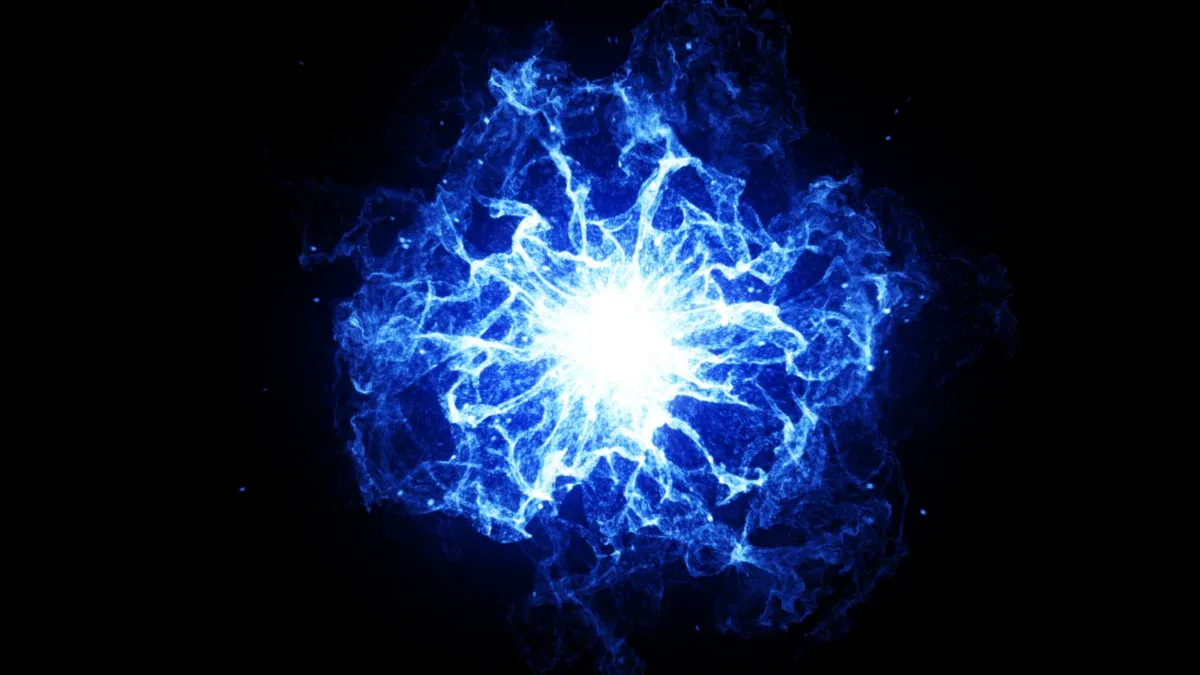
A digital illustration of a ball of electricity. (Vladlen Tian/iStock/Getty Images Plus) When you picture lightning, it tends to be fairly straightforward – a jagged gash of light that splits the sky, disappearing in less time than it takes to blink. But for centuries, a strange picture of a more eerie form has emerged. Thousands of records and eyewitness accounts have told of balls of lightning hovering above the ground before disappearing in a pop like soap bubbles. This fleeting phenomenon is all but impossible to study – and reports vary wildly in descriptions of its size, its hue, and even its behavior, making it one of the most peculiar mysteries in atmospheric science. But if you can't catch ball lightning in a field, physicist Chuliang Zhou and colleagues at the Chinese Academy of Sciences have reasoned, maybe we can learn more by reproducing something like it in a lab. "Here we report the first controlled generation of a macroscopic, long-lived soliton driven by relativistic terahertz electromagnetic fields," the researchers write in a paper published in Nature Photonics.
0 comments
No comments yet. Be the first to share your thoughts!