Meta prepares Muse Confidential VM for private AI work - TestingCatalog AI News
This story deserves to be shared
Send it to someone who'd care, or post it on your networks.
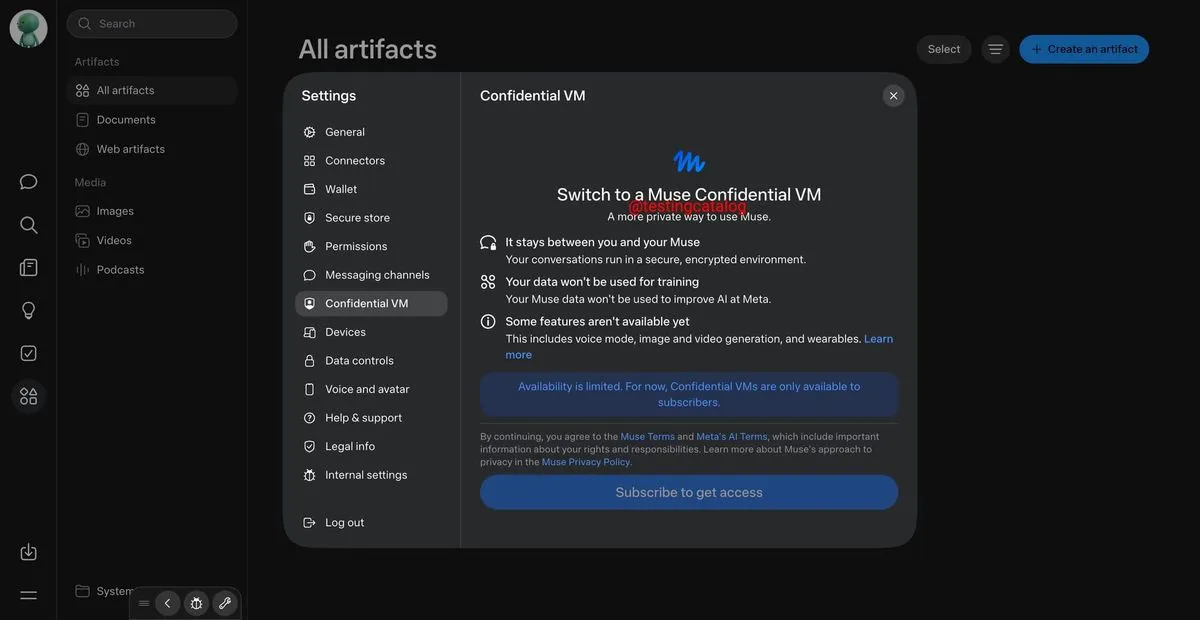
Meta is preparing to introduce Muse Confidential VM, a more private way to use its personal AI agent. The company previously teased the feature, and it is now partially implemented in the web interface. A dedicated settings section will allow users to enable it. According to the notice, conversations will run in a secure, encrypted environment that keeps data private, even from Meta. Conversations and other data processed in this mode will not be used to train Meta’s AI models. Unlike the existing Muse Secure VM, Confidential VM is designed to prevent even Meta from accessing users’ information. Meta previously confirmed plans to launch the technology before the end of 2026. Later this year, Meta will introduce Muse Confidential VM, where the whole VM, including a person’s data and conversations with Muse, is encrypted with a key only they hold, so not even Meta can access it. Private mode will initially have several limitations. Voice mode, image and video generation, and support for wearable devices such as Meta AI glasses and the Muse pin may not be available.
This article is an excerpt. To read the full content, visit the original source. TestingCatalog AI News
Related articles
Meta Extends Confidential Computing to AI Glasses with Private Processing - infoq.com
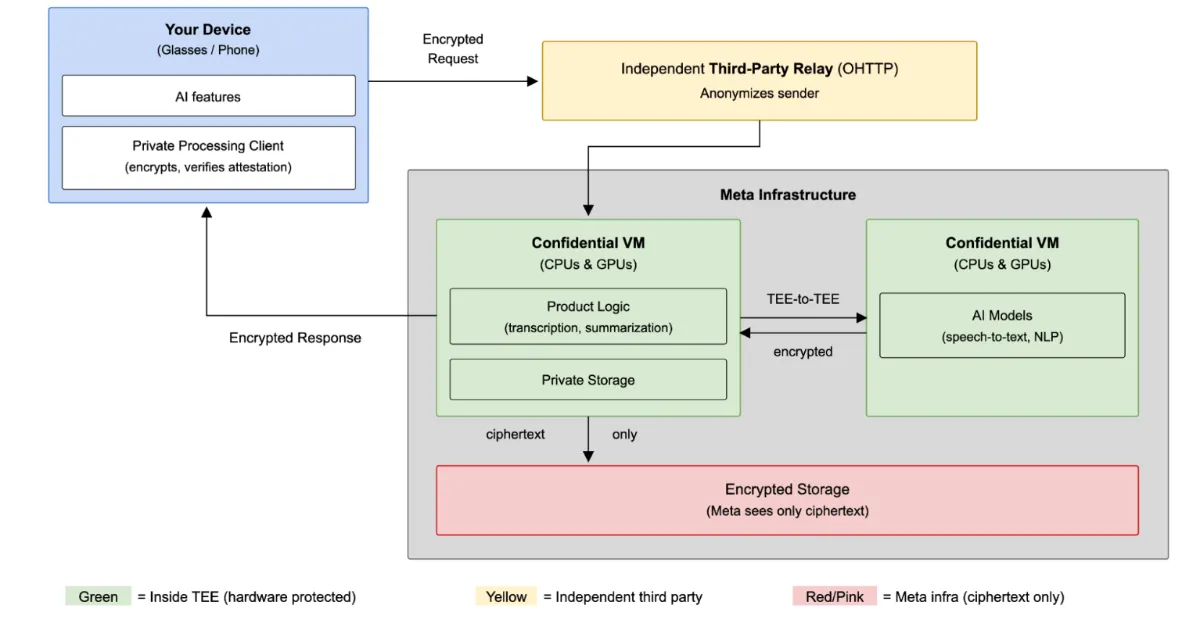
Meta has extended Private Processing to AI glasses, using confidential virtual machines (CVMs) for sensitive AI workloads and persistent user context in the cloud. The design combines Trusted Execution Environment (TEEs), remote attestation, anonymous credentials, OHTTP, and encrypted storage. Meta says it supports streaming transcription, contextual search, and long-term recall requiring more computing and persistent state. Basic interactions, such as calls and messages, can run on the glasses, while more advanced workloads require larger models and access to personal context accumulated over time. Meta introduced Private Processing for WhatsApp and Meta AI in 2025 and is now extending the architecture to wearable AI workloads.

OpenAI fires 3 safety researchers accused of sharing confidential company information: report - Fox Business
Three researchers have been fired from OpenAI after allegedly sharing confidential company information with a third-party AI safety organization, sources told The Wall Street Journal. The three researchers worked on the company's safety team, the Journal reported. "We have parted ways with three individuals for violating our policies on accessing and handling sensitive company information," an OpenAI spokesperson told the outlet. "Our investigation confirmed that these individuals mishandled sensitive information outside established company procedures, violating our policies and breaking the trust essential to our work," the spokesperson added. TRUMP SIGNS EXECUTIVE ORDER REBRANDING AI AS 'SUPER INTELLIGENCE' AS TECH TITANS INK SEPARATE SI ACCORD The firings come amid heightened scrutiny of AI safety as OpenAI CEO Sam Altman has publicly warned about the need to keep increasingly powerful artificial intelligence under human control.
0 comments
No comments yet. Be the first to share your thoughts!