Is AI the greatest art heist in history? - The Guardian
This story deserves to be shared
Send it to someone who'd care, or post it on your networks.
This article is an excerpt. To read the full content, visit the original source. The Guardian
Related articles
Frank Lloyd Wright’s Taliesin West Home in Arizona Temporarily Closes After a Man Dies
A a man died of a freak accident on the property on Friday during a walking tour.
After Protests and Riots, Art Basel Readies Paris Show
'The fair is proceeding as planned and final preparations are underway,' a spokesperson said. The post After Protests and Riots, Art Basel Readies Paris Show appeared first on Artnet News .
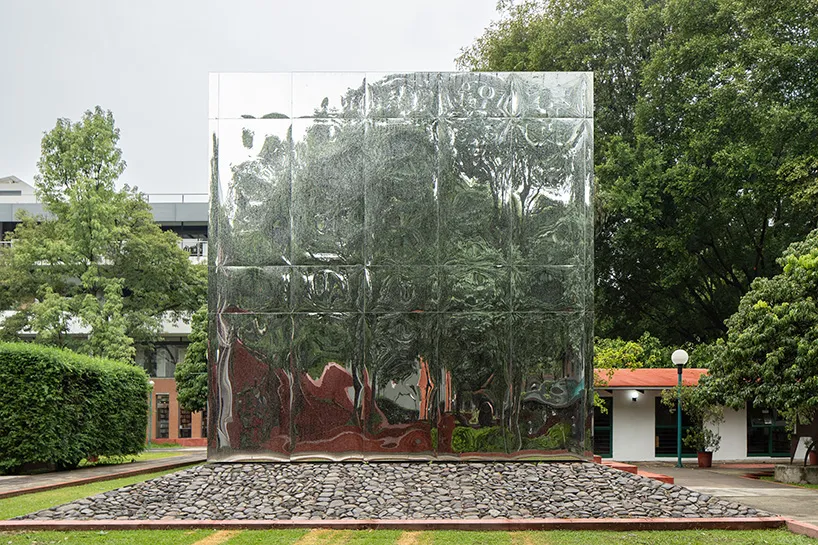
mirrored acrylic skin dissolves cube pavilion into its surroundings in mexico
MIRROR-FINISH ACRYLIC PANELS CONCEAL pavilion IN GUADALAJARADesigned by errre taller, Sfumato is a temporary reflective pavilion that reinterprets the Cubo MEM, a prominent sculptural landmark at the ITESO architecture complex in Guadalajara, Mexico. Selected as the winning proposal for the inaugural Pabellón MEM competition, the project investigates how an existing architectural structure can become visually imperceptible while maintaining its physical footprint.all images ©errre tallerCONCEALED STEEL FRAMING FORMS MONOLITHIC SKYWARD PAVILIONThe intervention by studio errre taller wraps the 6.40 × 6.40-meter cube in a reflective envelope composed of 3 mm mirror-finish acrylic panels. The standard 1.22 × 2.44-meter sheets are combined with 76 cm cut sections to maximize material efficiency while maintaining surface continuity. The panels are attached using double-sided tape and silicone to a light-gauge metal stud-and-track framing system supported by an interior wooden sub-structure fixed to the original PTR steel frame. To preserve the illusion of a monolithic volume, a single access portal is positioned discreetly on the less prominent west face.

Dance Is Not for Us review – desire and defiance as one revolutionary mover sweats it all out
In August 2019, Omar Rajeh sat in his bedroom, listening to the sound of pounding percussion with his world in crisis. In the midst of political instability, Citerne Beirut, a theatre and cultural centre Rajeh had founded in his native Lebanon, was forced to close, dismantled by order of the local government, who planned to build an incinerator on the site. Heartfelt … Omar Rajeh in Dance Is Not for Us. Photograph: Tristram Kenton/the GuardianRajeh tells us that as a teenager, coming of age at the end of the Lebanese civil war, dance had always seemed like the most revolutionary thing he could do. Now here he is, more than three decades later, still dancing – out of frustration, defiance, resistance and a desire to connect. As the percussive score gains momentum, Rajeh’s busy body builds up a sweat. In this danced stream of consciousness, Rajeh is not always an especially elegant mover, but he dances like it’s a necessary thing to do. Part of this year’s Dance Umbrella festival, Dance Is Not for Us is a solo that appears at times like an explosion of physical instinct, but it is mostly calm, considered musings on the nature of choreography, with all its workings exposed.
0 comments
No comments yet. Be the first to share your thoughts!