Graphene just defied a fundamental law of physics - Science Daily
This story deserves to be shared
Send it to someone who'd care, or post it on your networks.
This article is an excerpt. To read the full content, visit the original source. Science Daily
Related articles
Electronic opacity in double bilayer graphene junctions - Nature
We’re sharing this article early to provide faster access to peer-reviewed, accepted research. It is citable and carries a permanent DOI. This version is subject to further edits and will be replaced automatically by the final Version of Record. All legal disclaimers apply. AbstractIn this paper, we examine the transmission probability through a symmetric double bilayer-graphene junction modulated by Fano-type interference. At oblique incidence, two trajectories generated by Fano resonances and a quasi-bound well state are combined to generate perfect Fano interference resulting in null electron transmission. Interestingly, the transmission can be changed between normal and anomalous simply by adjusting the relative phase of the Fano resonances due to the appropriate modulation of the incidence angle, height of potential, and barrier and well width. This phenomenon is similar to electromagnetically induced absorption or to phase control of light propagation in quantum wells via Fano interference.
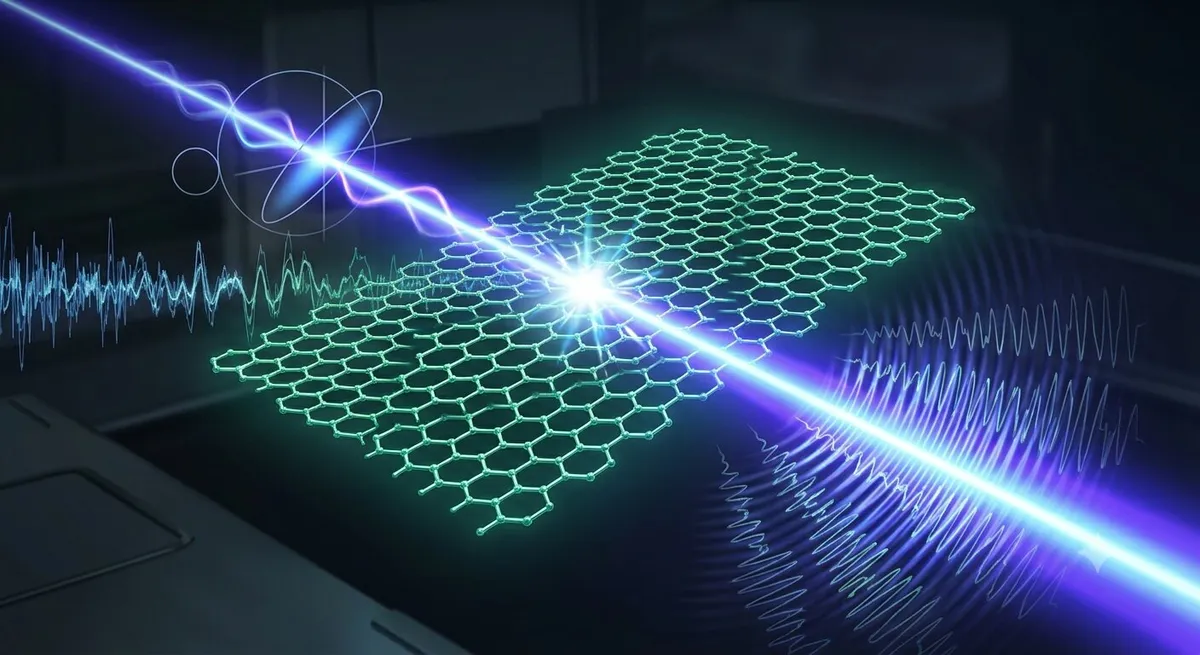
Normally forbidden emissions from graphene could expose quantum fluctuations in incoming light - Phys.org
Voltage fluctuations, light fluctuations, temperature fluctuations—any fluctuations are troublesome and thus undesirable. They don't just cause discomfort; in engineering and medical applications, they affect the accuracy of measurements or introduce errors in controls. Even at the minute level of quantum phenomena, fluctuations are considered undesirable. But what if some fluctuations can be made useful? A theoretical study from the Indian Institute of Technology Bombay (IIT Bombay) shows that structured quantum fluctuations in light can be used to sense and generate useful quantum optical signals.
Tiny wrinkles bend physics to change how electricity moves through graphene - EurekAlert!
image: Researchers have shown that tiny wrinkles in graphene can change the material’s electrical properties. By harnessing this characteristic, scientists may one day control electricity in atomically thin materials — such as graphene — by changing their shape instead of adding new chemicals or materials, potentially powering more responsive sensors and ultrathin electronic devices. UNIVERSITY PARK, Pa. — Tiny wrinkles could reveal new behaviors in graphene, an exceptionally strong, conductive and thin material used in batteries, computer chips and other electronics. According to a new study published in Advanced Materials, small bends in graphene’s two-dimensional (2D), or one-atom-thick, structure can change the material’s electrical properties.
0 comments
No comments yet. Be the first to share your thoughts!