Exclusive: National Gallery meets voluntary redundancy targets - Arts Professional
This story deserves to be shared
Send it to someone who'd care, or post it on your networks.
This article is an excerpt. To read the full content, visit the original source. Arts Professional
Related articles
Surprisingly high redundancy in electronic structure data across materials explained by low intrinsic dimensionality - Nature
AcknowledgementsThe authors thank UCLA's Institute for Digital Research and Education (IDRE), Michigan Technological University's MRI computing clusters, and the National Energy Research Scientific Computing Center (NERSC) for providing computational resources. The authors thank Abhishek Keripale for assistance with the development of later versions of the CrFeCoNi machine-learning models. The authors used GPT-5 (OpenAI) for language editing and proofreading and subsequently reviewed and edited all content. FundingThis work was primarily supported by the U. S. Department of Energy (DOE), Office of Science, Basic Energy Sciences (BES), under Award DE-SC0023432, which provided primary support for the overall project conception and integrated KS-DFT–ML investigations. The University of California National Laboratory Fees Research Program under Grant L25CR9003 supported data generation and post-processing at UCLA (ASB). The National Science Foundation under Award 2442313 supported data-pruning and dimensionality analyses at Michigan Technological University (SG, SH). This research also used resources of the National Energy Research Scientific Computing Center (NERSC), a U. S.

Patient-Owned Health Data Model Reduces Clinical Trial Recruitment Redundancy - The Clinical Trial Vanguard
The same patient, identified and re-consented for the third or fourth time across separate studies, is not an edge case. It is how clinical research is currently structured, and the inefficiency is measurable: every redundant records request, re-registration, and repeat consent conversation adds cost to the sponsor and time to a patient already managing a demanding diagnosis. The case building around patient-owned health data argues that the architecture itself is the problem, not the execution. The traditional model treats each protocol as a discrete relationship. A trial opens, participants are found, data flows inward, and the relationship ends. But sponsors rarely stop needing evidence from the same populations once a study closes. Observational work, real-world outcomes, label extensions, and post-market commitments all draw on the same patient groups, rebuilt from scratch each time. What the patient-owned model proposes instead is a single consented relationship that persists across those activities, turning what was an episodic research interaction into ongoing infrastructure.
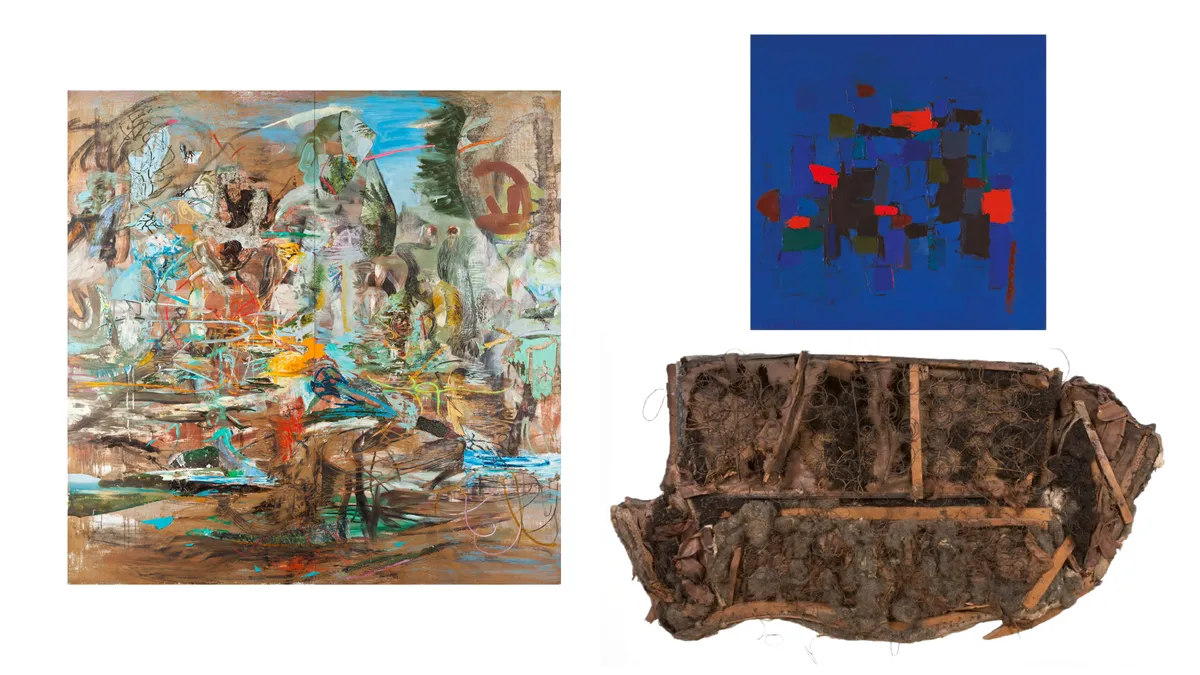
Diasporican Abstraction: A Cross-Border Cartography of Puerto Rican Abstraction
More than sixty artists explore migration, memory, and identity in this survey of Puerto Rican abstraction across and beyond the archipelago. Left: Raphael Collazo, “Arcana Mundi (Mysteries of the World)", 1985; Top right: Olga Albizu, “Blue Oil”, 1974; Bottom right: Raphael Montañez Ortíz, “Archaeological Find #22: The Aftermath”, 1961

Smiles Meyer Queers “The Last Supper”
The Los Angeles-based photographer, who was raised in a conservative Catholic environment, is reclaiming the divinity of queer and trans identity through religious imagery. The First Gathering (2024), with Smiles Meyer as creative director; Kaley Azambuja as stylist; Scout Nankin as intimacy coordinator/movement director; @hot_at_the_party as makeup artist; Betty Connolly as photo/lighting assistant; and models from left to right: Alena, Teague, Joey, JA, Mia, Jules, Annalise, Kat, Bamby, Mars, Chloe, Zaphir, and Lena (all images courtesy Smiles Meyer)
Louvre Blocked as Fallout from a Weekend of Unrest Continues to Shake France
Protesters blocked the Louvre Monday as fallout from a weekend of unrest continues to shake France.
0 comments
No comments yet. Be the first to share your thoughts!