Examining public acceptance intentions for government digital human through expectation confirmation and technology acceptance models - Nature
This story deserves to be shared
Send it to someone who'd care, or post it on your networks.
This article is an excerpt. To read the full content, visit the original source. Nature
Related articles

[Talk] ML Tlachac — Bots and Bias: Technology Acceptance and Digital Depression Datasets - The University of Rhode Island
AbstractAs AI chatbots are increasingly being used in education contexts and digital modalities are increasingly being used in depression assessment research, it is important to understand human perspectives and bias. My research started in two main areas: exploring AI chatbot acceptability at Bryant University and comparing digital depression assessment datasets. For the former research area, we surveyed faculty, staff, and students about their AI chatbot use and perceptions at the end of 2023 and 2025. While usage increased over the two years, support of AI chatbots in education remained relatively consistent. For the latter research area, we identified observational datasets for depression assessment collected by smartphones (n=80), wearable technology (n=80), and cameras (n=63). Women comprised the majority of participants across all three modalities, with patients less frequently recruited for smartphone datasets and the elderly more frequently recruited for wearable technology datasets. Missing dataset details were prevalent, raising concerns regarding the ability to assess the bias and generalizability of models constructed on these datasets.
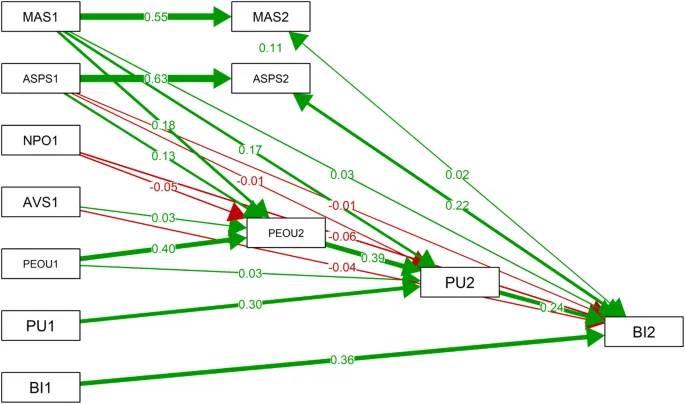
Cross-time associations among technology acceptance, disability-related attitudes, and social problem-solving in university students with learning disabilities | Scientific Reports - Nature
IntroductionLearning disabilities (LD) are a group of neurobiologically based disorders characterized by persistent problems in reading, writing, and mathematical reasoning. These conditions are not intellectual disabilities, sensory impairments, or inadequate instruction1,2,3. Higher education places qualitatively different demands on students with LD than in primary and secondary school, with a significant increase in the need for independent self-regulation, adaptive technology use, and interpersonal problem solving1,4. The transition to university is widely recognized as a time of increased vulnerability for this group, during which poor institutional support and strongly held negative attitudes, both self-directed and societal, can compound academic difficulties and threaten psychological well-being5. In the Saudi Arabian higher education system, students with LD face challenges that are shaped not only by neuropsychological factors but also by cultural, linguistic, and structural contexts that differ markedly from those in Western settings where the bulk of the empirical literature has been developed6.
0 comments
No comments yet. Be the first to share your thoughts!