Ether ETF outflows continue, pass $1B in October so far
This story deserves to be shared
Send it to someone who'd care, or post it on your networks.

US spot Ether ETFs have shed $1.08 billion so far in October, the biggest monthly outflow of 2026, while Bitcoin ETF inflows slowed after Monday’s spike. The cash drain from US spot Ether exchange-traded funds (ETFs) rolled on as the funds surpassed $1 billion in withdrawals so far in October. Ether ETFs net outflows totalled $1.08 billion since the start of October after adding $26 million on Tuesday, according to SoSoValue data. The month’s withdrawals erased September’s $832 million in net inflows, leaving year-to-date net inflows at approximately $485 million. October has already recorded the largest monthly net outflow since November 2025, with eight trading sessions still to go. Monthly flows in US spot Ether ETFs. Source: SoSoValueThe outflows coincided with Ether’s 9.7% slide in October, from $2,700 to $2,438 at publication. ETH was down nearly 18% throughout 2026, according to CoinGecko. Meanwhile, Bitcoin ETFs recorded $23 million in net inflows on Tuesday, adding to $527 million on Monday. US spot Bitcoin ETFs have recorded about $67 million in net outflows in October, leaving net inflows for the year at roughly $809 million, according to SoSoValue.
This article is an excerpt. To read the full content, visit the original source. Cointelegraph
Related articles

Bitcoin, Ether ETFs shed $549M as October ETH outflows near $1B
US spot Bitcoin and Ether exchange-traded funds (ETFs) saw $549 million in net outflows last week as investors continued pulling money from two of the largest crypto funds. Bitcoin ETFs recorded around $229 million in weekly net outflows, while Ether funds posted even higher withdrawals at $320 million, according to SoSoValue data. The latest withdrawals marked a second consecutive week of losses for Bitcoin ETFs and a third for Ether funds. Outflows slowed from the previous week, when the two recorded $1.22 billion in net outflows. Spot Ether ETFs have recorded roughly $955 million in net outflows so far in October, more than in any other month this year. Monthly flows in spot Ether ETFs. Source: SoSoValueEther (ETH) fell 5% over the past seven days to around $2,433, while Bitcoin dipped 1.3% to $82,783 at the time of publication, according to CoinGecko data. Despite the withdrawals, both Bitcoin and Ether ETFs remain in positive territory for 2026, with Bitcoin ETFs attracting roughly $259 million in net inflows year-to-date and Ether ETFs drawing about $610 million.

Drift exploiter sends $109M in Ether to Tornado Cash in 2 days
Wallets linked to the $295 million April hack still held $138 million in Ether after sending another $46 million to the mixer Wednesday. A Drift exploiter-linked wallet transferred 18,800 Ether, worth about $46 million, to Tornado Cash on Wednesday. The exploiter transferred $61 million in Ether to the crypto mixer on Tuesday, taking its two-day total to 44,510 ETH, or $109 million, as blockchain data tracker Onchain Lens said on X. The transfers to Tornado Cash make the funds harder to trace and represent nearly 37% of the $295 million stolen from decentralized exchange (DEX) Drift in April. The attack ranks as this year’s third-largest crypto hack, according to DefiLlama. The Drift exploiter-labelled wallets still held 56,569 Ether, worth roughly $138 million after Wednesday’s flurry of transfers, Arkham data shows. The Solana-based DEX reported about $295 million in losses from the April 1 hack, which its security consultant Mandiant attributed to a North Korean threat group. Drift opened claims and redemptions for DFX recovery tokens on Oct. 1, giving affected users a claim on a pool that launched with about $3.1 million and receives exchange revenue and recovered funds.
Crypto rises with Asian tech stocks, zcash extends gain after setting upgrade date
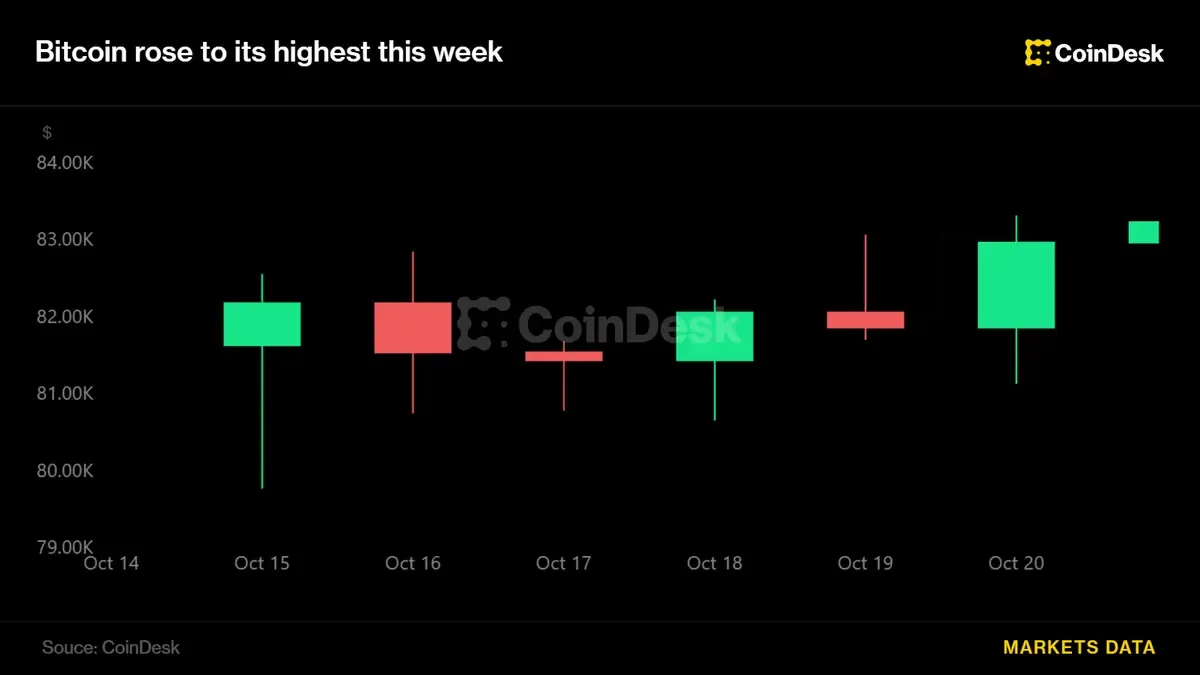
Oct 21, 2026, 6:34 a.m. EDT4 min read(CoinDesk)SummaryBitcoin rose to around $83,500, up 0.6% since midnight UTC and its highest level in a week, as an earnings-led rebound in Asian technology stocks lifted risk assets. SpaceX and Tesla formed special committees to discuss a merger that would combine more than 30,000 bitcoin, while South Korea’s Kospi index rose 3.29% and Nasdaq 100 futures gained 0.44%. Near led the CoinDesk 100 Index with a 6.0% gain, while zcash extended a jump of about 11% over the past day after developers set a November date for the privacy-focused blockchain’s upgrade. Bitcoin BTC$83,384.26 reached its highest level in a week on Wednesday, trading around $83,500 and adding 0.6% since midnight UTC, as an earnings-led rebound in Asian technology stocks lifted risk assets. SpaceX SPCX and Super Micro Computer (SMCI) set the tone with strong results on Tuesday in the U. S. South Korea’s Kospi advanced 3.29% and Nasdaq 100 futures rose 0.44%. Elon Musk, CEO of SpaceX and Tesla TSLA, said the two companies have formed special committees to discuss a merger, which would combine more than 30,000 bitcoin ($2.5 billion) held on their balance sheets.
Live updates: Bitcoin clings to $82,500 as SpaceX results lift stock futures
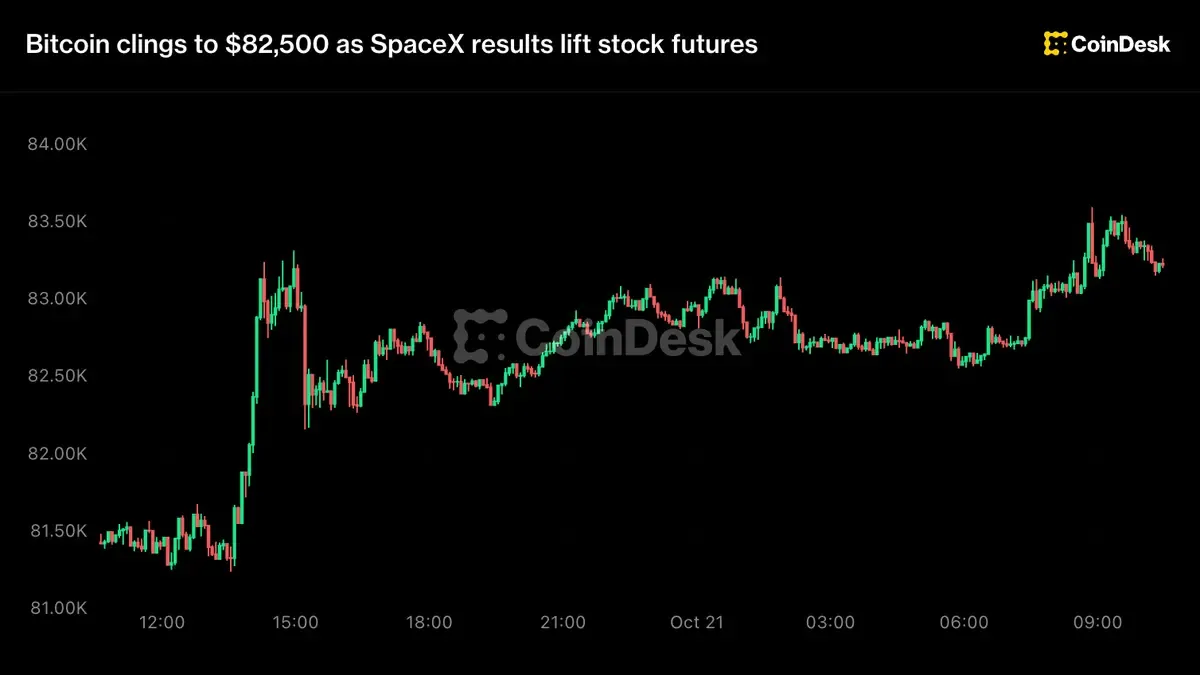
Bitcoin is hanging just above $82,500 on Wednesday, the level XS.com’s Simon-Peter Massabni calls its most important support, as stock futures climbed on SpaceX’s blowout results and oil pushed back above $110. Bitcoin’s fate is tied to tech again. It fell in lockstep with the Nasdaq last week after the hot U. S. inflation report and a selloff in AI and chip stocks, and Massabni, XS.com’s head of business development, said that link is getting stronger. “In the short term, this development challenges the notion that Bitcoin can consistently serve as an independent safe haven from traditional market volatility,” he said. A “decisive and sustained break” below $82,500 could hand control to sellers and expose bitcoin to a drop toward $70,000, Massabni said. That’s the downside case laid out by market maker Wintermute, and it would mean a further 15% slide from here. Tech gave bitcoin some cover on Wednesday. Nasdaq 100 futures rose 0.4% and S&P 500 futures 0.2%.

Business Brief: B.C’s financial reckoning
Good morning. The future of one Western province has become, for now, a little more certain. The spotlight turns next to the path British Columbia will choose in a high-stakes election this weekend. In focus today, we look at the fiscal reckoning that awaits the winner. Up firstIn the newsManufacturing: Trump walks back his threat to ban Bombardier sales in the U. S. Tech: Shopify chief technology officer Mikhail Parakhin leaves after two years. Health care: Grifols reopening two Canada locations after a series of health inspections spurred a two-month pause. Resources: Alberta’s agricultural sector embraces referendum result, but fears Ottawa will return to old habits. Open this photo in gallery:A paddleboarder off Kitsilano Beach, beneath low clouds over Vancouver’s North Shore mountains. DARRYL DYCK/The Globe and MailIn focusHow B. C.’s picture became so cloudyRegardless of which party comes out on top in this weekend’s election, the next government faces the grinding task of putting the province’s troubled fiscal house back in order. Over the last four years, under Premier David Eby’s New Democratic Party, the B. C.

Shinhan, SBI make Japan-Korea tourist spending a test case for yen stablecoins
The companies will assess safeguards for travelers and whether stablecoins can speed up trade settlement between South Korea and Japan. South Korea’s Shinhan Card announced Wednesday that it signed an agreement with Japan’s SBI VC Trade and SBI XDC Network APAC to test yen stablecoin payments for travelers and cross-border trade settlement. Under the pact signed Tuesday, the companies will test stablecoin card payments, wallet-to-wallet payments and cross-border trade settlement. They will also assess anti-money-laundering and fraud-detection controls. Shinhan Card is one of South Korea’s biggest credit card companies. SBI is a Japanese financial heavyweight that runs banks, brokerages, insurers and crypto exchanges. The latest initiative is intended to support cross-border payments and settlement between the East Asian nations and improve payment convenience for travelers. Travel between the two countries generated more than 10 million visitor arrivals in the first eight months of 2026, according to official tourism figures from both countries. South Korea was Japan’s largest source of foreign visitors with 7.42 million arrivals.
0 comments
No comments yet. Be the first to share your thoughts!