DiffSyn: a generative diffusion approach to materials synthesis planning - Nature
This story deserves to be shared
Send it to someone who'd care, or post it on your networks.
This article is an excerpt. To read the full content, visit the original source. Nature
Related articles

Straightforward on-demand synthesis of heteroleptic silanes - Nature
The stepwise installation of carbon substituents at silicon starting from tetrachlorosilane or tetraalkoxysilanes is burdened by chemoselectivity issues, typically affording product mixtures. Now, monoselective bromination of multihydrosilanes followed by nucleophilic displacement opens the door to the programmable and reliable synthesis of functionalized silicon building blocks. This is a preview of subscription content, access via your institution
AI × 2D material growth: Integrated pipeline for process optimization, custom synthesis and mechanism decoding - EurekAlert! Science News Releases
image: Three modules in the data-knowledge dual driven ML framework are included parameter optimization, customized synthesis, and mechanism deciphering. Machine learning (ML) is transforming the research paradigm of materials science. As a mathematical tool adept at solving high-dimensional problems, it enables efficient process optimization, on-demand customized synthesis and quantitative interpretation of multifactorial growth mechanisms. While numerous ML-assisted strategies have been developed, including active learning loops, supervised-learning workflows and transformer-based language models for functional material design and process optimization, existing ML applications in synthesis remain fragmented, lacking a holistic framework that integrates process optimization, customized synthesis, and multifactorial mechanism deciphering, especially under data scarcity.
Prioritizing Quality Before Synthesis in Paleoenvironmental Hazard Science - Eos
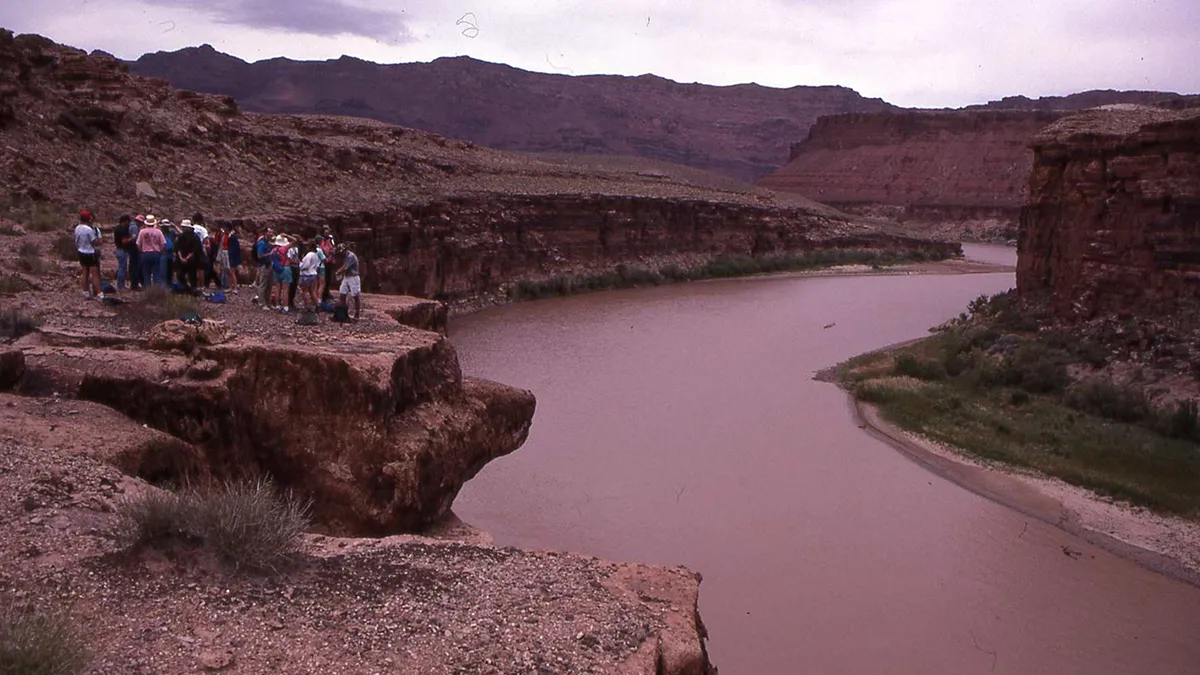
In May 1992, a group of scientists gathered at the edge of Marble Canyon in northern Arizona, where the Colorado River has cut into Permian sandstone to form cliffs that rise hundreds of feet above the water. The occasion was the First International Workshop on Paleoflood Hydrology, organized by Vic Baker of the University of Arizona. For Baker and his colleagues, the canyon walls were not just scenery. They were a kind of archive. Here, sediment deposits mark the high-water lines of floods that surged through the canyon centuries before any stream gauges were there to measure them. In particular, Baker and his colleagues studied slackwater deposits, fine-grained sediments emplaced by floodwaters in sheltered alcoves and tributary mouths.
0 comments
No comments yet. Be the first to share your thoughts!