De novo design of lipopeptides with antimicrobial potency enabled by a chain-as-prompt deep learning framework - Nature
We’re sharing this article early to provide faster access to peer-reviewed, accepted research. It is citable and carries a permanent DOI. This version is subject to further edits and will be replaced automatically by the final Version of Record. All legal disclaimers apply.
AbstractAntimicrobial lipopeptides (AMLPs) represent a promising solution to global antibiotic crisis, yet their precision design remains challenging due to the inability of current computational models to account for N-terminal fatty acid modification. Here we develop a deep learning-driven AMLP model for de novo design of AMLPs by integrating a chain-as-prompt mechanism with domain-adaptive transfer learning, effectively bridging the representation gap between peptide sequence and lipid-induced bioactivity. Using the AMLP model, 2657 evolutionarily selected RiPP-derived core peptide sequences from 96,911 bacterial genomes are inspiringly designed for virtual lipidation with seven N-terminal fatty acid chains (C6–C18) followed by predictive screening, generating 6197 candidate sequences.
This article is an excerpt. To read the full content, visit the original source. Nature
Related articles
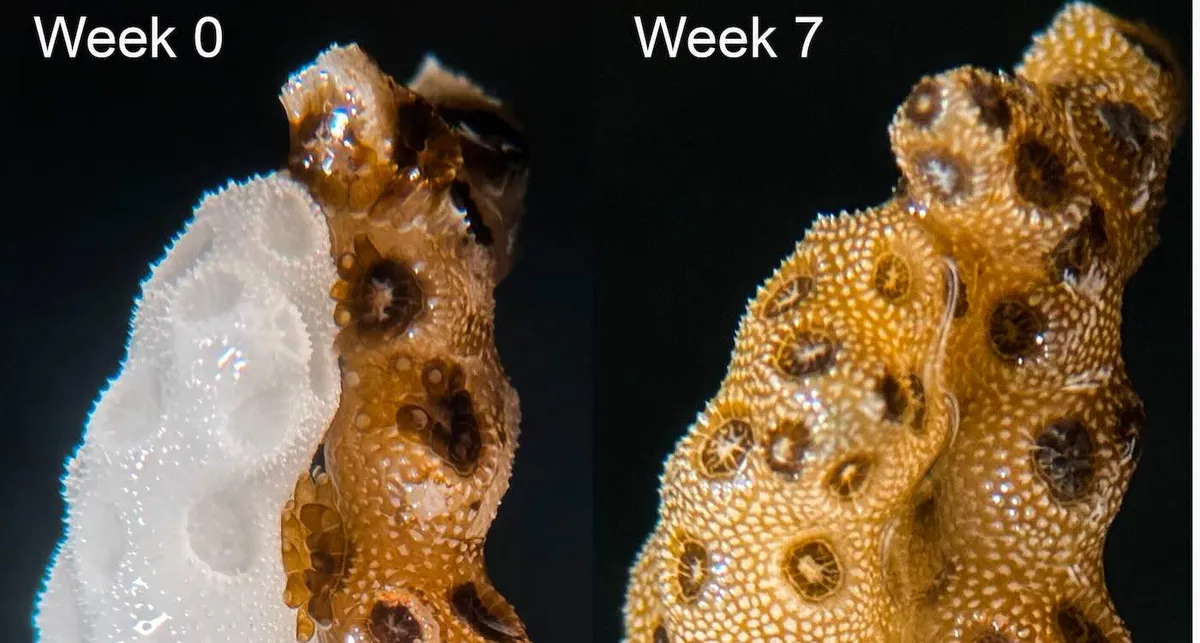
Coral Bleaching Reversed at Record Speed Using New Stanford Method: ‘Not a Lost Cause, at All’ - Good News Network
Coral bleaching restoration at Stanford – by Dan Griffin / GG Films (via SWNS, cropped) Coral bleaching has been reversed at record speed using a new method developed at Stanford University.
Experimental characterization and scaling of flexural rigidity in sewn multilayer structures - Nature
We’re sharing this article early to provide faster access to peer-reviewed, accepted research. It is citable and carries a permanent DOI. This version is subject to further edits and will be replaced automatically by the final Version of Record. All legal disclaimers apply. AbstractSewing is one of the established methods used to fabricate and assemble multilayer insulation (MLI) blankets for aerospace applications, yet the resulting effective flexural behavior remains insufficiently understood. This study investigates the room-temperature, quasi-static flexural behavior of MLI blankets composed of aluminized BoPET radiation shields and polyester net spacers across structural configurations of 2, 6, 12, and 24 layers. A full factorial design was employed to evaluate the influence of the number of layers, stitch density, needle thread tension, and needle foot force. Statistical analyses demonstrated that the number of layers is the dominant factor governing flexural response. Among the sewing parameters, needle thread tension was associated with modifications in bending length, while needle foot force primarily affected local compaction.
0 comments
No comments yet. Be the first to share your thoughts!