Comparative evaluation of unilateral anterior crossbite and monoiodoacetate injection models for temporomandibular joint osteoarthritis in rats - Nature
This story deserves to be shared
Send it to someone who'd care, or post it on your networks.
We’re sharing this article early to provide faster access to peer-reviewed, accepted research. It is citable and carries a permanent DOI. This version is subject to further edits and will be replaced automatically by the final Version of Record. All legal disclaimers apply.
AbstractTo systematically compare unilateral anterior crossbite (UAC) and monosodium iodoacetate (MIA) models for temporomandibular joint osteoarthritis (TMJOA) research. This study used healthy adult male SPF-grade Sprague–Dawley (SD) rats, aged 6–8 weeks and weighing 180–200 g, with a total of 24 rats. After a 7-day acclimatization period, the rats were randomly and equally allocated into three groups: a normal control group (NC), an occlusion intervention group (UAC), and a drug injection group (MIA). Condylar height at the anterior, central, and posterior regions was quantitatively measured via a computer-aided image analysis system to elucidate the observed morphological alterations. Pathological assessments of the TMJ were conducted using Safranin O-Fast Green staining, hematoxylin and eosin (HE) staining, and immunohistochemistry (IHC).
This article is an excerpt. To read the full content, visit the original source. Nature
Related articles

What to know about knee osteoarthritis - Yahoo
In today's health headlines, what to know about knee osteoarthritis, what wearable sensors might tell doctors that an X-ray may not, and what wearable sensors could mean for patient care.
IκB kinase epsilon deficiency attenuates osteoarthritis-associated pain and synovitis with limited cartilage protection in complementary mouse models - Nature
ORCID: orcid.org/0000-0002-3666-39521, Yuki Hyodo1, Ichiro Kurakazu1, Taisuke Uchida1, Ryota Hirose1, Masanari Kuwahara1, Takumi Kita1, Koki Kato1, Li Ziyang1, Gai Eto1 & … Yasuharu Nakashima1 We’re sharing this article early to provide faster access to peer-reviewed, accepted research. It is citable and carries a permanent DOI. This version is subject to further edits and will be replaced automatically by the final Version of Record. All legal disclaimers apply.

Managing Knee Osteoarthritis Across the Lifespan - EMJ
LIFELONG physical activity and targeted strength training preserve joint integrity while reducing overall knee osteoarthritis risk. In young adults between 20 and 30 years of age, articular cartilage maintains peak resilience through dynamic cyclic loading. Walking for 10 minutes stimulates interstitial fluid pressurization and nutrient influx, restoring compressed tissue thickness three times faster than supine rest. However, clinicians must actively counsel young athletes on acute injury prevention. Anterior cruciate ligament ruptures peak before age 25, predisposing nearly half of affected patients to posttraumatic joint degeneration within ten years. Diagnostic vigilance must also account for normal baseline variance. A systematic review of imaging of asymptomatic knees in adults under 40 reveals cartilage defects in 11% and meniscal tears in 4%, demonstrating that incidental structural irregularities do not necessarily warrant clinical alarm.
U of U Health Studies Minimally Invasive Treatment for Knee Osteoarthritis Pain - University of Utah Health
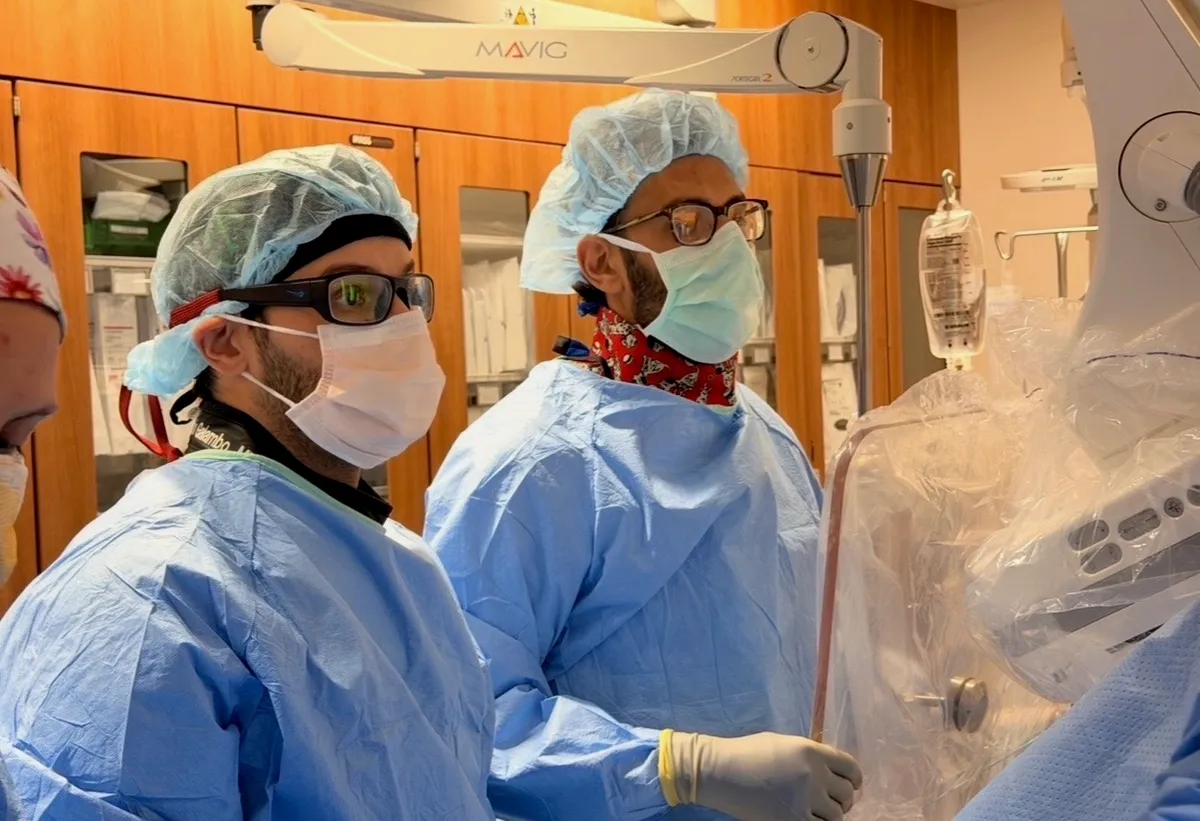
For people living with knee osteoarthritis, pain can make everyday activities like walking, climbing stairs, and exercising increasingly difficult. An estimated 5 million U. S. adults live with symptomatic knee osteoarthritis that doesn’t respond to non-surgical therapies. Treatments such as physical therapy, medications, and injections can help, but when those options no longer provide enough relief, patients may face a difficult decision about what comes next. University of Utah Health is studying an emerging, minimally invasive procedure called genicular artery embolization (GAE) that could offer another option for some of these patients. “For patients with painful knee osteoarthritis who have exhausted conservative treatments and are not good candidates for knee replacement, options can be frustratingly limited,” says Zachary McCormick, MD, a physical medicine and rehabilitation physician at U of U Health and co-investigator on the study. “Genicular artery embolization is an emerging, minimally invasive treatment that may offer meaningful relief for some of these patients.” How Does Genicular Artery Embolization Work?

Retifanlimab Versus Avelumab for Metastatic Merkel Cell Carcinoma: Comparative Analysis Insights - DocWireNews
Results from a recent matching-adjusted indirect comparison (MAIC) analysis indicated clinical favorability of retifanlimab versus avelumab for the treatment of metastatic Merkel cell carcinoma (MCC), which investigators described as “a rare and aggressive skin cancer with poor prognosis and low survival rate. A team of researchers from Italy conducted the study and published their findings in Advances in Therapy. Both retifanlimab and avelumab are classified as monoclonal immune checkpoint inhibitor (ICI) antibodies, and investigators highlighted that both medications are approved for the treatment of metastatic or locally advanced recurrent MCC. They explained that the goal of their research was to assess clinical outcomes of both ICIs via a MAIC analysis of data from the phase 2 POD1UM-201 trial and part B of the phase 2 JAVELIN Merkel 200 trial. Patient data from each trial were used in the analysis, with data from POD1UM-201 informing the retifanlimab group and aggregate data from JAVELIN Merkel 200 informing the avelumab treatment group. Investigators also underscored that the data cutoff of POD1UM-201 was July 2024.
0 comments
No comments yet. Be the first to share your thoughts!