Chinese team invents 1-gram microscope for precise neural detection - Xinhua
This story deserves to be shared
Send it to someone who'd care, or post it on your networks.

A mouse wearing Airscope explores in a habitat built in a laboratory at Tsinghua University in Beijing, capital of China, Oct. 19, 2026. (Xinhua/Wei Mengjia)BEIJING, Oct. 20 (Xinhua) -- Chinese scientists have developed a wireless microscope weighing only 1 gram that can record neural activity in the mouse cerebral cortex with single-cell resolution in natural environments. Named Airscope, the device was developed by a team led by Dai Qionghai, an academician of the Chinese Academy of Engineering and a professor at Tsinghua University, in collaboration with researchers from other institutions. Details of the achievement were published in Nature on Monday. Dai said the microscope provides a new tool for understanding the neural basis of intelligence and will drive optical brain-computer interfaces toward more precise neural detection. Its future applications may expand beyond neuroscience to fields such as immunity and oncology, enabling complete tracking of disease processes, Dai added.
This article is an excerpt. To read the full content, visit the original source. Xinhua
Related articles

China Focus: Chinese team invents 1-gram microscope for precise neural detection - Xinhua
A mouse wearing Airscope explores in a habitat built in a laboratory at Tsinghua University in Beijing, capital of China, Oct. 19, 2026. (Xinhua/Wei Mengjia)BEIJING, Oct. 20 (Xinhua) -- Chinese scientists have developed a wireless microscope weighing only 1 gram that can record neural activity in the mouse cerebral cortex with single-cell resolution in natural environments. Named Airscope, the device was developed by a team led by Dai Qionghai, an academician of the Chinese Academy of Engineering and a professor at Tsinghua University, in collaboration with researchers from other institutions. Details of the achievement were published in Nature on Monday. Dai said the microscope provides a new tool for understanding the neural basis of intelligence and will drive optical brain-computer interfaces toward more precise neural detection. Its future applications may expand beyond neuroscience to fields such as immunity and oncology, enabling complete tracking of disease processes, Dai added.
Oxygen collisions show evidence of jet quenching, a signature of early-universe matter - Phys.org
New results from the STAR experiment at the Relativistic Heavy Ion Collider (RHIC) provide strong evidence that smashing oxygen nuclei together at nearly the speed of light generates a quark-gluon plasma (QGP), a type of matter that existed just after the birth of the universe. The data, just published in Physical Review Letters, show that energetic jets of particles lose energy as they traverse the hot, dense matter left in the collision's wake.
Samara claims NASA contract to demonstrate attitude-control technology - SpaceNews
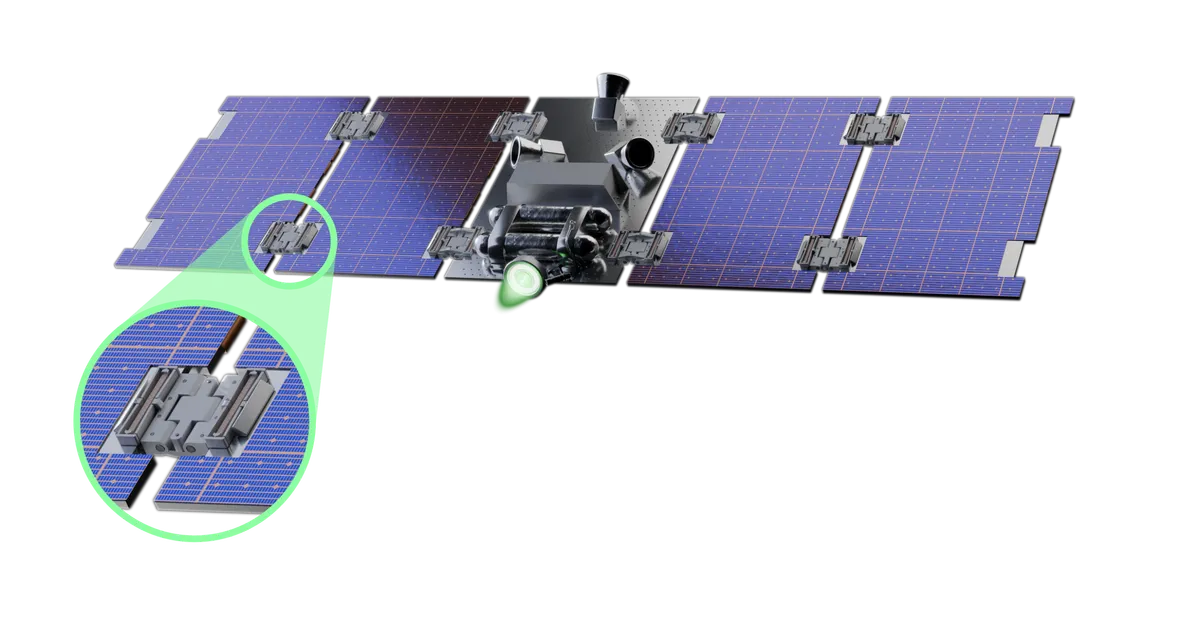
Samara Aerospace is focused on Multifunctional Structures for Attitude Control, technology that includes small piezoelectric actuators in the hinges of deployable solar panels to improve satellite pointing accuracy. Credit: Samara Aerospace SAN FRANCISCO – NASA awarded a $1.3 million contract to Samara Aerospace to demonstrate hardware and software for the company’s attitude-control technology in a laboratory setting.
0 comments
No comments yet. Be the first to share your thoughts!