A pulsar's apparent slowdown reveals a rare stellar trio - Phys.org
This story deserves to be shared
Send it to someone who'd care, or post it on your networks.
Pulsars are rapidly rotating neutron stars, the extremely dense cores left behind when massive stars explode. Astrophysicists have recently observed a pulsar rotating over 300 times per second that appeared to be slowing down unusually quickly.
This article is an excerpt. To read the full content, visit the original source. Phys.org
Related articles
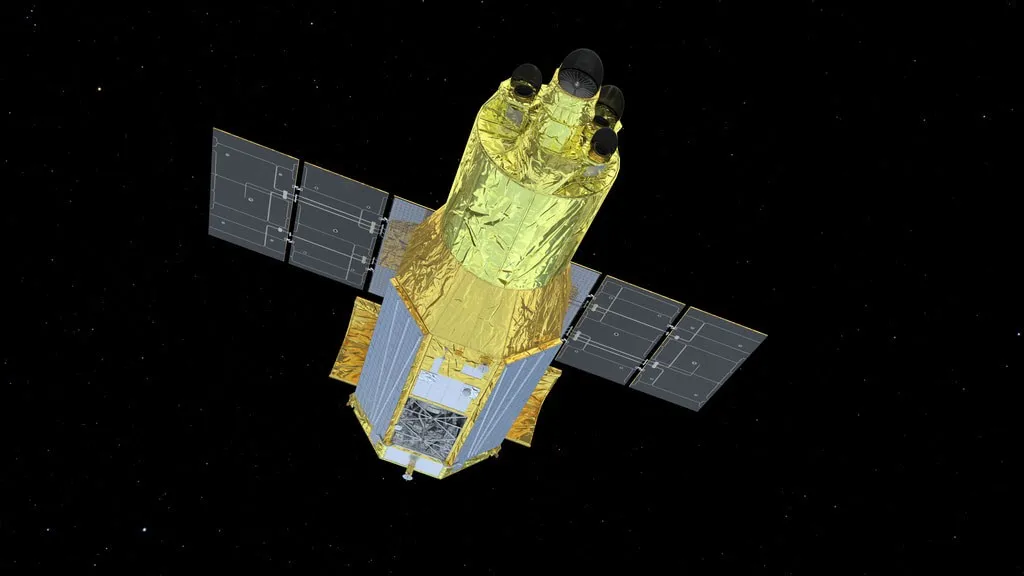
NASA-JAXA XRISM Mission Sees Pulsar Gathering Companion’s ‘Wind’ - NASA Science (.gov)
5 min readFrancis ReddySep 18, 2026 Article Using data from the Japan-led XRISM (X-ray Imaging and Spectroscopy Mission) observatory, astronomers have directly observed a giant star’s outflow, called a stellar wind, being captured by its compact companion and providing the power source for strong X-ray flares. The research is part of NASA’s exploration of the extreme universe to better understand how the cosmos works. “We’ve never before seen clear indications of wind plasma falling onto a compact object,” said Roi Rahin, a researcher at UMBC (University of Maryland, Baltimore County) and NASA’s Goddard Space Flight Center in Greenbelt, Maryland. “We can now test our understanding of these processes in much greater detail.” A paper describing the findings published Friday in the journal Science Advances. The target system is BP Crucis, a high-mass X-ray binary located about 13,000 light-years away in the southern constellation Crux. The primary star, known as Wray 977, is a blue hypergiant about 40 times the Sun’s mass and 60 times its size. It’s so big, hot, and luminous that ionized gas constantly streams away from it, a phenomenon astronomers call a stellar wind.
Custom frame timing captures ultrafast events across five orders of magnitude in time - Phys.org
Most conventional methods of ultrafast photography use evenly spaced intervals in which images are taken, but new developments have shown how much can be left out of the story, especially when multiple timescales are involved.
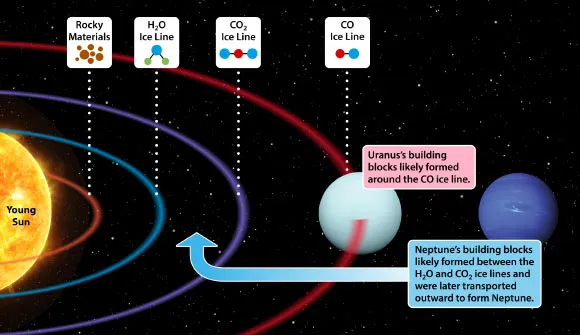
Uranus and Neptune May Have Taken Different Paths to Becoming Ice Giants - Sci.News
Uranus and Neptune are often described as near-twins, but a new study suggests their chemistry, and possibly their histories, may differ more than expected. The materials making up Neptune and Uranus likely came from different regions in the protoplanetary disk around the young Sun. Image credit: SwRI.
0 comments
No comments yet. Be the first to share your thoughts!