A Mechanism for the Generation of Enhanced Fluxes at Discrete Energies on the Wakes of the Galilean Moons - AGU Publications
This story deserves to be shared
Send it to someone who'd care, or post it on your networks.
This article is an excerpt. To read the full content, visit the original source. AGU Publications
Related articles
Multimodal analysis reveals hydrolysis as a shared mechanism in magnetic tape degradation - Nature
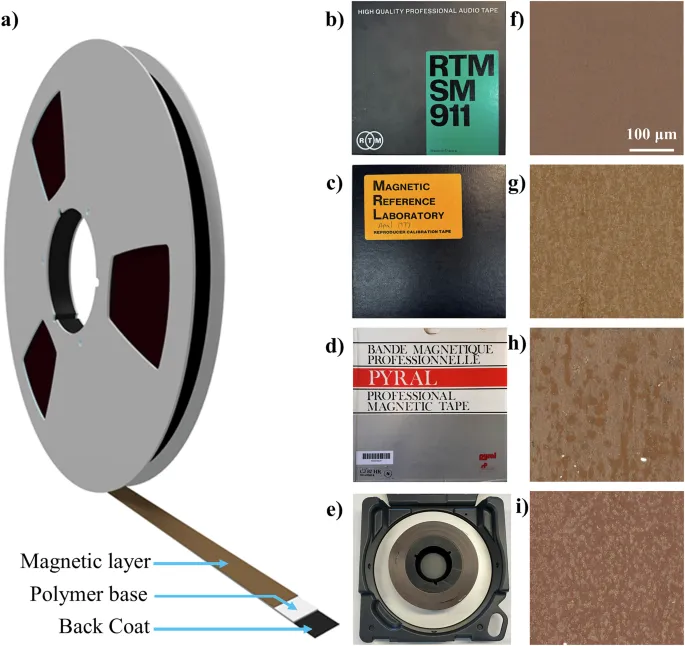
IntroductionMagnetic tape was the dominant medium for professional audio and video recording from the 1950s through the early 2000s and remains a critical carrier of twentieth-century cultural heritage [https://www.iasa-web.org/magnetic-tape-alert-project]. Large archival collections worldwide contain unique recordings stored on magnetic tape. As these tapes age, they suffer from wear and chemical decay that can make them fragile and even unplayable1,2. Magnetic audio tape typically consists of three main layers, shown schematically in (Fig. 1a)2,3,4. The top magnetic layer is made of micron-sized magnetic pigment, most commonly gamma ferric oxide (γ-Fe2O3) but sometimes magnetite (Fe3O4), chromium dioxide (CrO2), and other magnetic materials. These particles are embedded in a polymer binder, typically polyester-polyurethane (PE-PU). This layer can also contain other materials such as lubricants and abrasives. The base layer is typically made of plastic, such as cellulose acetate, polyvinyl chloride (PVC), or polyethylene terephthalate (PET), with the latter being the most common in archived magnetic audio tapes.
AI × 2D material growth: Integrated pipeline for process optimization, custom synthesis and mechanism decoding - EurekAlert! Science News Releases
image: Three modules in the data-knowledge dual driven ML framework are included parameter optimization, customized synthesis, and mechanism deciphering. Machine learning (ML) is transforming the research paradigm of materials science. As a mathematical tool adept at solving high-dimensional problems, it enables efficient process optimization, on-demand customized synthesis and quantitative interpretation of multifactorial growth mechanisms. While numerous ML-assisted strategies have been developed, including active learning loops, supervised-learning workflows and transformer-based language models for functional material design and process optimization, existing ML applications in synthesis remain fragmented, lacking a holistic framework that integrates process optimization, customized synthesis, and multifactorial mechanism deciphering, especially under data scarcity.
Scientists discover new mechanism for bacterial fosfomycin resistance - News-Medical
Bacteria can survive antibiotics in several ways, including by pumping the drugs out of their cells before they can take effect. Researchers at the University of Osaka have discovered a previously unknown mechanism that allows the bacterium responsible for many cases of pneumonia and meningitis to export the antibiotic fosfomycin. The findings reveal how this molecular pump works and could help researchers better understand drug resistance and develop new ways to combat resistant bacteria. The bacterium, Streptococcus pneumoniae, a major cause of pneumonia and meningitis, can develop resistance to antibiotics, yet many of its drug-export systems remain poorly understood. By systematically examining transport proteins in the bacterium, the researchers identified an uncharacterized protein complex, which they named FoeAB. Producing more FoeAB made bacterial cells more resistant to fosfomycin. The team then isolated FoeAB from a related bacterium, Streptococcus thermophilus and placed it in artificial membranes, demonstrating directly that the protein transports fosfomycin.
0 comments
No comments yet. Be the first to share your thoughts!