A large intraplate hydrogen-rich hydrothermal system driven by serpentinization in the western Pacific: Kunlun - Science | AAAS
This story deserves to be shared
Send it to someone who'd care, or post it on your networks.
This article is an excerpt. To read the full content, visit the original source. Science | AAAS
Related articles
Interfacial control and evaporation pinning of nanocapillary filling from ambient to serpentinization temperatures - Nature
We’re sharing this article early to provide faster access to peer-reviewed, accepted research. It is citable and carries a permanent DOI. This version is subject to further edits and will be replaced automatically by the final Version of Record. All legal disclaimers apply. AbstractFluid transport in nanometer-scale channels underlies nanofluidic technologies and geological systems, yet measured capillary filling rates in hydrophilic channels are often far slower than classical theory predicts. Here we show, using a coupled flow model based on classical density functional theory combining hydrodynamics, electrokinetics and capillarity, that electrokinetic resistance and locally elevated viscosity near the channel walls jointly suppress flow, capturing the measured slowdown across independent experiments. At higher temperatures relevant to serpentinization (around 200 degrees Celsius), the model predicts a regime of evaporation-driven pinning: once relative humidity falls below saturation, classical capillary scaling breaks down and evaporation, orders of magnitude faster than at ambient conditions, balances capillary inflow and pins the meniscus inside the channel.
Impact Crater Hydrothermal Systems Support Rapid Microbial Enrichment and Diverse Metabolic Potential - Astrobiology Web
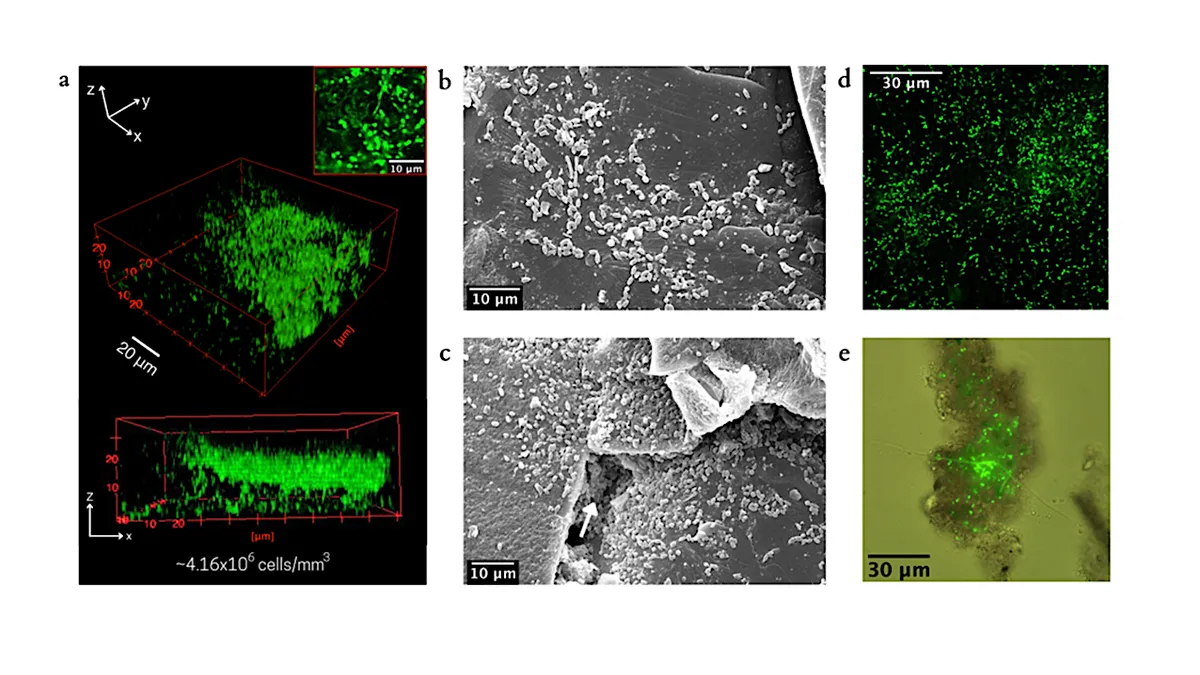
Biofilm formation and microbial habitats in artificial impact hydrothermal system. (a) Red altered surface: Confocal microscopic examination of a biofilm formation on oxidized suevitic surfaces from 60°C showing top down and side-on views of SYBR Gold stained cells. (b, c) Interior of submerged suevite: Scanning electron microscopy of cross sections of suevite from 50°C revealing colonies of endoliths on planes (b) and along grain boundaries (c, white arrow). (d) Interior of submerged suevite: Confocal microscopic examination of a cross section of suevite from 70°C showing SYBR Gold stained endoliths. (e) Sediment grain: Fluorescence microscopy showing SYBR Gold-stained microbes attached to the surfaces of a grain from 50°C, overlayed onto brightfield image. -- Geobiology [Geobiology ] Impact crater hydrothermal systems, formed after asteroid and comet impacts, have been proposed as promising habitats for life on early Earth and as key targets in the search for life on planetary bodies such as Mars, since they provide liquid water and active geochemical turnover.

Scientists discover a hidden switch that burns fat and blocks new fat cells - Science Daily
Scientists have identified a remarkable protein switch that influences whether cells burn fat or store it. Disabling this protein increases fat consumption and interferes with the formation of new fat cells, raising the possibility of a different approach to treating obesity. Subsequent research has strengthened the discovery, revealing that the same protein helps regulate how much energy the body burns. What if one of the keys to fighting obesity lies not in suppressing appetite, but in changing how the body's cells use energy?

Ice sheet expansion may have started 2,000 years ago, but we canceled that - Ars Technica
The tiny remains of the Laurentide Ice Sheet began getting somewhat less tiny. Baffin Island is a good location for ice sheets to spend their retirement.
0 comments
No comments yet. Be the first to share your thoughts!