Targeted pathway mining reveals novel modified hexapeptides from the demiguisin family - Nature
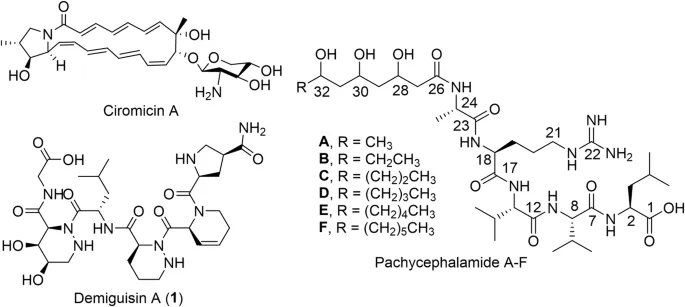
IntroductionBirds rely on a collection of behavioural, physiological, and chemical defences to mitigate the constant threat posed by pathogens and parasites in their environment1. Preen oil from the uropygial gland (UG) is a key component of avian integumentary immunity, supporting feather maintenance and waterproofing, while the UG is also known to harbour diverse microbes, including γ- and α-Pseudomonadota and Actinomycetota, that contribute to feather defense2,3. We recently exemplified a case of the bacterial isolate Amycolatopsis sp. PS_44_ISF1 derived from the UG of the toxic bird Pachycephala schlegelii that can directly contribute to the bird’s chemical defence system, by producing bioactive metabolites such as the antifungal macrolactam ciromicin A3,4, the co-secreted tensioactive lipopeptide family pachycephalamides, and a highly modified hexapeptide, named demiguisin A (1) (Fig. 1). The chemical structure of 1, caught our interest, as it contains non-proteinogenic piperazic acid (hexahydropyridazine-3-carboxylic acid, Piz) residues within the sequence Gly–β,γ-OH-Piz–Leu–Piz–DHPA–γ-c-Pro (Fig. 1)3,5.