The drought is over. Has the water returned? - EurekAlert!
This story deserves to be shared
Send it to someone who'd care, or post it on your networks.
image: Satellite-based assessment of recovery after severe drought in large river basins. (a) Cumulative recovery probability measured from the time of maximum water storage loss. The black curve represents events in all basins, and the red curve represents events in basins with at least one event remaining unrecovered for more than five years. Shaded ribbons indicate uncertainty. (b) Median recovery time among recovered events in each basin. White circles indicate that recovery times differ by more than one year between events. (c) The longest observed period without recovery in each basin through 2025. Squares indicate that another severe drought prolonged the deficit.
The return of rain does not necessarily mean that a river basin has replenished its water reserves. A new satellite-based study shows that recovery after severe drought is widespread across large river basins, but highly uneven. Some recover relatively quickly, while others experience water storage deficits that persist for years.
This article is an excerpt. To read the full content, visit the original source. EurekAlert!
Related articles
With Science Funding Cuts, US Risks Future Talent Drought | Working Knowledge - Harvard Business School
American research institutions have long drawn some of the world’s most promising minds, many of whom go on to power R&D at major US companies. But funding cuts have made US labs less appealing, threatening a critical talent pipeline for potentially a generation. Harvard Business School Professor Raffaella Sadun, who asked early-career scientists about their aspirations both before and after universities began to lose funding in early 2025, says the “uncertainty of the moment” is significantly reshaping their plans: Scientists report being more than 20 percentage points less likely to pursue academia or stay in the United States—and many say they regret pursuing doctoral degrees. “These are not the complaints of established scientists defending their budgets, but rather the stated intentions of the next generation—the scientists who would, in ordinary times, become the principal investigators of the future,” Sadun and her fellow researchers write in the June working paper “Before the Exodus? Young Scientists and the Future of US Science.”What can be disrupted in a single year may take a generation to rebuild.

Simulations explore nuclear mitigation of asteroid threats - Phys.org
Lawrence Livermore National Laboratory researcher Isaiah Santistevan led the development of three-dimensional simulations exploring how a nuclear device could deflect or disrupt an asteroid threatening Earth. Credit: Blaise Douros/LLNL Lawrence Livermore National Laboratory (LLNL) researchers are developing three-dimensional simulations to examine how a nuclear device could be used to deflect or potentially disrupt an asteroid threatening Earth.
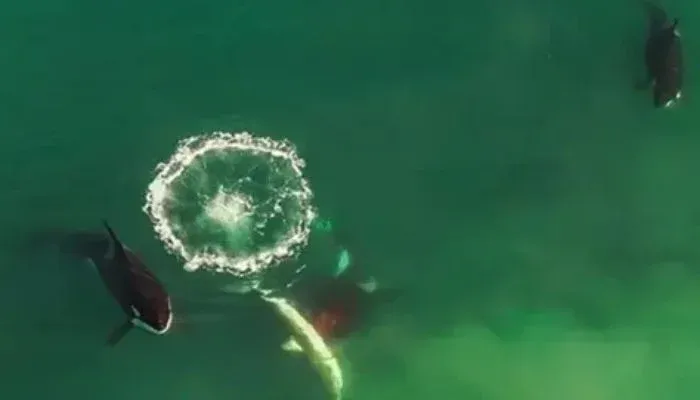
Orcas are hunting great White Sharks around the world, scientists confirm - Geo News
Orcas are hunting great White Sharks around the world, scientists confirmThe killing of great whites by orcas has been reported in the waters of South Africa, California, and Australia, and the implications that the hunting behaviour would have on the marine ecosystem have been considered. In fact, it all started back on May 3, 2017, when the body of a female great white, weighing 1,100 kilograms, washed ashore in Gansbaai, close to Cape Town, with a deep gash through which its 90-kilogram liver had been extracted. Five more corpses of great whites appeared with similar wounds in the coming months, as claimed by shark biologist Alison Towner of Rhodes University. Two adult males, called Port and Starboard, who are supposed to be brothers judging by their dorsal fins that fold differently, were identified as the most probable perpetrators. The connection was officially established in 2022 based on video footage of a drone that caught three orcas chasing and biting a 3-meter great white off Mossel Bay. The sharks quickly disappeared from Dyer Island, one of the best places in the world to witness a great white.

A Black Hole 12,000 Light-Years Away Is Firing a Plasma Jet Toward Earth - Gadget Review
Milky Way’s first microblazar candidate sits 12,000 light-years away, offering a rare ground-level lab for studying relativistic jetsA black hole 12,000 light-years away is firing a jet of plasma almost directly toward Earth. At that distance, no known or expected danger to Earth has been identified by the researchers or the institutions involved. What astronomers have actually found is rarer and more interesting than a threat. Researchers have identified IRAS 18293-0941 as a compelling candidate for the Milky Way’s first microblazar, a class of object that gives astrophysicists a close-up laboratory for studying some of the most violent physics in the galaxy. What Astronomers FoundThe discovery centers on a binary system whose black hole expels plasma jets at close to three-quarters the speed of light, pointed almost directly toward Earth. The system pairs a hot, massive star with a black hole that completes a full orbit roughly every 11.38 days. Material drawn from the companion star feeds the black hole, and some of that matter gets expelled outward as opposing jets traveling at approximately three-quarters the speed of light. Terminology matters here.
0 comments
No comments yet. Be the first to share your thoughts!