B.C. drought forces volunteers to rescue salmon from drying streams - CBC
This story deserves to be shared
Send it to someone who'd care, or post it on your networks.
This article is an excerpt. To read the full content, visit the original source. CBC
Related articles
The drought is over. Has the water returned? - EurekAlert!
image: Satellite-based assessment of recovery after severe drought in large river basins. (a) Cumulative recovery probability measured from the time of maximum water storage loss. The black curve represents events in all basins, and the red curve represents events in basins with at least one event remaining unrecovered for more than five years. Shaded ribbons indicate uncertainty. (b) Median recovery time among recovered events in each basin. White circles indicate that recovery times differ by more than one year between events. (c) The longest observed period without recovery in each basin through 2025. Squares indicate that another severe drought prolonged the deficit. The return of rain does not necessarily mean that a river basin has replenished its water reserves. A new satellite-based study shows that recovery after severe drought is widespread across large river basins, but highly uneven. Some recover relatively quickly, while others experience water storage deficits that persist for years.
With Science Funding Cuts, US Risks Future Talent Drought | Working Knowledge - Harvard Business School
American research institutions have long drawn some of the world’s most promising minds, many of whom go on to power R&D at major US companies. But funding cuts have made US labs less appealing, threatening a critical talent pipeline for potentially a generation. Harvard Business School Professor Raffaella Sadun, who asked early-career scientists about their aspirations both before and after universities began to lose funding in early 2025, says the “uncertainty of the moment” is significantly reshaping their plans: Scientists report being more than 20 percentage points less likely to pursue academia or stay in the United States—and many say they regret pursuing doctoral degrees. “These are not the complaints of established scientists defending their budgets, but rather the stated intentions of the next generation—the scientists who would, in ordinary times, become the principal investigators of the future,” Sadun and her fellow researchers write in the June working paper “Before the Exodus? Young Scientists and the Future of US Science.”What can be disrupted in a single year may take a generation to rebuild.

Ancient mud reveals a surprising secret about Greenland’s ice - Earth.com
Mud from a fjord shows an Atlantic air pattern brought wetter, colder spells to southern Greenland, a clue to how its ice may fare. Greenland’s ice is shrinking as the planet warms. But in the island’s southwest, rainfall and snowfall have been influenced by the same North Atlantic air-pressure pattern for at least 5,000 years. When that pattern tipped one way, the region turned wetter and colder. The record comes from mud on the floor of a Greenland fjord, and it suggests snowfall, not only temperature, shaped how the area’s ice grew and shrank. It doesn’t yet show how glaciers there will respond to the warming ahead. Johan Faust, a researcher at MARUM, the Center for Marine Environmental Sciences at the University of Bremen in Germany, led the work with colleagues in Germany, Norway, Denmark and Canada. A seesaw in the airThe pattern is called the North Atlantic Oscillation. It’s the difference in air pressure between a low that sits near Iceland and a high near the Azores, and it’s strongest in winter. When that difference is large, the pattern is in its positive phase. Northwestern Europe and southwestern Greenland both get more rain and snow.

Simulations explore nuclear mitigation of asteroid threats - Phys.org
Lawrence Livermore National Laboratory researcher Isaiah Santistevan led the development of three-dimensional simulations exploring how a nuclear device could deflect or disrupt an asteroid threatening Earth. Credit: Blaise Douros/LLNL Lawrence Livermore National Laboratory (LLNL) researchers are developing three-dimensional simulations to examine how a nuclear device could be used to deflect or potentially disrupt an asteroid threatening Earth.
A giant asteroid will skim Earth in 2029—and it’s not us who should worry - Futura, le média qui explore le monde
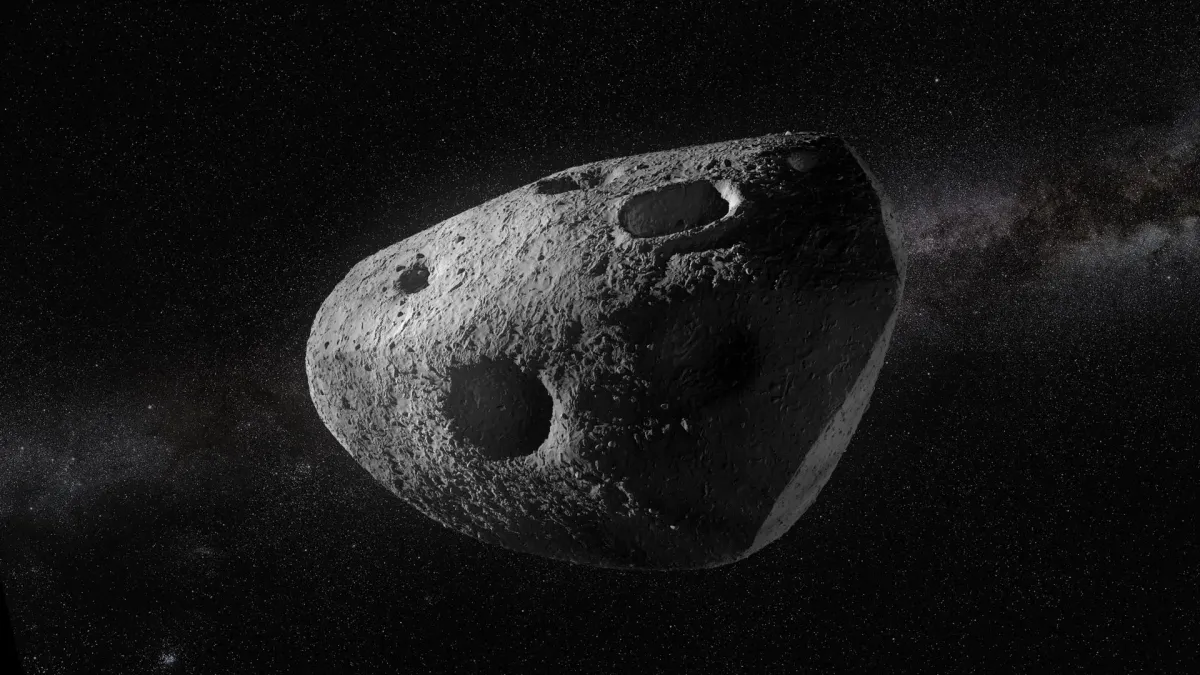
The Futura Team represents the pulse of Futura’s editorial department, bringing together a collective expertise dedicated to the dissemination of scientific knowledge. Rather than the work of a single author, every article published under this signature is the result of a rigorous collaborative process involving journalists, editors, and fact-checkers. Specializing in news analysis via desk research and international wire services, the team focuses on transforming raw information into accessible, verified content. This curation and synthesis process ensures constant monitoring of technological innovations and major scientific breakthroughs. By cross-referencing sources and conducting multiple rounds of peer review, the Futura Team guarantees scientific accuracy and pedagogical clarity. This collective signature serves as a hallmark of trust, providing reactive, cross-disciplinary information at the forefront of current events Normally, when an asteroid swings by Earth, the burning question is simple: “Are we at risk?” Should we prepare for a massive space rock to pancake our planet? Not this time.
0 comments
No comments yet. Be the first to share your thoughts!