Swarming robots to tackle space debris - European Space Agency
This story deserves to be shared
Send it to someone who'd care, or post it on your networks.
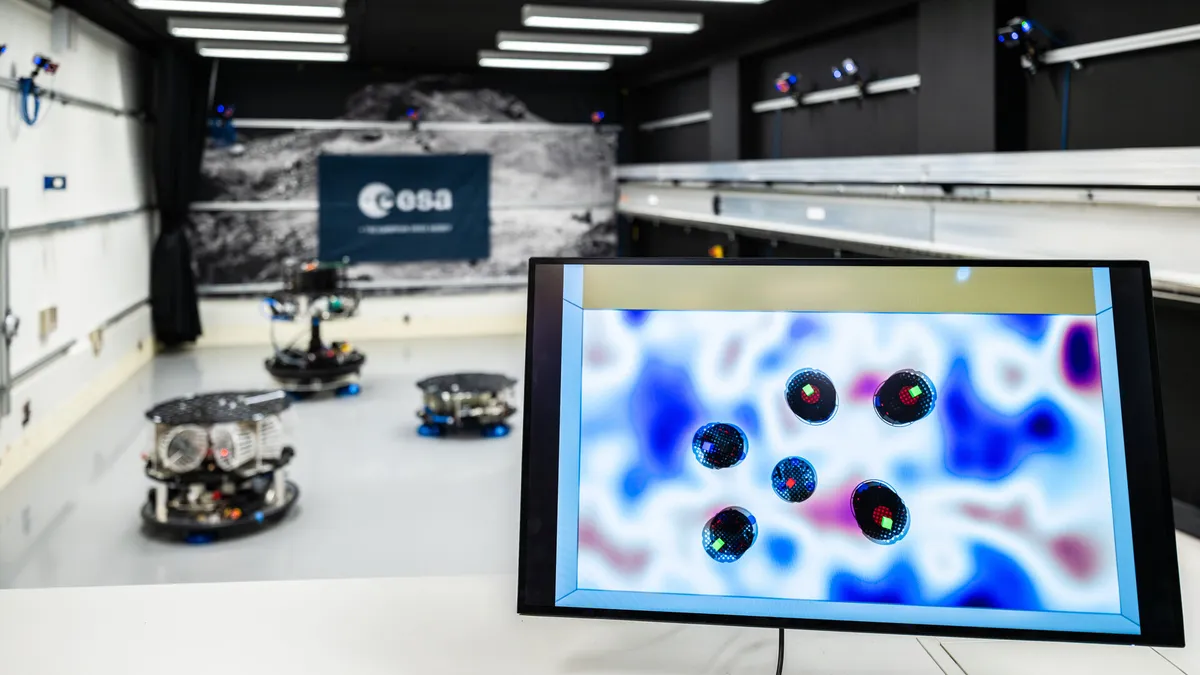
Resembling a brightly coloured artwork, a virtual environment software replicates the real-life setup shown right behind the screen – a group of robotic platforms hovering over an extremely flat floor. While the real setup includes only three objects, the screen displays three more virtual ones alongside them. The minds behind this experiment are part of Star-bots, a student team from the University of Bologna, Italy. They are one of the teams selected for this year’s edition of the ESA Academy Experiments Programme, which gives students access to testing facilities and technical guidance. The Star-bots team’s project tackles the issue of space debris. The number of non-functional objects in space is growing – some are satellites that have reached the end of their lifetime, ran out of fuel, or have collided with others and broke up into smaller pieces. The team’s experiment addresses this by testing how a swarm of autonomous robots could help with active debris removal, a process of cleaning up non-functional objects from space by grabbing onto them and changing their orbit to reenter the atmosphere and burn up.
This article is an excerpt. To read the full content, visit the original source. European Space Agency
Related articles

Simulations explore nuclear mitigation of asteroid threats - Phys.org
Lawrence Livermore National Laboratory researcher Isaiah Santistevan led the development of three-dimensional simulations exploring how a nuclear device could deflect or disrupt an asteroid threatening Earth. Credit: Blaise Douros/LLNL Lawrence Livermore National Laboratory (LLNL) researchers are developing three-dimensional simulations to examine how a nuclear device could be used to deflect or potentially disrupt an asteroid threatening Earth.
A giant asteroid will skim Earth in 2029—and it’s not us who should worry - Futura, le média qui explore le monde
Orcas are hunting great White Sharks around the world, scientists confirm - Geo News
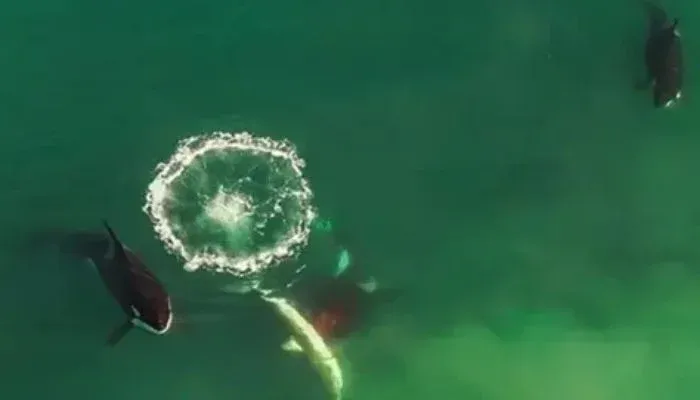
Orcas are hunting great White Sharks around the world, scientists confirmThe killing of great whites by orcas has been reported in the waters of South Africa, California, and Australia, and the implications that the hunting behaviour would have on the marine ecosystem have been considered. In fact, it all started back on May 3, 2017, when the body of a female great white, weighing 1,100 kilograms, washed ashore in Gansbaai, close to Cape Town, with a deep gash through which its 90-kilogram liver had been extracted. Five more corpses of great whites appeared with similar wounds in the coming months, as claimed by shark biologist Alison Towner of Rhodes University. Two adult males, called Port and Starboard, who are supposed to be brothers judging by their dorsal fins that fold differently, were identified as the most probable perpetrators. The connection was officially established in 2022 based on video footage of a drone that caught three orcas chasing and biting a 3-meter great white off Mossel Bay. The sharks quickly disappeared from Dyer Island, one of the best places in the world to witness a great white.
0 comments
No comments yet. Be the first to share your thoughts!