Subglacial landforms as proxy for offshore freshened groundwater in formerly glaciated margins - Nature
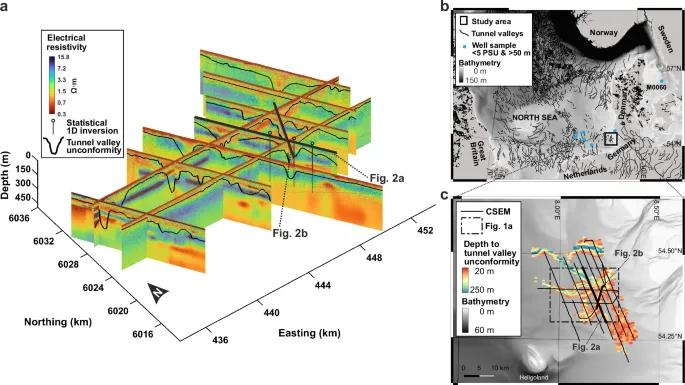
IntroductionOffshore freshened groundwater (OFG) is subsurface porewater with salinity below that of ambient seawater, occurring in sediments and rocks beneath or seaward of the shoreline. The definition refers to a salinity state rather than to a process and this distinction led to a recent proposal to rename the phenomenon Offshore Relatively Fresh Groundwater (ORFG), since "freshened" can be read as implying ongoing change1. OFG has emerged as a significant yet poorly constrained part of the global hydrological cycle, with reservoirs identified along continental margins worldwide2,3. Global water stress is growing, particularly in densely populated coastal regions. OFG is also of broader scientific importance for understanding geohazards, biogeochemical cycling, subseafloor microbiology, and the preservation of archaeological records. There is therefore an urgent need to better constrain the emplacement, stability, and distribution of OFG2,3,4,5,6,7,8,9,10.
This article is an excerpt. To read the full content, visit the original source. Nature
Related articles
Science Talk: Invisible Water in a Changing Climate: Groundwater, Drought, and Water Security - UNU | United Nations University
Experimental characterization and scaling of flexural rigidity in sewn multilayer structures - Nature
We’re sharing this article early to provide faster access to peer-reviewed, accepted research. It is citable and carries a permanent DOI. This version is subject to further edits and will be replaced automatically by the final Version of Record. All legal disclaimers apply. AbstractSewing is one of the established methods used to fabricate and assemble multilayer insulation (MLI) blankets for aerospace applications, yet the resulting effective flexural behavior remains insufficiently understood. This study investigates the room-temperature, quasi-static flexural behavior of MLI blankets composed of aluminized BoPET radiation shields and polyester net spacers across structural configurations of 2, 6, 12, and 24 layers. A full factorial design was employed to evaluate the influence of the number of layers, stitch density, needle thread tension, and needle foot force. Statistical analyses demonstrated that the number of layers is the dominant factor governing flexural response. Among the sewing parameters, needle thread tension was associated with modifications in bending length, while needle foot force primarily affected local compaction.
0 comments
No comments yet. Be the first to share your thoughts!