Soldiers Searching for Old Landmines Found Korea’s Oldest Known Gunpowder Weapon - ZME Science
This story deserves to be shared
Send it to someone who'd care, or post it on your networks.
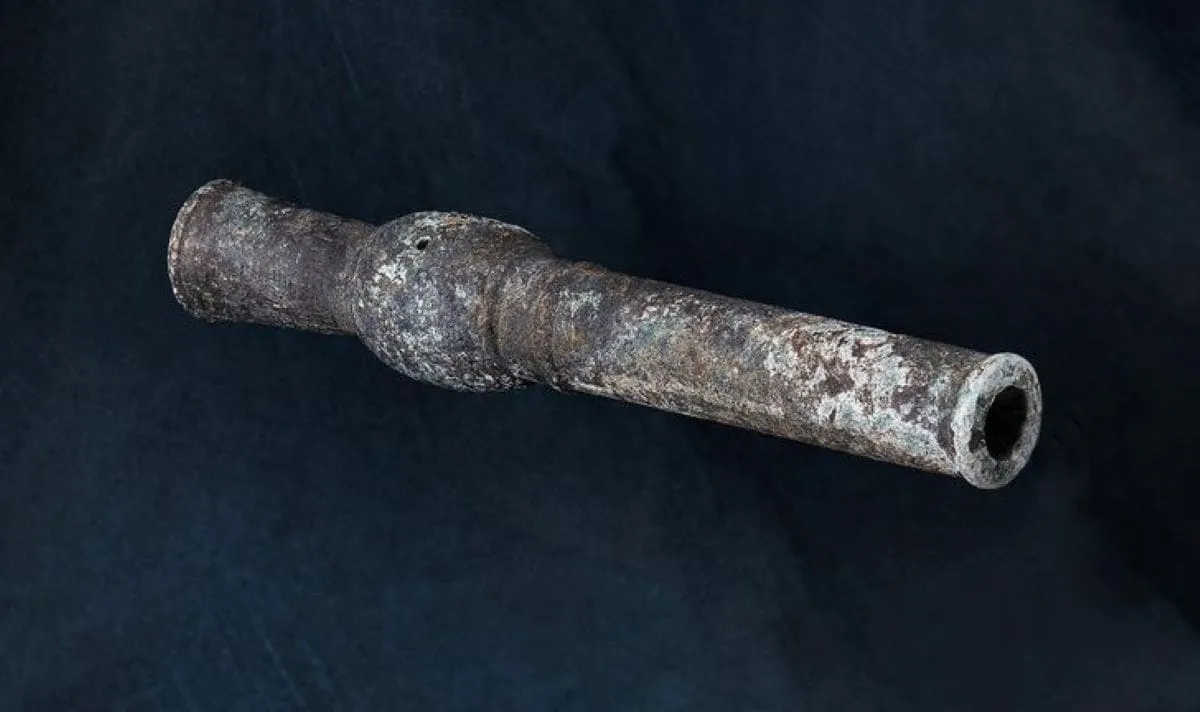
The oldest confirmed gunpowder firearm found in South Korea. Credit: Korea Heritage Service
In November 2023, troops sweeping a suspected minefield on Mount Geumseong in southwestern South Korea uncovered a small bronze object barely four inches beneath the soil. Fortunately, it was not a landmine, but a gun—one that may have been buried there for 600 years or more.
This article is an excerpt. To read the full content, visit the original source. ZME Science
Related articles

Consciousness May Be 500 Million Years Old. Scientists Are Searching for It in the Brain’s Ancient Core. - Popular Mechanics
Here’s what you’ll learn when you read this story:A team of researchers at MIT believes vertebrates may have first developed the neural pathways for consciousness 500 million years ago. Ancient deep brain structures from the thalamus to the medulla could hold the keys to specific conscious experiences like thirst. Using transcranial focused ultrasound, the scientists are trying to map where those conscious experiences live in the brain. We’ve been poking around inside each other’s heads since the Stone Age, but we still don’t know what consciousness is or where it comes from. Now, a research team at MIT is suggesting that it’s partly a question of how you define consciousness in the first place—and only once you’ve defined consciousness can you attempt to hunt it down in the brain. “Some people see consciousness as very much tied to cognition, your capacity for complex thought,” explains Daniel Freeman, PhD, one of the MIT scientists involved with a new study probing the brain for the source of consciousness.

SpaceX Sent 6,300 Pounds to the Space Station. The Strangest Cargo Was Grown in a Lab - Inc.com
The spacecraft delivered materials and equipment for new research studies to the station.

Ancient mud reveals a surprising secret about Greenland’s ice - Earth.com
Mud from a fjord shows an Atlantic air pattern brought wetter, colder spells to southern Greenland, a clue to how its ice may fare. Greenland’s ice is shrinking as the planet warms. But in the island’s southwest, rainfall and snowfall have been influenced by the same North Atlantic air-pressure pattern for at least 5,000 years. When that pattern tipped one way, the region turned wetter and colder. The record comes from mud on the floor of a Greenland fjord, and it suggests snowfall, not only temperature, shaped how the area’s ice grew and shrank. It doesn’t yet show how glaciers there will respond to the warming ahead. Johan Faust, a researcher at MARUM, the Center for Marine Environmental Sciences at the University of Bremen in Germany, led the work with colleagues in Germany, Norway, Denmark and Canada. A seesaw in the airThe pattern is called the North Atlantic Oscillation. It’s the difference in air pressure between a low that sits near Iceland and a high near the Azores, and it’s strongest in winter. When that difference is large, the pattern is in its positive phase. Northwestern Europe and southwestern Greenland both get more rain and snow.

Simulations explore nuclear mitigation of asteroid threats - Phys.org
Lawrence Livermore National Laboratory researcher Isaiah Santistevan led the development of three-dimensional simulations exploring how a nuclear device could deflect or disrupt an asteroid threatening Earth. Credit: Blaise Douros/LLNL Lawrence Livermore National Laboratory (LLNL) researchers are developing three-dimensional simulations to examine how a nuclear device could be used to deflect or potentially disrupt an asteroid threatening Earth.
0 comments
No comments yet. Be the first to share your thoughts!