Researchers for 1st time observe solar-storm-like eruptions near black hole - Xinhua
This story deserves to be shared
Send it to someone who'd care, or post it on your networks.
JERUSALEM, Oct. 18 (Xinhua) -- An international team of researchers has discovered eruptions similar to solar storms near a giant black hole, the Israel Institute of Technology (Technion) said Sunday. Published in the Astrophysical Journal Letters, the study provides the first evidence that the physical processes driving solar storms can also occur near supermassive black holes. Solar storms occur when energy stored in magnetic fields is suddenly released, producing bursts of radiation and streams of charged particles that can disrupt satellites and communications on Earth. The researchers analyzed X-ray emissions from the region around a black hole in the galaxy NGC 3783, using the XRISM and XMM-Newton space telescopes to track changes in radiation. They identified a pattern known as the "Neupert effect," first discovered on the Sun in 1968 but never previously observed near a black hole. The discovery suggests that powerful magnetic eruptions may occur across vastly different cosmic environments, from the Sun to black holes millions of times more massive, the researchers say. ■
This article is an excerpt. To read the full content, visit the original source. Xinhua
Related articles
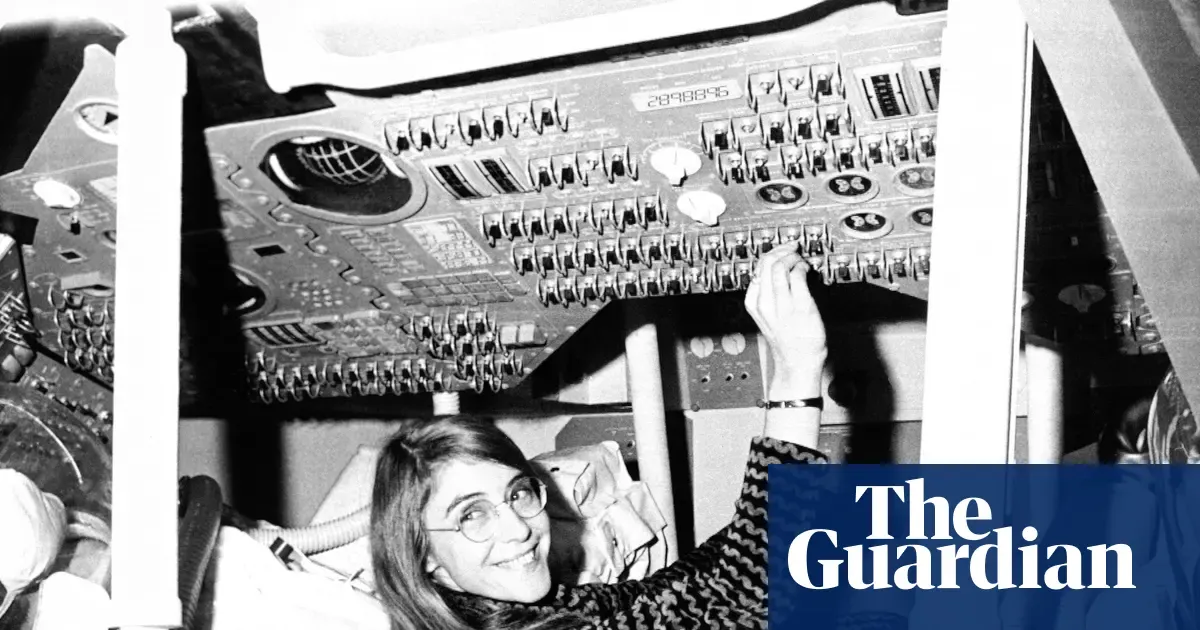
Margaret Hamilton obituary - The Guardian
Apollo was a bold, innovative project. It tested the boundaries of technology and human achievement, and took people to the moon. However, one thing it failed to challenge was the prevailing hierarchy. Nearly everyone involved in Nasa’s space programme in the 1960s was male and white. If you weren’t, you needed to be exceptional at what you did. Margaret Hamilton, who has died aged 90, was one of those exceptional people. Without her input, sending spacecraft into lunar orbit, and putting Neil Armstrong and his successors on to the surface of the moon, might have been impossible. Hamilton directed the software engineering division at the Massachusetts Institute of Technology (MIT) Instrumentation Laboratory, which had been charged with developing the computer systems for Apollo. The result of this work was the Apollo Guidance Computer (AGC). This provided the astronauts with a computer-linked keypad, similar in appearance to a calculator and known by the acronym DSKY – short for Display and Keyboard – which they used for navigating and controlling the direction and manoeuvrability of the spacecraft.
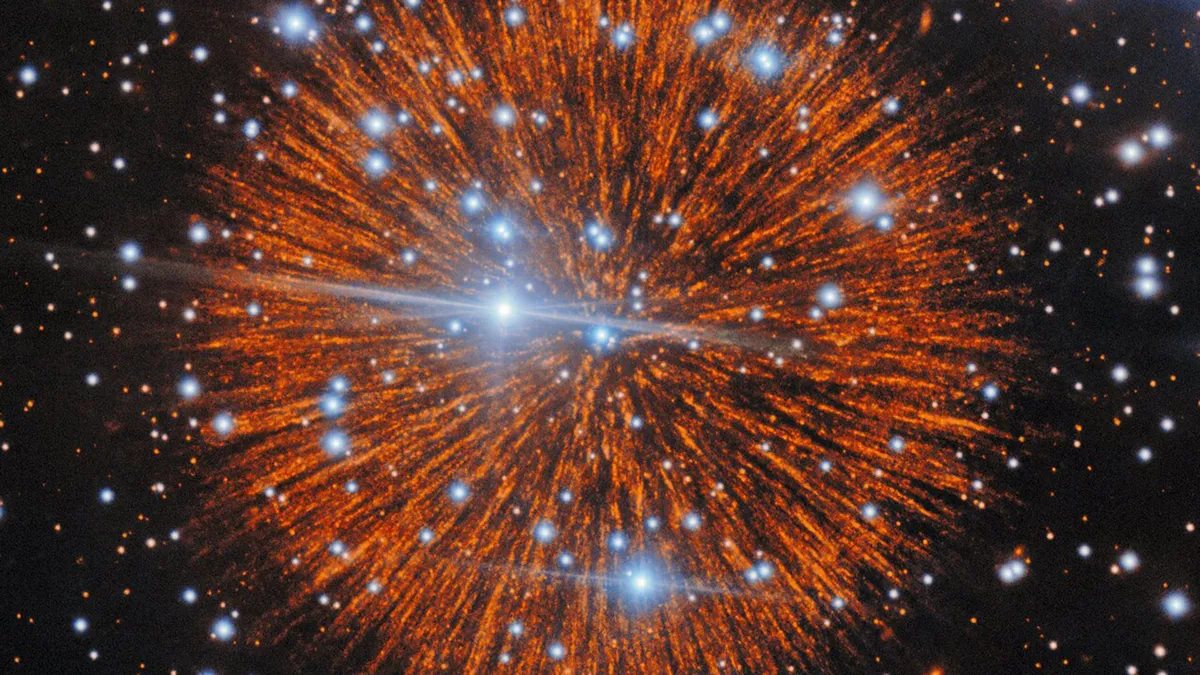
Famous supernova that lit up skies in 1181 is now full of mysterious knots — Space photo of the week - Live Science
Pa 30, linked to a supernova seen in 1181, reveals chains of tiny gas knots in a new image from the Gemini North telescope in Hawaii.

Scientists who discovered a third form of magnetism win major physics prize - Science Daily
Scientists have uncovered a previously unknown form of magnetism, overturning an understanding of magnetic behavior that had stood for more than a century. The discovery, known as altermagnetism, has revealed a third fundamental category of collinear magnetism and opened new possibilities for quantum materials, advanced electronics, and future computing technologies. Three physicists responsible for the breakthrough have been named recipients of the 2026 Europhysics Prize, one of Europe's most prestigious honors in condensed matter physics. The European Physical Society (EPS) Condensed Matter Division selected Professor Jairo Sinova of Johannes Gutenberg University Mainz (JGU), Dr. Libor Šmejkal, and Professor Tomas Jungwirth for their work establishing altermagnetism as a distinct form of magnetic order alongside ferromagnetism and antiferromagnetism.

Smaller babies perform poorer as teens, study finds - Yahoo
Babies who are smaller than expected at birth tend to have poorer school performances as teenagers, a study has found. More than 92,000 children were followed from infancy to adolescence, all of whom were born at full term, between 37 and 41 weeks pregnant. The researchers at the University of Warwick found that children who weighed less than most babies of the same sex, born at the same stage of pregnancy, tended to achieve lower scores in subjects like mathematics and reading. The differences were still apparent in adolescence, suggesting that the link between size at birth and academic performance persists well beyond early childhood into mid-teens. "For babies born at term, being small for their stage of pregnancy may indicate adverse effects on the brain that affect learning and last into adolescence," Prof Dieter Wolke said. However, he said the long-term effects of being born small may be altered by parenting home stimulation and school support.

Researchers identify first known juvenile fossil of Huphsuchus dating back approximately 247 mln years - Global Times
Researchers identify world’s 1st known juvenile fossil of Huphsuchus dating back around 247 mln years in C. China’s Hubei Reconstruction of a juvenile Huphsuchus in its natural habitat Photo: Courtesy of Hubei Institute of GeosciencesAn international collaborative study has recently confirmed the world’s first juvenile fossil of Huphsuchus, an extinct genus of small marine reptiles dating back approximately 247 million years, discovered in Yuan’an county, Central China’s Hubei Province, the Global Times learned from the Hubei Institute of Geosciences, Hubei Geological Bureau, on Sunday. The research has been published in the Zoological Journal of the Linnean Society. Wang Yinuo of Peking University, and Zou Yarui, a senior engineer from the Hubei Institute of Geosciences, Hubei Geological Bureau, are the paper’s co-first authors. Researched and named in 1972 by Chinese paleontologist Yang Zhongjian, Huphsuchus was a prehistoric marine reptile that lived in shallow marine waters during the Early Triassic, approximately 247 million years ago.
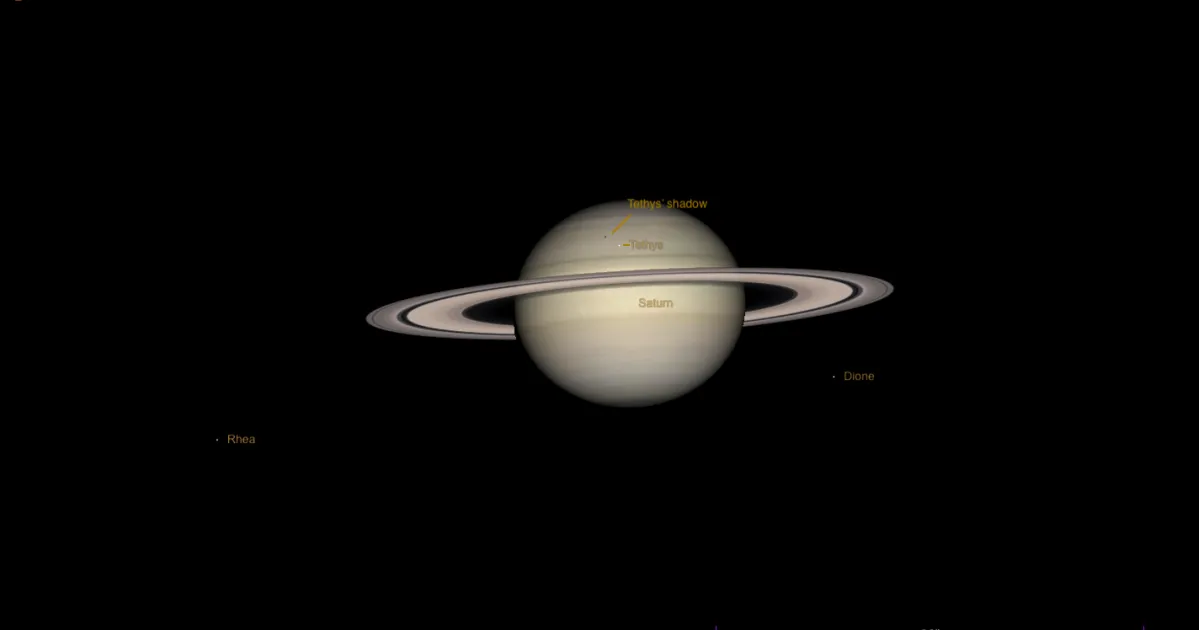
The Sky Today on Sunday, October 18: Another Tethys transit - Astronomy.com
Saturn’s small moon Tethys makes another transit across the disk along with its shadow; several other moons are observable as well. For a few hours on October 18, Tethys transits Saturn, accompanied by its shadow. Astroimagers may be able to capture its journey. Titan lies farther east, outside this field of view. Only moons brighter than 10th magnitude are shown. Credit: Alison Klesman (via TheSkyX)
0 comments
No comments yet. Be the first to share your thoughts!