Regional heterogeneity in the association between extreme temperatures and emergency hospitalizations in Germany - Nature
This story deserves to be shared
Send it to someone who'd care, or post it on your networks.
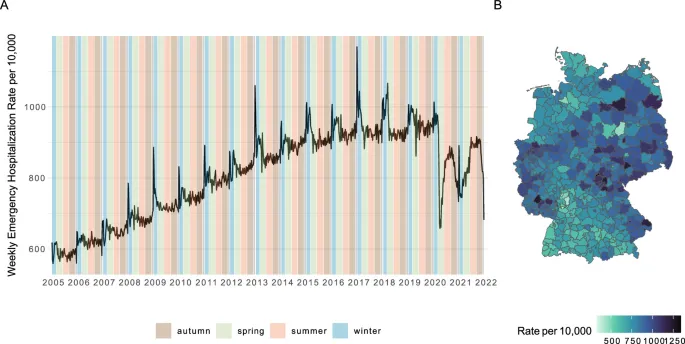
IntroductionClimate change is resulting in an increasing frequency of heatwaves, which leads to a substantial increase in deaths and hospitalizations in the summer1. Besides heat, cold continues to be a major health threat and accounts for substantial proportions of deaths2 and hospitalizations3,4. Current evidence suggests heat to be associated with more hospitalizations due to infectious diseases, respiratory, cardiovascular, and neurological outcomes5,6,7, while cold temperatures were primarily associated with cardiovascular and respiratory conditions8. Compared to mortality, hospitalizations reflect a more sensitive indicator of temperature-related health effects, including also less severe cases. Moreover, temperature-related (emergency) hospitalizations are of central public health importance since they naturally reflect unplanned admissions, reveal vulnerabilities in the population, and thus represent a source of uncertainty and potential strain on existing hospital capacity.
This article is an excerpt. To read the full content, visit the original source. Nature
Related articles
The molecular heterogeneity and clinical impact of genomic driver alterations in prostate cancer - Nature
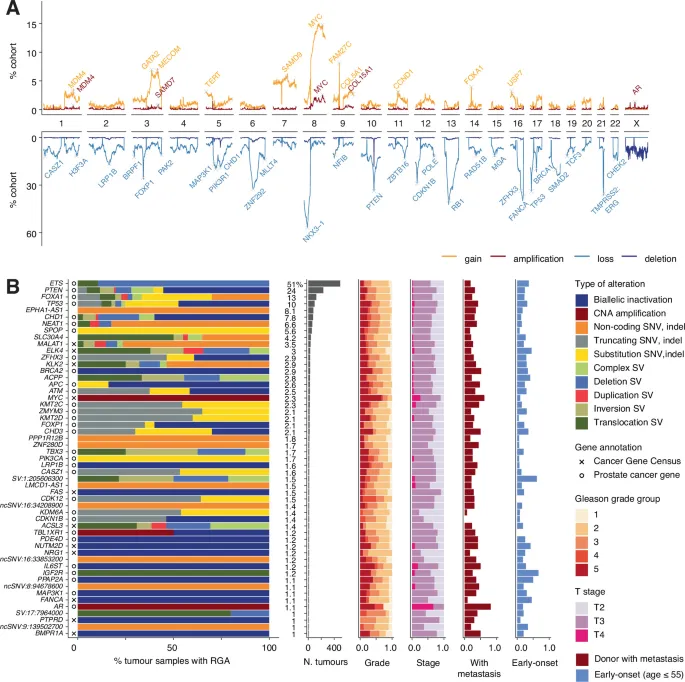
IntroductionProstate cancer is the most common malignancy in men that accounts for 10% of male cancer-related deaths and is expected to increase in incidence in the coming decades1. Its clinical trajectory is highly variable, with disease courses ranging from localised disease with long indolent phases that often require no therapy, to early-onset cancer that typically necessitates definitive treatment with curative intent2 and life-threatening metastatic prostate cancer3. The management of newly diagnosed prostate cancer is primarily based on established clinical and pathological information along with small gene or mRNA panels. The most pressing unmet clinical needs include reliable prognostic approaches to minimize overtreatment and the identification of therapeutic targets4. This is especially challenging due to the considerable molecular heterogeneity of the disease. Its genomic landscape is dominated by structural variation (SV) and copy-number alteration (CNA) drivers, while in contrast, drivers involving small mutations including single-nucleotide variants (SNVs) and insertions-deletions (indels) are relatively infrequent5,6.

GLP-1s are linked to lower psychiatric hospitalizations: study - TradingView
Patients with schizophrenia and type 2 diabetes on GLP-1 receptor agonists were less likely to require acute psychiatric care, such as hospital visits, compared with those using other diabetes drugs such as DPP-4 or SGLT2 inhibitors, according to a new peer-reviewed study. The study published on Wednesday in the Lancet Psychiatry journal was based on electronic health record data representing more than 70,200 adults with schizophrenia and T2D who were receiving diabetes therapy between Jan. 1, 2018, and Oct. 1, 2025According to its authors, patients on GLP-1 agonists had a 24% lower risk of undergoing psychiatric hospitalizations compared with those who were not treated for diabetes and an 18% and 17% lower risk compared with those who were on DPP-4 and SGLT2 inhibitors, respectively. Lead investigator Najmeh Davoodian, an associate research fellow at Deakin University in Australia, said that the results marked the first to show a connection between schizophrenia hospitalizations and GLP-1s, a popular drug class marketed by Novo Nordisk NVO and Lilly LLY.
Permeability heterogeneity controls fluid migration and microseismicity evolution in The Geysers geothermal field, California - Nature
We’re sharing this article early to provide faster access to peer-reviewed, accepted research. It is citable and carries a permanent DOI. This version is subject to further edits and will be replaced automatically by the final Version of Record. All legal disclaimers apply. AbstractFracture networks directly govern the efficiency of geothermal energy extraction and play a critical role in fluid migration and microearthquake generation. Using deep learning and Markov clustering, we build a high-resolution microseismic catalog covering the past decade for The Geysers geothermal field, California. Our observations reveal distinctive clustering patterns and inferred fracture systems tightly correlated with injection operations. Source mechanism analyses and pore pressure simulations indicate that the inferred connected fracture network provides pathways for rapid and directional pore pressure diffusion, highlighting that heterogeneous permeability controls the localized migration of fluids and the associated microseismic response.
0 comments
No comments yet. Be the first to share your thoughts!