OpenAI claims we've entered the AGI era — has GPT-6 Astra really demonstrated general intelligence? - Live Science
This story deserves to be shared
Send it to someone who'd care, or post it on your networks.

OpenAI says its newly launched GPT-6 Astra model brings humanity to the threshold of AGI, but external evaluators argue that inflated lab metrics and opaque testing obscure its true reliability.
This article is an excerpt. To read the full content, visit the original source. Live Science
Related articles

Claude Haiku 5.5 vs GPT-6 Luna: Which Cheap Model Should You Use? - Medium
For prompts up to 100,000 tokens, both charge $0.10 in and $0.50 out per million tokens. At max effort, Artificial Analysis reports three times the cost per index task for Haiku. At their shared index score of 38, the gap is about 14%; Haiku’s rates rise above 100,000 prompt tokens.8 min read6 days ago--Press enter or click to view image in full sizeTwo illustrated model cards pair Claude Haiku 5.5 with GPT-6 Luna (AI-generated artwork made with OpenAI image generation). Anthropic released Claude Haiku 5.5 on October 7. Its base price is $0.10 per million input tokens and $0.50 per million output tokens, a tenth of Haiku 4.5’s base rates. OpenAI’s GPT-6 Luna, out since September 22, charges exactly the same. Same price list. On Artificial Analysis’s Intelligence Index, Haiku 5.5 scores 43 and Luna scores 38. A year ago, Haiku 4.5 scored 17. So Haiku wins? Look at the next column. Artificial Analysis also reports what one question in its index costs. At max effort, Haiku 5.5 costs $0.21 per task against Luna’s $0.07. You pay three times as much for five more points. Both max settings are useful to compare if that is how you plan to run the models.
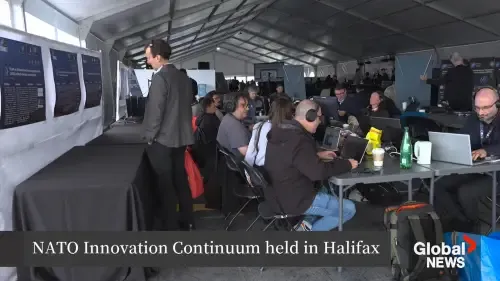
New defence technologies demonstrated at NATO event in Dartmouth - Global News
$10B data centre stirs debate in Nova Scotia Government of Canada backs Nova Scotia offshore wind with $100M investment
Newest sUAS technology demonstrated at Game of Drones 26-2 - Edwards Air Force Base website (.mil)

Simulations explore nuclear mitigation of asteroid threats - Phys.org
Lawrence Livermore National Laboratory researcher Isaiah Santistevan led the development of three-dimensional simulations exploring how a nuclear device could deflect or disrupt an asteroid threatening Earth. Credit: Blaise Douros/LLNL Lawrence Livermore National Laboratory (LLNL) researchers are developing three-dimensional simulations to examine how a nuclear device could be used to deflect or potentially disrupt an asteroid threatening Earth.
0 comments
No comments yet. Be the first to share your thoughts!