NASA’s Webb Detects Methane on Interstellar Comet 3I/ATLAS - NASA Science (.gov)
This story deserves to be shared
Send it to someone who'd care, or post it on your networks.
This article is an excerpt. To read the full content, visit the original source. NASA Science (.gov)
Related articles
APOD: 2026 August 24 – Comet 220P in Outburst - NASA Science (.gov)
Scientists Puzzled as James Webb Detects Signal From Completely Empty Void in Space - Futurism
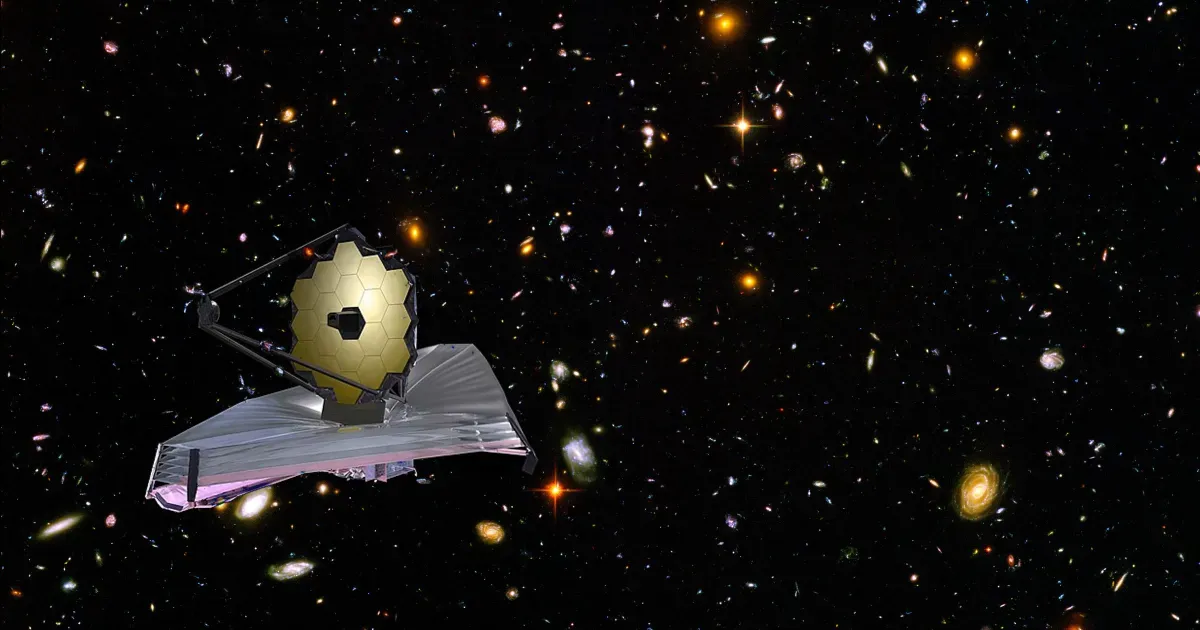
Using the NASA’s James Webb Space Telescope, a team of researchers led by University of Minnesota astrophysicist Mason Huberty had a closer look at a group of almost 10,000 galaxies spanning billions of light-years in the Fornax constellation. As detailed in a new paper published in The Astrophysical Journal, they honed in on a small space in the region that they thought was entirely unoccupied. But to their astonishment, they observed a single emission line emanating from it — twice over a span of just three months. Emission lines are bright, narrow bands of light emitted at a specific wavelength by distant celestial objects and other phenomena. Puzzlingly, prior observations from the same region didn’t feature the same reading.
Capture of Interstellar Planetesimals in Protoplanetary Discs in Binary Star Systems - Astrobiology Web
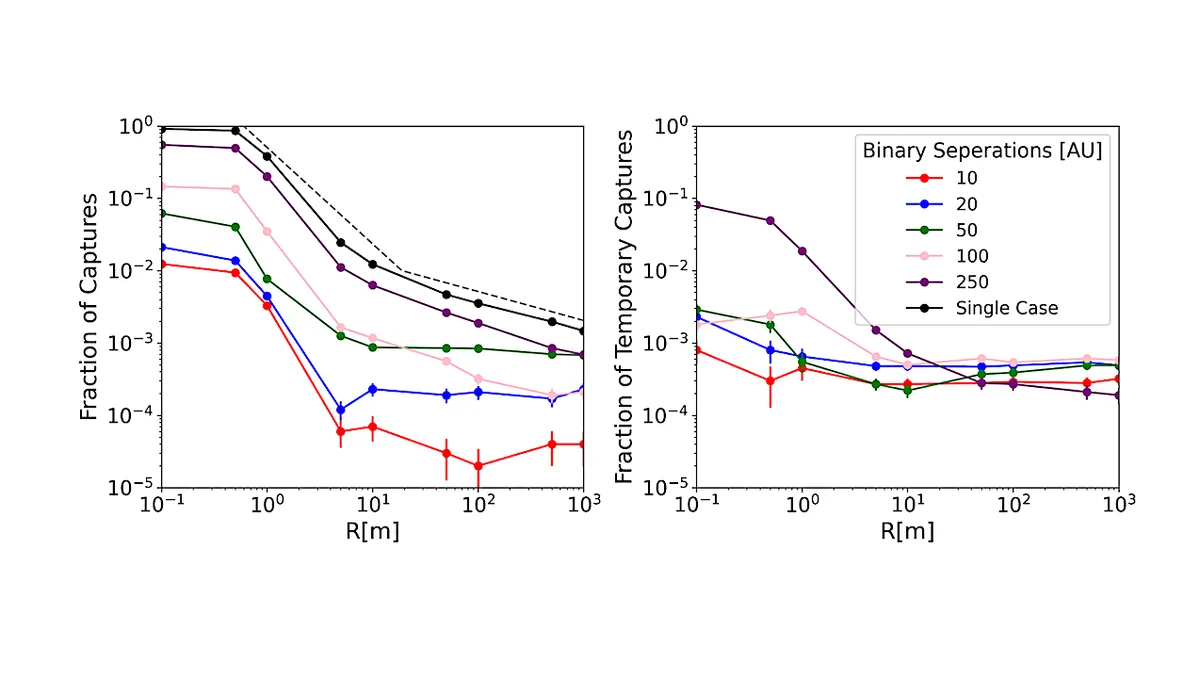
Fraction of planetesimal interactions that resulted in a capture (left) or a temporary capture (right) for planetesimals of different sizes (R) and stars with different separations. Each point represents anywhere from 10,000-100,000 simulations. The single case results were also obtained with REBOUND using the same set-up for direct comparison. The grey dotted line represents the theoretical amount of captures for the single case derived by Grishin et al. (2019). -- [astro-ph. EP] [astro-ph. EP] Planet formation requires growth over 12 orders of magnitude in size, from micron-sized dust grains to fully formed planets.
0 comments
No comments yet. Be the first to share your thoughts!