NASA’s Roman telescope just opened its planet-hunting eye - Science Daily
This story deserves to be shared
Send it to someone who'd care, or post it on your networks.
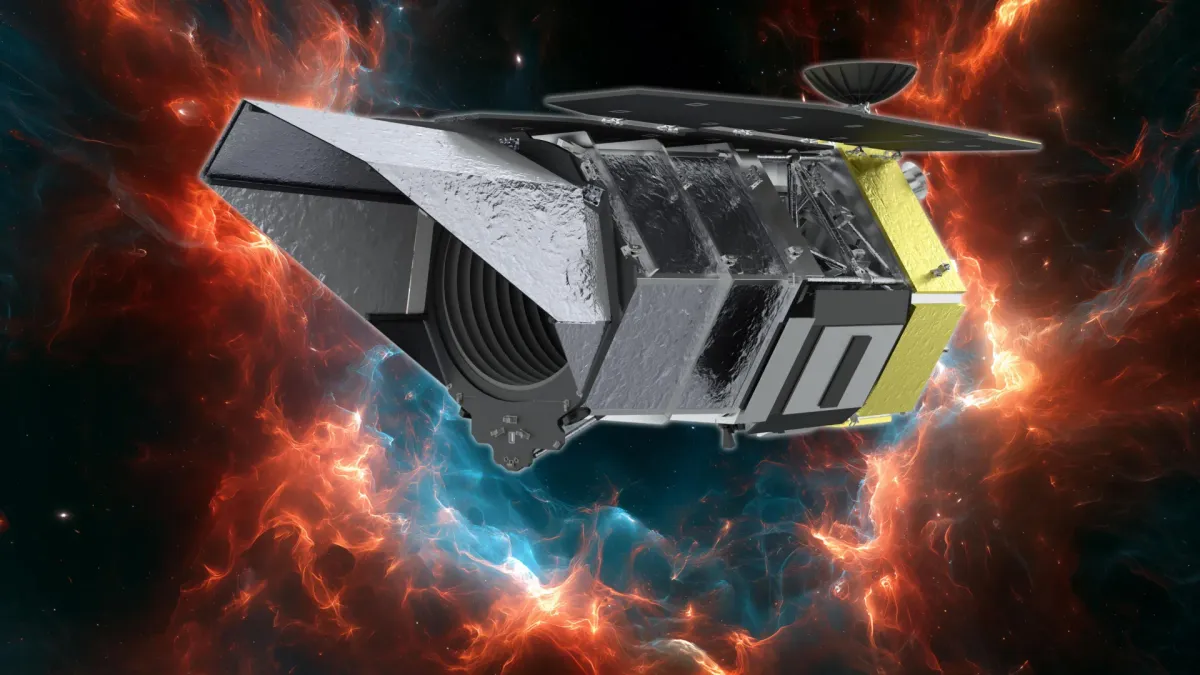
NASA's Nancy Grace Roman Space Telescope has completed an important series of tests showing that it can keep its gaze extremely steady during observations. From Sept. 15 to 21, engineers tested Roman's fine-guidance system, which helps the observatory remain precisely locked onto its targets. Then, on Sept. 22, the telescope's Coronagraph Instrument received cosmic light for the first time.
Roman's primary science instrument, the Wide Field Instrument, contains 18 detectors. Engineers designated a small section of each detector to rapidly monitor a different guide star -- stars whose positions are already known with high precision.
This article is an excerpt. To read the full content, visit the original source. Science Daily
Related articles

A Vast Hole Almost The Size of Portugal Opened Up in Antarctica's Winter Sea Ice. Now We Know Why. - ScienceAlert
Every winter, Antarctica roughly doubles in size as sea ice locks into place over the ocean. Typically, Breid Bay in East Antarctica is entirely covered in a frozen crust from July through August. But in August 2024, satellite images revealed a massive hole in the ice, formally known as a polynya, which is a region of open seawater surrounded by sea ice. It's something scientists have never seen before at that time of year. At its largest, the hole reached an area of 89,121 square kilometers, which is only slightly smaller than the entire landmass of Portugal. According to a research team from India led by earth scientist Jeebanjyoti Swain, the hole was the result of a series of extreme weather conditions, including a series of intense atmospheric rivers and marine heatwaves. Swain and team have published their findings in Geophysical Research Letters.(a) Polynya event captured by NASA Worldview satellite, (b) Bathymetry of the Breid Bay, (c) Daily sea‐ice concentration showing the evolution of the open‐ocean polynya.

Simulations explore nuclear mitigation of asteroid threats - Phys.org
Lawrence Livermore National Laboratory researcher Isaiah Santistevan led the development of three-dimensional simulations exploring how a nuclear device could deflect or disrupt an asteroid threatening Earth. Credit: Blaise Douros/LLNL Lawrence Livermore National Laboratory (LLNL) researchers are developing three-dimensional simulations to examine how a nuclear device could be used to deflect or potentially disrupt an asteroid threatening Earth.

A Black Hole 12,000 Light-Years Away Is Firing a Plasma Jet Toward Earth - Gadget Review
Milky Way’s first microblazar candidate sits 12,000 light-years away, offering a rare ground-level lab for studying relativistic jetsA black hole 12,000 light-years away is firing a jet of plasma almost directly toward Earth. At that distance, no known or expected danger to Earth has been identified by the researchers or the institutions involved. What astronomers have actually found is rarer and more interesting than a threat. Researchers have identified IRAS 18293-0941 as a compelling candidate for the Milky Way’s first microblazar, a class of object that gives astrophysicists a close-up laboratory for studying some of the most violent physics in the galaxy. What Astronomers FoundThe discovery centers on a binary system whose black hole expels plasma jets at close to three-quarters the speed of light, pointed almost directly toward Earth. The system pairs a hot, massive star with a black hole that completes a full orbit roughly every 11.38 days. Material drawn from the companion star feeds the black hole, and some of that matter gets expelled outward as opposing jets traveling at approximately three-quarters the speed of light. Terminology matters here.
0 comments
No comments yet. Be the first to share your thoughts!