Integrating hippopotamus optimization algorithm into machine learning frameworks for predicting suspended sediment concentrations - Nature
This story deserves to be shared
Send it to someone who'd care, or post it on your networks.
ORCID: orcid.org/0000-0001-8061-88361, Yaser Mehri2, Ali Abdolrazaq Sabbar3, Mohammad Javad Nahvinia3 & … Mohammad Hosein Omid2
We’re sharing this article early to provide faster access to peer-reviewed, accepted research. It is citable and carries a permanent DOI. This version is subject to further edits and will be replaced automatically by the final Version of Record. All legal disclaimers apply.
This article is an excerpt. To read the full content, visit the original source. Nature
Related articles
Deployment of edge-lightweight AI vertical models in multimodal anomaly detection and energy optimization of tech-long production line - Nature
We’re sharing this article early to provide faster access to peer-reviewed, accepted research. It is citable and carries a permanent DOI. This version is subject to further edits and will be replaced automatically by the final Version of Record. All legal disclaimers apply. AbstractAiming at the problems that the abnormal state of high-speed liquid packaging production lines is difficult to identify in time, the computing power of edge controller is limited, and the energy consumption regulation and condition monitoring are separated from each other, a multimodal lightweight artificial intelligence (AI) system embedded in Tech-Long production controller is constructed; this realizes the collaborative optimization of abnormal operation window identification and energy consumption of the whole line. First, this study collects vibration, acoustic, and thermal signals from the bottle blowing, filling, and packaging sections; it also constructs cross-sectional anomaly characterization through time synchronization, feature-level alignment, and hierarchical fusion.
Numerical simulation and structural optimization of electrostatic precipitators for particle purification in space capsules - Nature
We’re sharing this article early to provide faster access to peer-reviewed, accepted research. It is citable and carries a permanent DOI. This version is subject to further edits and will be replaced automatically by the final Version of Record. All legal disclaimers apply. AbstractTo support the performance optimization of electrostatic precipitators (ESPs) for potential aerospace applications, a coupled numerical model integrating the discrete phase model (DPM) with user-defined scalar (UDS) transport equations was developed to resolve the electric-field characteristics and particle transport behavior within the ESP. Focusing on the structural optimization of the discharge electrode and collection plate, four representative ESP configurations were established for comparison: a conventional flat-plate type, a W-type, a W1-type combining a corrugated collection plate with an auxiliary electrode, and a single-electrode type. The effects of a pre-installed filter screen, the internal airflow distribution, the electric-field and charge-density characteristics, and the relationship between particle trajectories and collection efficiency were systematically investigated.

SpaceX Sent 6,300 Pounds to the Space Station. The Strangest Cargo Was Grown in a Lab - Inc.com
The spacecraft delivered materials and equipment for new research studies to the station.
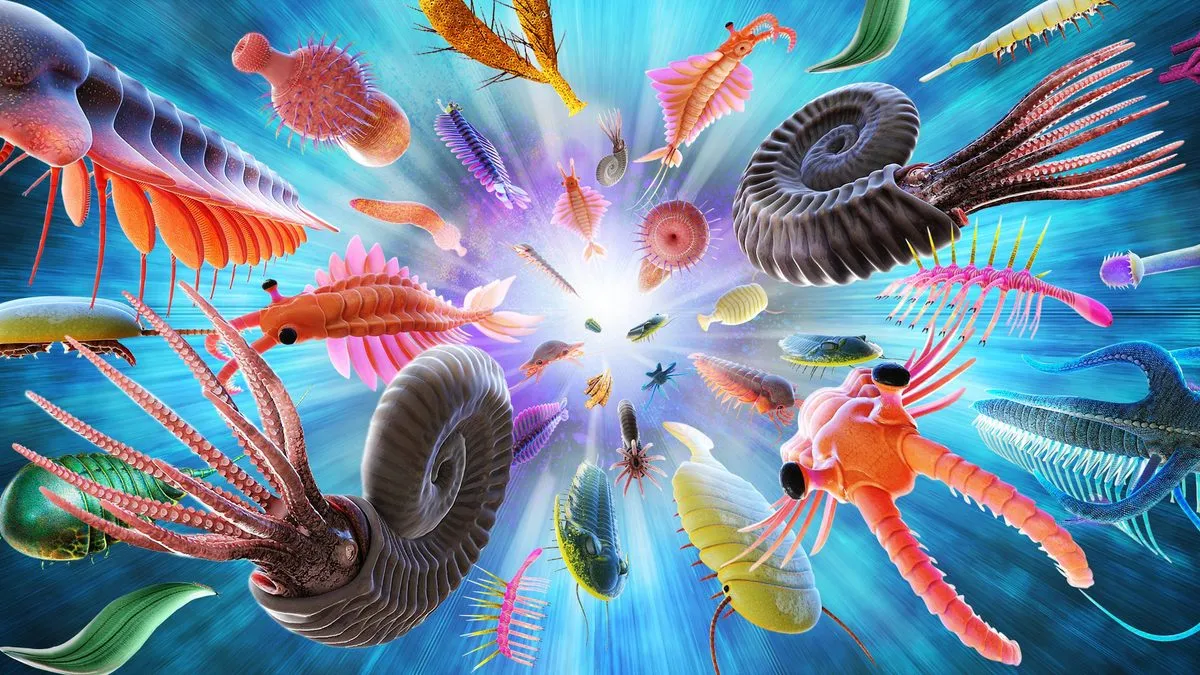
Did an eruption of poop trigger the biggest explosion of life and diversity Earth has ever seen? - BBC Wildlife Magazine
The history of life on Earth doesn’t start with the Cambrian Explosion. However, this was the point in time that nearly all major animal groups appeared, proliferated, and diversified. It wiped out 90% of life on Earth, turned the oceans into graveyards – and it very nearly ended life on our planet entirely
0 comments
No comments yet. Be the first to share your thoughts!