Error Mitigation Cuts Sampling Overhead For Quantum Circuits - Quantum Zeitgeist

Researchers at Google Quantum AI and Cornell University have demonstrated a new error mitigation technique that surpasses existing methods by operating entirely in classical post-processing. Their work introduces virtual error cancellation, a method that reduces sampling overhead by using only syndrome records from quantum circuits, bypassing the need for prior noise characterization and modified circuits. Numerical simulations using a distance-7 rotated surface code show the full-stack dual-decoder algorithm achieves more than three orders of magnitude of suppression in error rate compared to standard decoding.
This approach operates entirely through classical post-processing, offering a streamlined pathway to more reliable computation. The core of this advancement lies in the ability to avoid the typical requirements of noise learning and circuit alterations, both of which add complexity and overhead to quantum error mitigation.
This article is an excerpt. To read the full content, visit the original source. Quantum Zeitgeist
Related articles

HPV Self-Sampling May Improve Cervical Screening Access - EMJ
HUMAN papillomavirus (HPV) self-sampling could offer a promising approach to improving cervical cancer screening access among socially vulnerable migrant women, according to a mixed-methods study conducted in Portugal. Researchers found high levels of acceptability among women participating in a community-based HPV self-sampling intervention, with significant improvements in perceived comfort, confidence, and trust following the experience. The findings suggest that culturally adapted screening approaches delivered through trusted community organisations could help address persistent inequalities in cervical cancer prevention.
ARES-SI: adaptive reinforcement-enhanced sampling for suicidal ideation - Nature
We’re sharing this article early to provide faster access to peer-reviewed, accepted research. It is citable and carries a permanent DOI. This version is subject to further edits and will be replaced automatically by the final Version of Record. All legal disclaimers apply. AbstractSuicidal ideation (SI) fluctuates rapidly within individuals, but standard ecological momentary assessment (EMA) uses fixed schedules that miss critical risk windows. We present ARES-SI (Adaptive Reinforcement-Enhanced Sampling for Suicidal Ideation), a reinforcement learning system that personalizes EMA timing to individual risk patterns. ARES-SI combines random forest models to predict active SI probability and non-response likelihood with a Q-learning algorithm to determine optimal assessment intervals (30 min for high-risk states, 3 h for low-risk states, and next day to reduce burden). We trained the system using EMA data from 98 participants across three studies with varied sampling frequencies (4–15 assessments per day; 2359 positive active SI responses) over 28-day protocols.

No V12 Required: Argentina's Mid-Engine Supercar Packs An American V8 Punch - CarBuzz
Classic gems, tasteful customs, legendary supercars - for Silvian, they're all fair game. He's been in love with cars and motorcycles for as long as he can remember, so it made perfect sense to eventually turn that passion into a full-time writing career. Around six years and more than 3,000 articles later, he is still going strong and doesn't plan on hitting the brakes anytime soon. Argentina is a country known for its natural beauty, soccer legends, and chainsaw-wielding president, but it probably isn’t the first place you’d expect a rad V8 supercar to be developed. However, that assumption might change once you learn about a company called Valtor, the brainchild of engineer-turned-CEO Sergio Arias. He leads a small but ambitious team of designers and engineers like himself, who’d previously caught people’s attention with the Azor GT concept last year. Now they’re back at it once again with the Eaglon, an evolution of the Azor and something that could easily be mistaken for a Ferrari by those who don’t know their automotive lore.
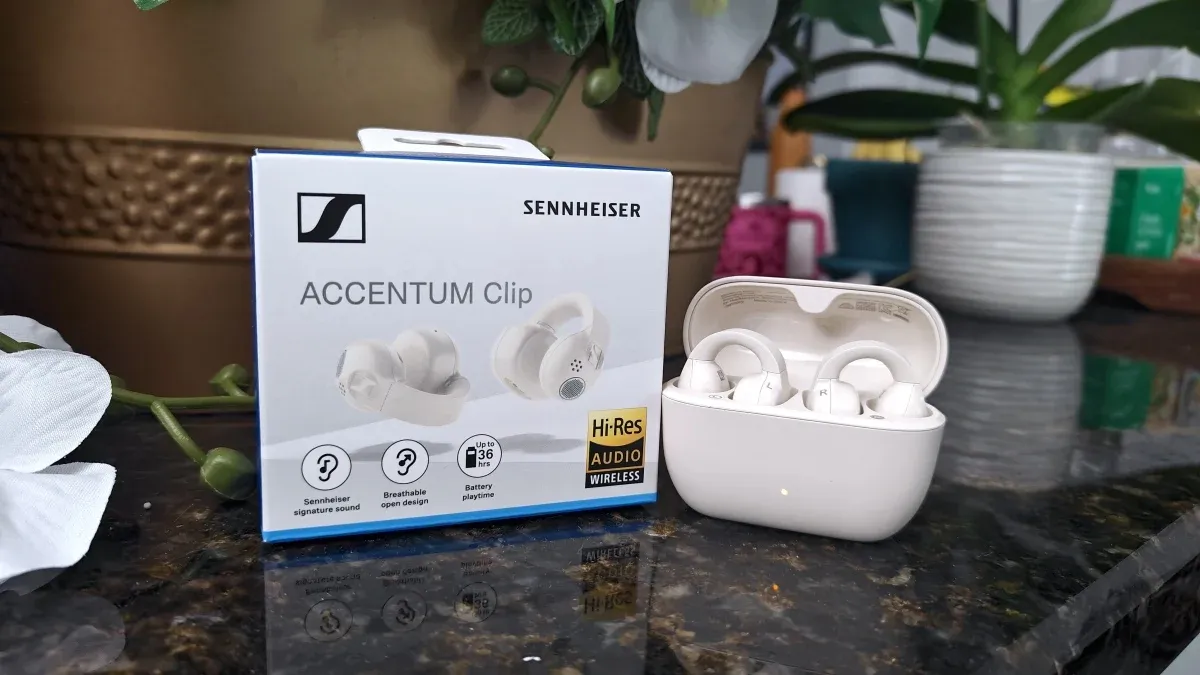
Sennheiser open earbuds are elite, but there's a catch - Mashable
Sennheiser is infamous for being fashionably late with its true wireless releases. Just look at the flagship Momentum True Wireless 5, which took more than two years to hit store shelves. So, it’s no surprise that the legacy audio brand waited this long to create its first-ever open earbuds. So, the Sennheiser Accentum Clip are here, and they join an already crowded market. A direct competitor to market favorites such as the Shokz OpenDots series and the upscale Bose Ultra Open Earbuds, these clip-on buds not only live up to the Accentum line’s critically acclaimed reputation – they’re easily the best-sounding open earbuds money can buy. There’s just one problem: Are you willing to cross the border to own a pair? That's right — Sennheiser has decided not to release these excellent open earbuds to U. S. shoppers.
0 comments
No comments yet. Be the first to share your thoughts!