Dr. Gu Receives Prestigious National Neutron Scattering Science Prize - The University of Southern Mississippi
This story deserves to be shared
Send it to someone who'd care, or post it on your networks.
This article is an excerpt. To read the full content, visit the original source. The University of Southern Mississippi
Related articles
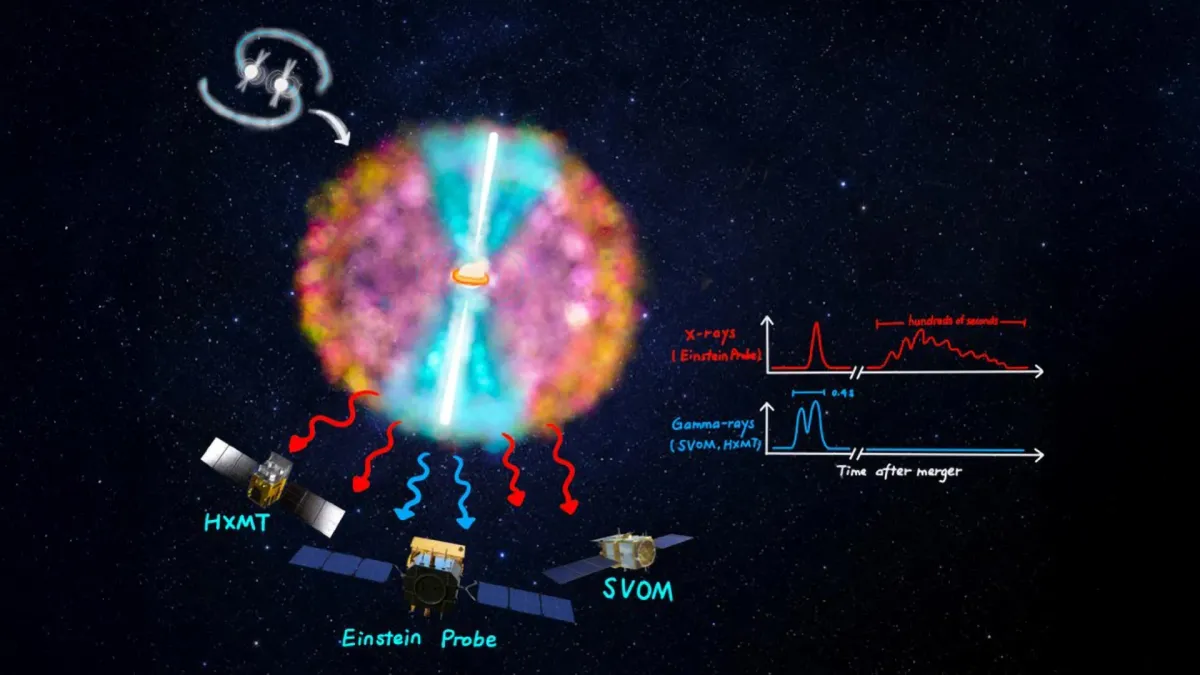
Einstein Probe reveals a hidden phase of neutron star collisions - Science Daily
Short gamma-ray bursts, or short GRBs, are believed to occur when two compact objects, such as neutron stars, spiral toward one another before colliding and merging. These extraordinarily violent events produce gravitational waves and rank among the most powerful explosions in the Universe. For decades, astronomers have mainly detected these events through their gamma-ray flashes. Their earliest soft X-ray emission has been far more difficult to observe because most narrow-field X-ray telescopes depend on gamma-ray alerts to locate a burst before turning toward it. Einstein Probe's wide-field soft X-ray monitoring has now exposed this previously unseen stage, giving astronomers a direct look at the opening moments of a short GRB.

Ancient mud reveals a surprising secret about Greenland’s ice - Earth.com
Mud from a fjord shows an Atlantic air pattern brought wetter, colder spells to southern Greenland, a clue to how its ice may fare. Greenland’s ice is shrinking as the planet warms. But in the island’s southwest, rainfall and snowfall have been influenced by the same North Atlantic air-pressure pattern for at least 5,000 years. When that pattern tipped one way, the region turned wetter and colder. The record comes from mud on the floor of a Greenland fjord, and it suggests snowfall, not only temperature, shaped how the area’s ice grew and shrank. It doesn’t yet show how glaciers there will respond to the warming ahead. Johan Faust, a researcher at MARUM, the Center for Marine Environmental Sciences at the University of Bremen in Germany, led the work with colleagues in Germany, Norway, Denmark and Canada. A seesaw in the airThe pattern is called the North Atlantic Oscillation. It’s the difference in air pressure between a low that sits near Iceland and a high near the Azores, and it’s strongest in winter. When that difference is large, the pattern is in its positive phase. Northwestern Europe and southwestern Greenland both get more rain and snow.

Simulations explore nuclear mitigation of asteroid threats - Phys.org
Lawrence Livermore National Laboratory researcher Isaiah Santistevan led the development of three-dimensional simulations exploring how a nuclear device could deflect or disrupt an asteroid threatening Earth. Credit: Blaise Douros/LLNL Lawrence Livermore National Laboratory (LLNL) researchers are developing three-dimensional simulations to examine how a nuclear device could be used to deflect or potentially disrupt an asteroid threatening Earth.
0 comments
No comments yet. Be the first to share your thoughts!