China's space station marks new ‘harvest season,’ aims to grow two generations of rice in orbit for first time - Global Times
This story deserves to be shared
Send it to someone who'd care, or post it on your networks.
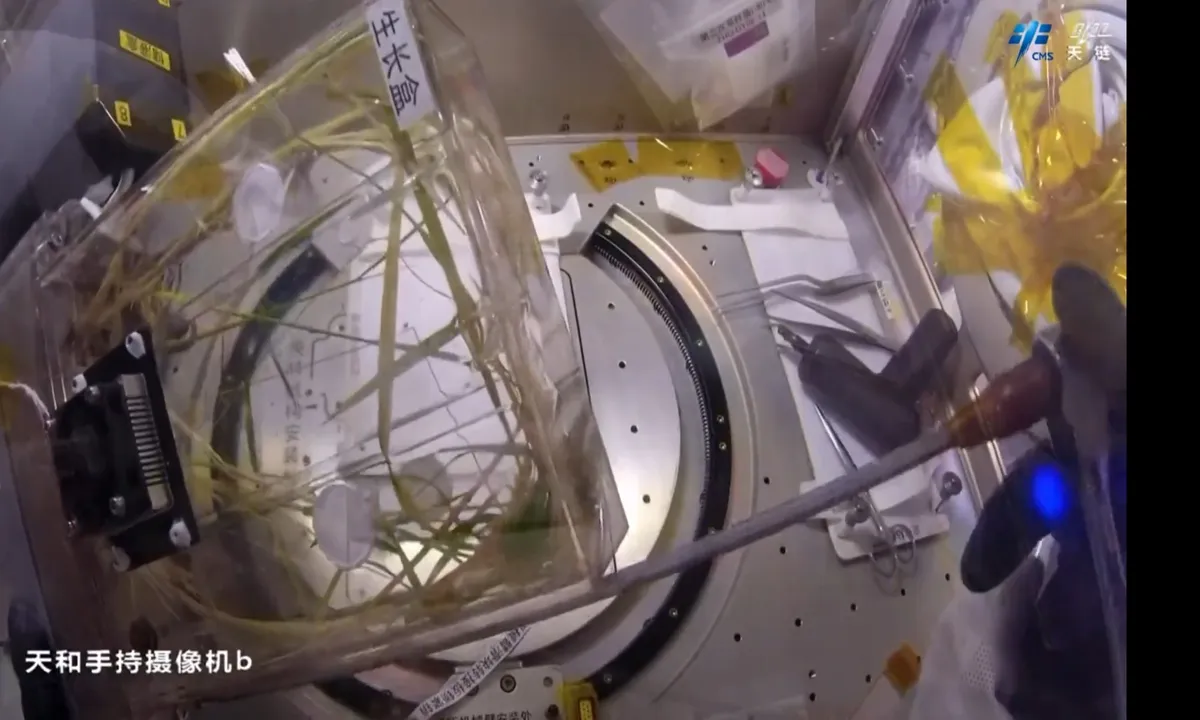
Picture of China's space station rice experiment. Photo: China Central TelevisionChina's space station has welcomed a new "autumn harvest," with astronauts collecting, sowing and storing a new batch of rice experiment samples last week, marking further progress in research on rice cultivation in space, CCTV News reported on Sunday. The research project, which focuses on the molecular mechanisms regulating multigenerational genetic stability and environmental adaptability of rice in space, is progressing smoothly, according to the media report. The latest experiment is expected to grow two generations of rice in orbit for the first time, helping researchers understand the mechanisms through which prolonged exposure to microgravity affects the genetic stability of rice. In addition to the rice experiment, the astronauts conducted touch-interaction tests with Xiaohang, their robotic companion aboard the space station. The tests collected data on the robot's movements in response to different types of physical contact, providing data to improve its motion planning for future operations in orbit.
This article is an excerpt. To read the full content, visit the original source. Global Times
Related articles
Bacteroides–Escherichia interactions contribute to colonization resistance against Clostridioides difficile - Nature
AcknowledgementsWe thank Julia Nelson, Animal Disease Research and Diagnostic Laboratory, South Dakota for the help with 16S sequencing, and Metabolon, Inc. for the untargeted metabolomics. Metagenome data analysis for this project was performed using the OU Supercomputing Center for Education & Research (OSCER) at the University of Oklahoma (OU). We thank Suryang Kwak and Joohee Choi for their help in providing further details on their dataset:54. FundingThis project has received funding from the United States National Institutes of Health (contract no: G- 202306-70697), Walter R. Sitlington Endowment (grant no: 5- 153200), European Research Council (ERC) under the European Union’s Horizon 2020 research and innovation programme (grant no. 866028) and from the UK Medical Research Council (project no. MC_UU_00025/11).
Prolyl hydroxylation is required for maturation and secretion of Zika virus non-structural protein 1 - Nature
Bodine Bezemer1, Gijs J. Overheul1, Milou Stevens1, Cornelia G. Spruijt2, Michiel Vermeulen2,3, Pascal Miesen1 & … Ronald P. van Rij We’re sharing this article early to provide faster access to peer-reviewed, accepted research. It is citable and carries a permanent DOI. This version is subject to further edits and will be replaced automatically by the final Version of Record. All legal disclaimers apply.
Molecular architecture of Cryptococcus cell walls reveals species-specific chitosan-dependent remodeling - Nature
We’re sharing this article early to provide faster access to peer-reviewed, accepted research. It is citable and carries a permanent DOI. This version is subject to further edits and will be replaced automatically by the final Version of Record. All legal disclaimers apply. AbstractCryptococcus neoformans and Cryptococcus gattii are fungal pathogens that cause life-threatening infections, including cryptococcal meningitis. A distinctive feature of the cryptococcal cell wall is the extensive deacetylation of chitin to chitosan, a modification that is essential for virulence but whose structural role in cell-wall organization remains poorly understood. Here, we analyze the cell walls of wild-type strains of both species and their avirulent chitosan-deficient mutants, which serve as vaccine candidates. Loss of chitosan disrupted cell morphology and altered cell-wall ultrastructure, with more pronounced defects in C. neoformans. Solid-state NMR reveals that aggregated α-(1→3)-glucans form the principal rigid domain of the cell wall in both species and are closely associated with chitin microfibrils, whereas surrounding β-glucans and mannoproteins constitute a more dynamic matrix.
Prevalence of 406 rare diseases by ethnicity and recorded COVID-19 infection rates among 62.5 million people in England - Nature
Qingze Gu1, Seyed Alireza Hasheminasab1, Marta Pineda-Moncusí1, Chimweta Chilala2, Johan H. Thygesen3, Honghan Wu3, Sara Khalid1 & CVD-COVID-UK/COVID-IMPACT Consortium We’re sharing this article early to provide faster access to peer-reviewed, accepted research. It is citable and carries a permanent DOI. This version is subject to further edits and will be replaced automatically by the final Version of Record. All legal disclaimers apply.

NASA’s SpaceX launch lights up the sky with a giant glowing jellyfish - Science Daily
A SpaceX Falcon 9 rocket transformed the early morning sky into a spectacular display of light on October 13, 2026. As the rocket climbed above Earth carrying a Dragon spacecraft, sunlight illuminated its expanding exhaust plumes, creating an enormous glowing shape that resembled a jellyfish. This striking phenomenon, known as a "jellyfish," occurs when a rocket launches near sunrise or sunset. Sunlight reaches the exhaust high in the atmosphere, making the spreading plume shine brightly against the darker sky below.
0 comments
No comments yet. Be the first to share your thoughts!