Benchling launches Science Foundries, a new way for scientists and agents to work together - PR Newswire
This story deserves to be shared
Send it to someone who'd care, or post it on your networks.
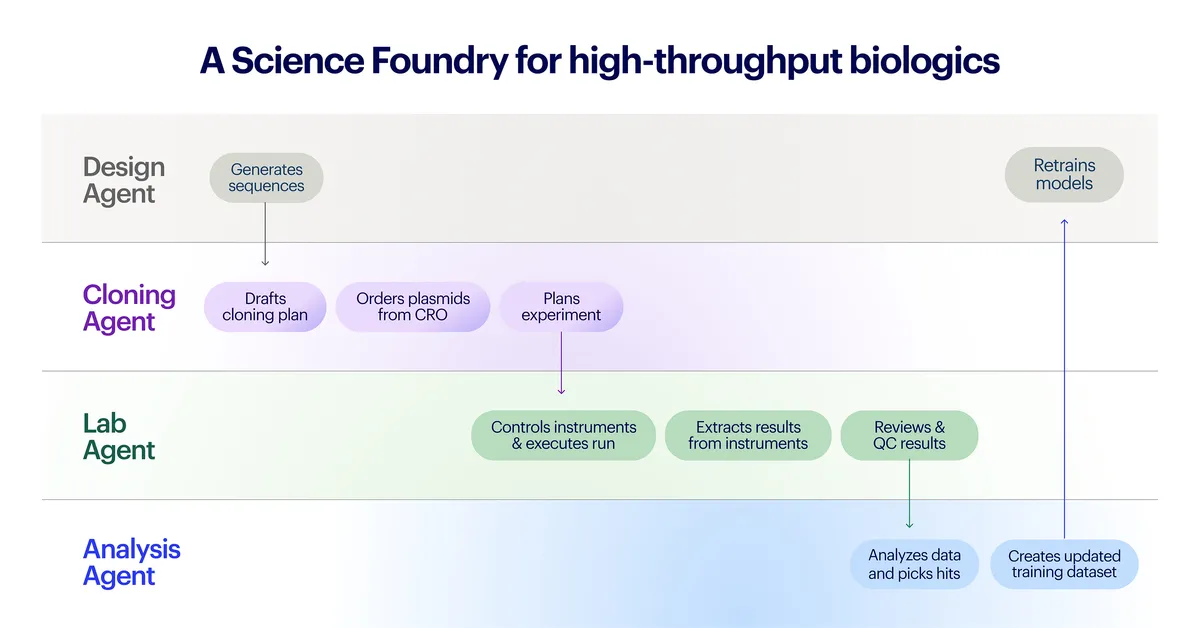
With agents working towards a shared goal on shared context, R&D teams run more science at once and move programs forward faster, /PRNewswire/ -- Benchling today launched Science Foundries, a new way to run scientific processes end-to-end with agents and scientists working together. With Science Foundries, R&D teams pick a process or a goal, such as produce proteins, optimize a promising lead, or improve a manufacturing process. They set which steps agents run and when scientists need to approve. From there, the Foundry runs. Agents execute and monitor work, coordinate handoffs, and surface key decisions to scientists, all working from the same scientific data and context.
A Science Foundry delivers an agentic workflow connecting models, CROs, lab instruments, and scientists.
This article is an excerpt. To read the full content, visit the original source. PR Newswire
Related articles
Benchling brings goal-driven AI agent teams to the lab with Science Foundries - R&D World
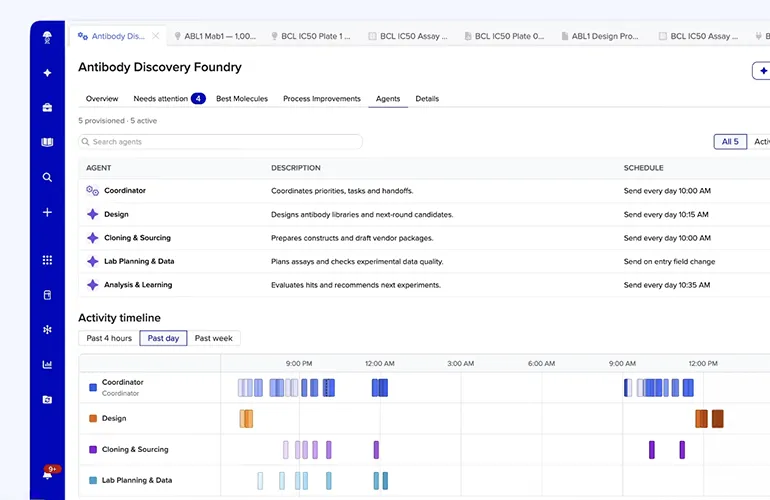
The Agents tab of an antibody discovery Foundry in Benchling lists five agents: coordinator, design, cloning and sourcing, lab planning and data, and analysis and learning. Each agent runs on a daily schedule or is triggered by an event. A timeline below shows their activity over the past day, including work around midnight. Credit: Image courtesy of Benchling Not long ago, a running joke took hold among software engineers and aspiring “vibe coders.” The bit was to hand an AI model a monumentally complex, multi-month task, building a full Slack clone from scratch, recreating a game like GTA, or even designing and training its own successor on a laptop, and demand it do the whole thing in a single shot. To seal the deal, prompts would end with a three-word incantation: “Make no mistakes.”

SpaceX Sent 6,300 Pounds to the Space Station. The Strangest Cargo Was Grown in a Lab - Inc.com
The spacecraft delivered materials and equipment for new research studies to the station.

Ancient mud reveals a surprising secret about Greenland’s ice - Earth.com
Mud from a fjord shows an Atlantic air pattern brought wetter, colder spells to southern Greenland, a clue to how its ice may fare. Greenland’s ice is shrinking as the planet warms. But in the island’s southwest, rainfall and snowfall have been influenced by the same North Atlantic air-pressure pattern for at least 5,000 years. When that pattern tipped one way, the region turned wetter and colder. The record comes from mud on the floor of a Greenland fjord, and it suggests snowfall, not only temperature, shaped how the area’s ice grew and shrank. It doesn’t yet show how glaciers there will respond to the warming ahead. Johan Faust, a researcher at MARUM, the Center for Marine Environmental Sciences at the University of Bremen in Germany, led the work with colleagues in Germany, Norway, Denmark and Canada. A seesaw in the airThe pattern is called the North Atlantic Oscillation. It’s the difference in air pressure between a low that sits near Iceland and a high near the Azores, and it’s strongest in winter. When that difference is large, the pattern is in its positive phase. Northwestern Europe and southwestern Greenland both get more rain and snow.

Simulations explore nuclear mitigation of asteroid threats - Phys.org
Lawrence Livermore National Laboratory researcher Isaiah Santistevan led the development of three-dimensional simulations exploring how a nuclear device could deflect or disrupt an asteroid threatening Earth. Credit: Blaise Douros/LLNL Lawrence Livermore National Laboratory (LLNL) researchers are developing three-dimensional simulations to examine how a nuclear device could be used to deflect or potentially disrupt an asteroid threatening Earth.
0 comments
No comments yet. Be the first to share your thoughts!