3D-printed brick phone brings back the art of simply answering calls
This story deserves to be shared
Send it to someone who'd care, or post it on your networks.
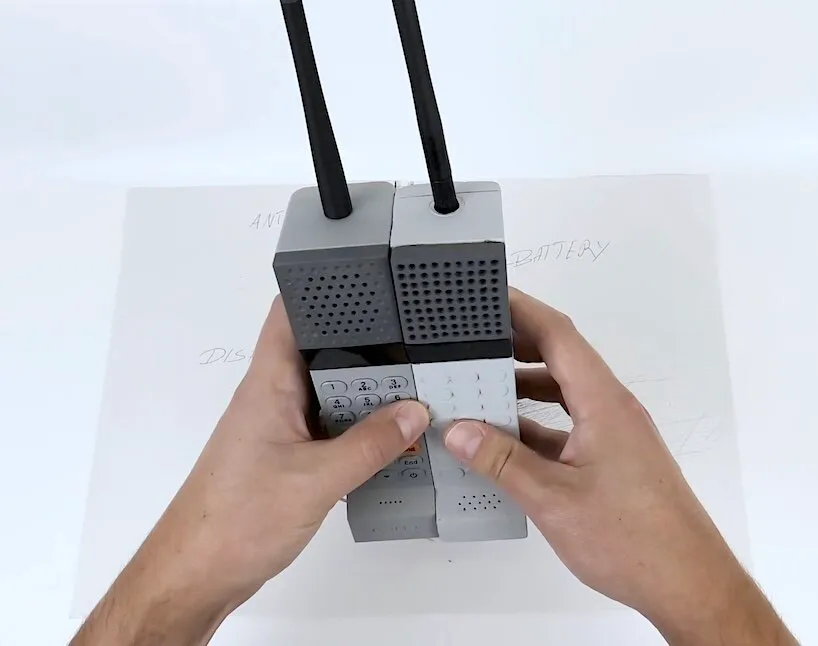
designer kevin noki recreates the 1980s brick phone as a 3D-printed bluetooth handset with 19 physical keys, allowing users to answer iphone calls without the usual smartphone distractions. Iñaki Laguardia October 16, 2026 4 min prefer designboom on googleADHD ONE REVISITS THE 1980S BRICK PHONEAs smartphones become increasingly difficult to put down, Cologne-based designer and maker Kevin Noki has taken a rather unconventional approach to digital detox: building a handset that looks straight out of the 1980s. Named ADHD ONE, short for Anti Distraction Handset Device, the project revisits the oversized brick phones of early mobile communication, complete with a physical keypad, compact display, and unmistakably chunky silhouette. Unlike most contemporary devices, however, its purpose is to offer fewer features rather than more. The concept is relatively straightforward. Instead of replacing a smartphone, ADHD ONE connects to an iPhone via Bluetooth, allowing users to receive and answer calls while keeping the original device out of sight.
This article is an excerpt. To read the full content, visit the original source. designboom
Related articles
The Best Booths at 1-54 London, From 3D-Printed Chairs to Futuristic Visions of Lagos’s Waterfront
The 1-54 Contemporary African Art Fair runs through October 18 at Somerset House.

Answering the Call at Manitoba’s Addiction Helplines - Shared Health
*Trigger warning – this profile touches on topics like addiction, substance use, and suicide. For more than a decade, Rick van Duinen has been a steady voice on the other end of the phone for Manitobans seeking help with addiction and problem gambling. As a Rehabilitation Counsellor with the Manitoba Addictions Helpline and Problem Gambling Helpline, he provides guidance, support, and connections to services for people navigating some of the most challenging periods of their lives.
After Protests and Riots, Art Basel Readies Paris Show
'The fair is proceeding as planned and final preparations are underway,' a spokesperson said. The post After Protests and Riots, Art Basel Readies Paris Show appeared first on Artnet News .

Dance Is Not for Us review – desire and defiance as one revolutionary mover sweats it all out
In August 2019, Omar Rajeh sat in his bedroom, listening to the sound of pounding percussion with his world in crisis. In the midst of political instability, Citerne Beirut, a theatre and cultural centre Rajeh had founded in his native Lebanon, was forced to close, dismantled by order of the local government, who planned to build an incinerator on the site. Heartfelt … Omar Rajeh in Dance Is Not for Us. Photograph: Tristram Kenton/the GuardianRajeh tells us that as a teenager, coming of age at the end of the Lebanese civil war, dance had always seemed like the most revolutionary thing he could do. Now here he is, more than three decades later, still dancing – out of frustration, defiance, resistance and a desire to connect. As the percussive score gains momentum, Rajeh’s busy body builds up a sweat. In this danced stream of consciousness, Rajeh is not always an especially elegant mover, but he dances like it’s a necessary thing to do. Part of this year’s Dance Umbrella festival, Dance Is Not for Us is a solo that appears at times like an explosion of physical instinct, but it is mostly calm, considered musings on the nature of choreography, with all its workings exposed.
0 comments
No comments yet. Be the first to share your thoughts!