3,500-year-old skeletons challenge what scientists thought they knew about syphilis - Science Daily
This story deserves to be shared
Send it to someone who'd care, or post it on your networks.
This article is an excerpt. To read the full content, visit the original source. Science Daily
Related articles

DNA from centuries-old skeletons buried in Montreal reveals no genetic mixing between Indigenous people and French colonists - Live Science
A study of DNA from early colonial-era skeletons in a Montreal cemetery has revealed that none of them had any Indigenous ancestry.
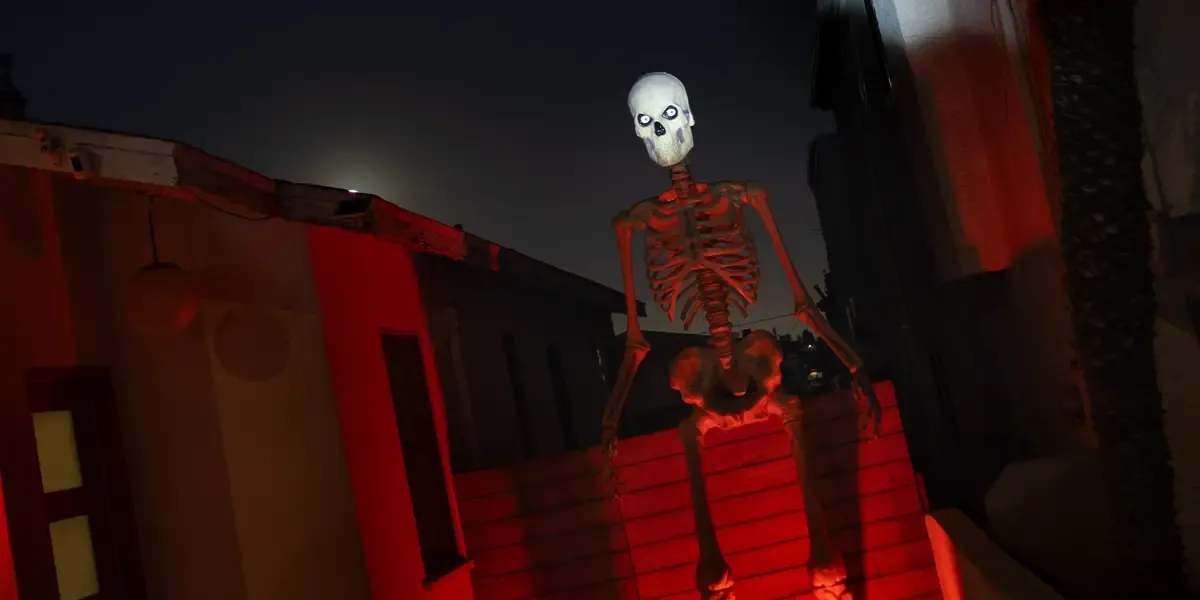
Americans’ love of oversized Halloween skeletons is still going strong - Business Insider
The original Skelly has amassed a massive following since it launched in 2020. It wasn't all that long ago that towering Halloween skeletons weren't really a thing. That all changed seemingly overnight in 2020, when Home Depot introduced its wildly popular 12-foot Skelly decoration, driving record Halloween sales for the home improvement chain that year. The trend is still going strong, with more than a dozen online communities devoted to supersized skeletons, including a Facebook group with nearly 300,000 members. Walmart-owned warehouse chain Sam's Club told Business Insider that sales of their version, an 11-foot Reaper, have been running ahead of expectations since it was launched back in June. The Reaper quickly rose to become one of the chain's top ten selling Halloween items, and was sold out at some warehouse locations, as of Friday. "Halloween is now a season, just like Christmas," said Kara Deleon, Senior Director of Seasonal Merchandising at Sam's Club. "It is truly taking on a much bigger persona than it's ever had in the past.

Simulations explore nuclear mitigation of asteroid threats - Phys.org
Lawrence Livermore National Laboratory researcher Isaiah Santistevan led the development of three-dimensional simulations exploring how a nuclear device could deflect or disrupt an asteroid threatening Earth. Credit: Blaise Douros/LLNL Lawrence Livermore National Laboratory (LLNL) researchers are developing three-dimensional simulations to examine how a nuclear device could be used to deflect or potentially disrupt an asteroid threatening Earth.

A Black Hole 12,000 Light-Years Away Is Firing a Plasma Jet Toward Earth - Gadget Review
Milky Way’s first microblazar candidate sits 12,000 light-years away, offering a rare ground-level lab for studying relativistic jetsA black hole 12,000 light-years away is firing a jet of plasma almost directly toward Earth. At that distance, no known or expected danger to Earth has been identified by the researchers or the institutions involved. What astronomers have actually found is rarer and more interesting than a threat. Researchers have identified IRAS 18293-0941 as a compelling candidate for the Milky Way’s first microblazar, a class of object that gives astrophysicists a close-up laboratory for studying some of the most violent physics in the galaxy. What Astronomers FoundThe discovery centers on a binary system whose black hole expels plasma jets at close to three-quarters the speed of light, pointed almost directly toward Earth. The system pairs a hot, massive star with a black hole that completes a full orbit roughly every 11.38 days. Material drawn from the companion star feeds the black hole, and some of that matter gets expelled outward as opposing jets traveling at approximately three-quarters the speed of light. Terminology matters here.
0 comments
No comments yet. Be the first to share your thoughts!