WATCH: Nobel Prize in physics awarded to Francis Halzen for demystifying neutrinos - PBS
This story deserves to be shared
Send it to someone who'd care, or post it on your networks.
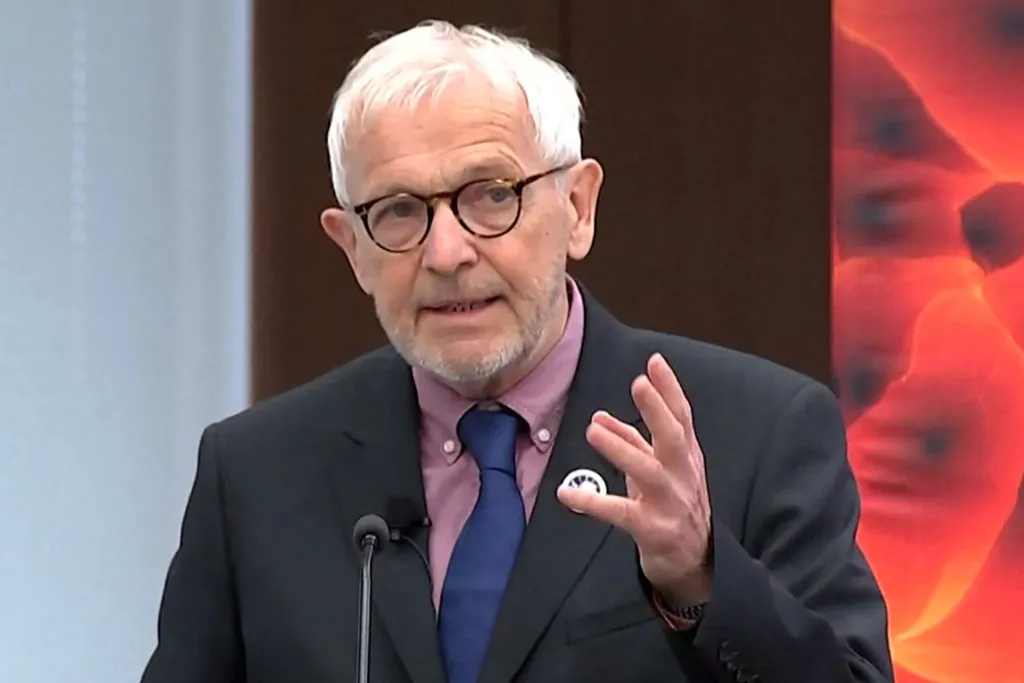
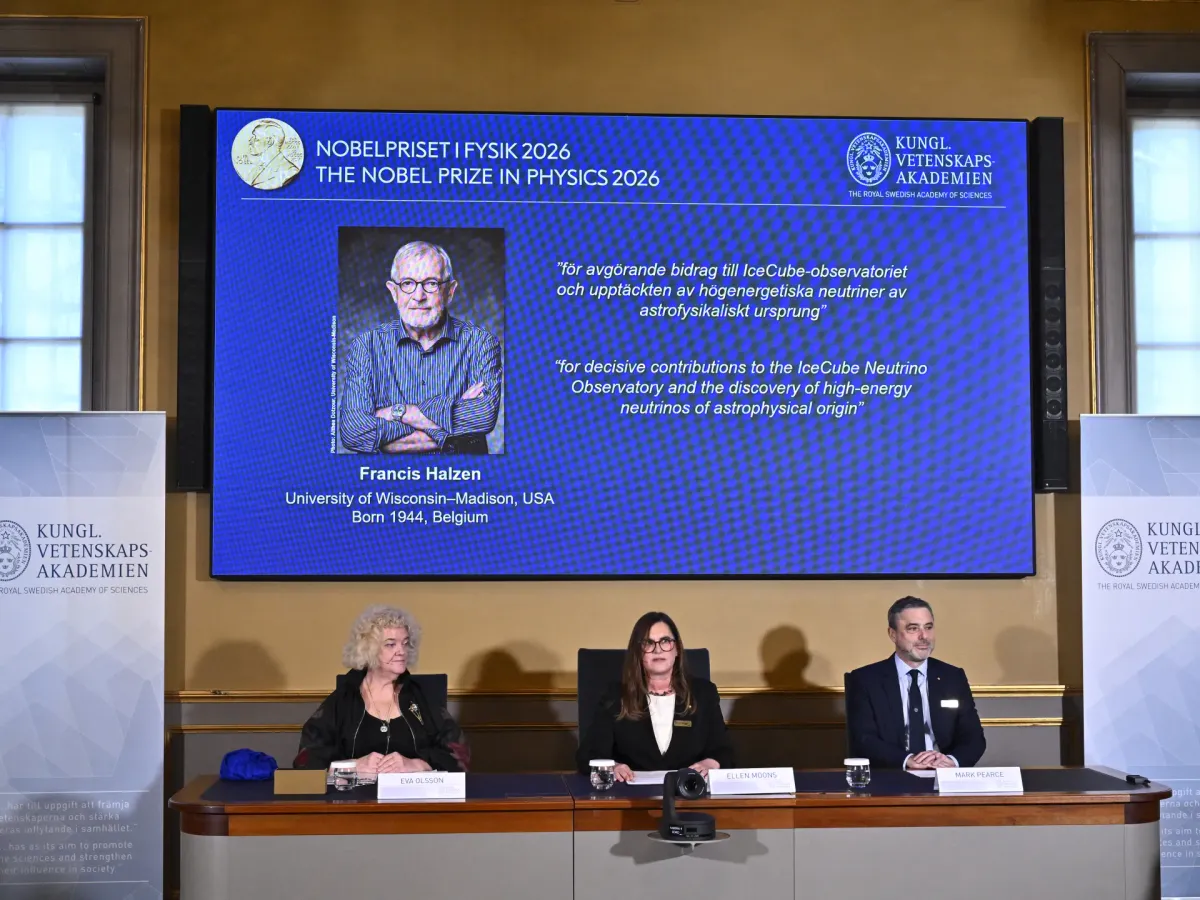
STOCKHOLM (AP) — Belgian-born scientist Francis Halzen won the Nobel Prize in physics Tuesday for his efforts to demystify a rare group of neutrinos, tiny cosmic particles that researchers believe offer clues to how the universe evolved.
"It was a great surprise, and I obviously didn't expect it," Halzen said, speaking to the Nobel Physics Committee by phone from Italy, in a call broadcast at the news conference to announce the winner.
This article is an excerpt. To read the full content, visit the original source. PBS
Related articles
Francis Halzen wins Nobel Prize in Physics for work on ‘ghost particles’ - Al Jazeera
Belgian physicist worked to build Antarctic observatory that tracks neutrinos from deep space. Belgian physicist Francis Halzen has won the 2026 Nobel Prize in Physics for creating a giant detector in Antarctica that captures neutrinos, the so-called “ghost particles” from space that scientists believe offer clues to how the universe evolved. The Royal Swedish Academy of Sciences announced the prestigious award in Stockholm on Tuesday, crediting Halzen with a central role in building the IceCube Neutrino Observatory. Recommended Stories list of 3 itemslist 1 of 3Is there life on another planet? Scientists find the strongest evidence yetlist 2 of 3Have scientists discovered a dark matter particle?list 3 of 3Nobel medicine prize honours US and German scientists for optogenetics workend of listThe neutrino interactions collected by the observatory provide information about how high-energy neutrinos are created and may even reveal previously unknown phenomena, the Academy said. “It was a great surprise, and I obviously didn’t expect it,” Halzen said, speaking to the committee by phone from Italy, in a call broadcast at the news conference to announce the winner.

Simulations explore nuclear mitigation of asteroid threats - Phys.org
Lawrence Livermore National Laboratory researcher Isaiah Santistevan led the development of three-dimensional simulations exploring how a nuclear device could deflect or disrupt an asteroid threatening Earth. Credit: Blaise Douros/LLNL Lawrence Livermore National Laboratory (LLNL) researchers are developing three-dimensional simulations to examine how a nuclear device could be used to deflect or potentially disrupt an asteroid threatening Earth.
0 comments
No comments yet. Be the first to share your thoughts!