The hidden math of Alzheimer's could point to new treatments - Science Daily
This story deserves to be shared
Send it to someone who'd care, or post it on your networks.

Could mathematics help uncover new ways to fight Alzheimer's disease? A researcher at Mississippi State University is using mathematical models to investigate how common metals influence the buildup of proteins associated with Alzheimer's and whether potential treatments could interfere with this process.
Shantia Yarahmadian, an associate professor in Mississippi State's Department of Mathematics and Statistics, is studying how metals such as copper and zinc may affect the behavior of amyloid-beta, a protein that can clump together and form plaques linked to Alzheimer's disease.
This article is an excerpt. To read the full content, visit the original source. Science Daily
Related articles

AI Came for Math. Now It’s Chasing the Rest of Science - WIRED
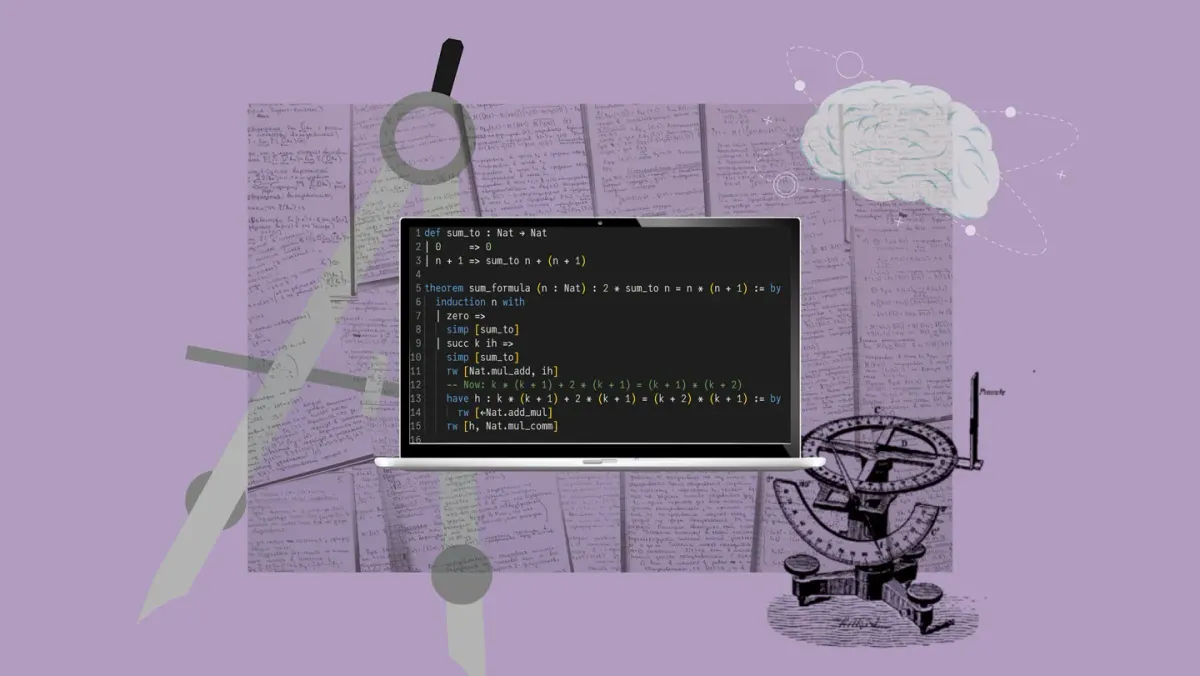
Last week, I attended a talk at MIT by Neil Thompson, who studies progress in computing and artificial intelligence. Over the course of just half an hour, Thompson made a convincing case that several scientific fields are about to be upended by AI. As mathematicians reel from the way AI is automating their field, Thompson’s latest study suggests that probability, statistics theory, economic theory, high-energy theory, gravitation and cosmology, and quantum physics may be next, thanks to the rapidly evolving capabilities of frontier models. Between mid-2024 and mid-2026, the study shows, the best AI models went from being able to correctly solve about 2 percent of theoretical problems in these fields to about 35 percent of such problems. And there are no signs that this progress will slow down. “Within just a few years, we expect a lot of theory questions to be totally transformed in terms of AI's ability to do them,” says Thompson. Broadly, Thompson’s lab digs into how advances in computer science impact society and affect innovation.
Can math stay human in the age of AI? - Science News
When AI companies value competition over collaboration, we may lose out on understanding AI is getting better at solving difficult math problems. But for mathematicians, the value of a proof can lie in more than the answer — it can also be in what the reasoning reveals.

Educators Should Embrace the 'Science of Math.' Here's Why (Opinion) - Education Week
The science of reading boom has created a groundswell of interest in whether there’s an analog for math. One of the more interesting thinkers on this count is Daniel Ansari, a professor of psychology and education at Western University in Ontario, where he directs the Numerical Cognition Laboratory. Daniel’s research focuses on how children develop mathematical and numerical skills, and he thinks there’s a lot of popular confusion regarding the “science of math.” I reached out to hear what he thinks we’re getting right and wrong. Here’s what he had to say.—RickRick: You study how young children learn math. How’d you get into that? Daniel: It happened rather accidentally. When applying to Ph. D. programs in psychology, I came across a position that involved investigating the numerical abilities of children with Williams syndrome, a rare genetic developmental disorder. The relationship between the two sounded interesting, so I applied and was accepted. Rick: There’s been much recent attention to the science of reading. Is there an analogous science of math? Daniel: Yes, there is.

Ancient mud reveals a surprising secret about Greenland’s ice - Earth.com
Mud from a fjord shows an Atlantic air pattern brought wetter, colder spells to southern Greenland, a clue to how its ice may fare. Greenland’s ice is shrinking as the planet warms. But in the island’s southwest, rainfall and snowfall have been influenced by the same North Atlantic air-pressure pattern for at least 5,000 years. When that pattern tipped one way, the region turned wetter and colder. The record comes from mud on the floor of a Greenland fjord, and it suggests snowfall, not only temperature, shaped how the area’s ice grew and shrank. It doesn’t yet show how glaciers there will respond to the warming ahead. Johan Faust, a researcher at MARUM, the Center for Marine Environmental Sciences at the University of Bremen in Germany, led the work with colleagues in Germany, Norway, Denmark and Canada. A seesaw in the airThe pattern is called the North Atlantic Oscillation. It’s the difference in air pressure between a low that sits near Iceland and a high near the Azores, and it’s strongest in winter. When that difference is large, the pattern is in its positive phase. Northwestern Europe and southwestern Greenland both get more rain and snow.
0 comments
No comments yet. Be the first to share your thoughts!